
By Dave Haney
Reprinted from Bluegrass Unlimited Magazine
February 1985, Volume 19, Number 8
White Mountain Bluegrass
Many bluegrass musicians find it difficult to maintain a satisfying relationship between musical life and family life. Like poker or hunting, bluegrass can become at one extreme an escape route that lets the “boys” (or perhaps the girls, or the kids) avoid domestic responsibility in a search for the lost freedom of their youth. This hurts the music as well as the family, since you can’t play your best if you are just playing in order to get out of the house. At the other extreme, you can let or make the whole family play. Aside from the domestic squabbles that arise when Junior favors Eddie Van Halen over Larry Sparks, many family bands are simply not very good. All else being equal, it is easier to harmonize with a family member than with an outsider, but few families have the reserve of talent that the Carters, Osbornes or Lewises were able to pass along.
A band from Portsmouth, New Hampshire, seems to have solved this problem: White Mountain Bluegrass is an excellent band, and its core members are an exemplary family. Since 1970, the husband and wife team of Mac and Hazel McGee has been presenting White Mountain’s brand of traditional bluegrass music to audiences throughout New England, and as far afield as Virginia and Nova Scotia. Doyle Lawson says in the liner notes to “Ice Covered Birches,” their debut album, “Mac and Hazel Mcgee are a legend in their time in the Northeast for the sincere approach they take toward their music and their relentless benevolence for others. I consider it an honor to call them and the other members of their fine group close friends. Their approach to bluegrass music reflects the way they live... clean, honest and straightforward.”
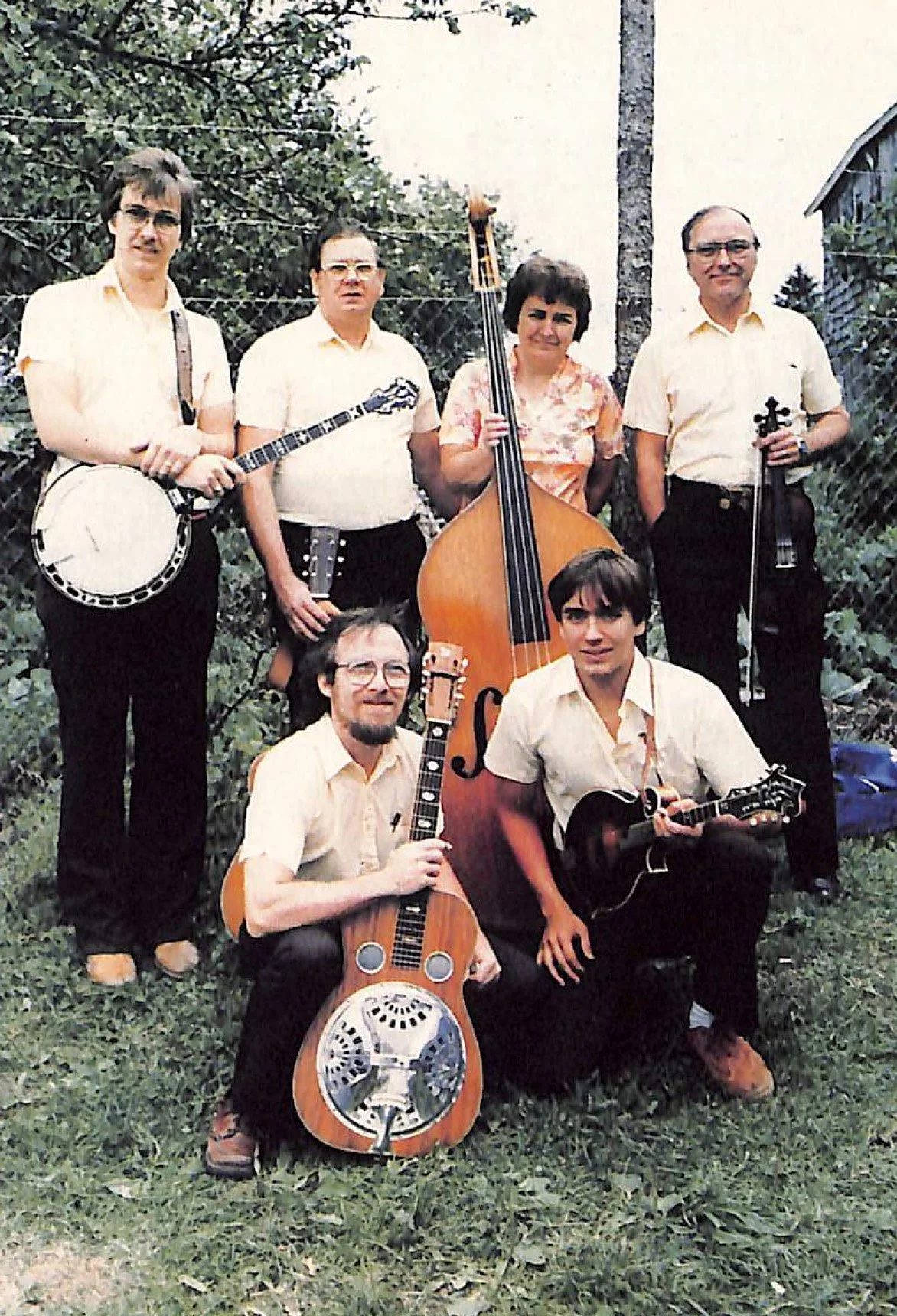
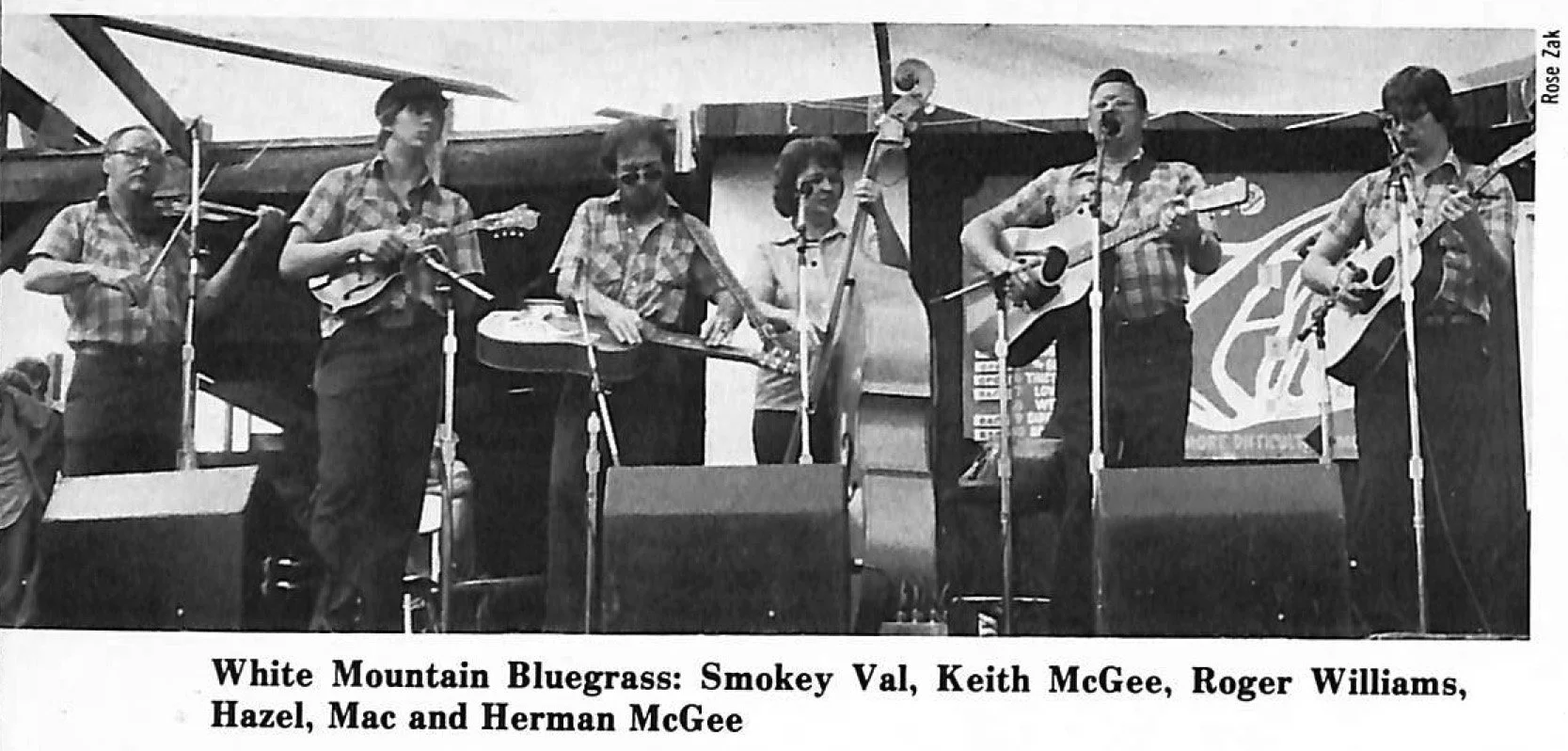
Mac plays guitar and sings lead, while Hazel plays bass and sings tenor. Along with their sons Herman on banjo and Keith on mandolin, Smokey Val on fiddle and Roger Williams on Dobro, they are known to fans throughout the Northeast and to musicians throughout the country for their soulful singing and no- nonsense musicianship. Joe Val has called Mac and Hazel “two of the finest bluegrass singers in the business today.” Mac’s high lead voice has a lonesome Stanley feeling, with the sureness of phrasing that comes from long years of knowing the music from the inside out. According to Mac, a singer must have experienced the emotions he sings about. “The songs that you’re singing—you’ve got to live a little bit of that; you’ve got to know what it’s all about. I can pick up words in songs that were written by somebody down home (Mac is from rural Georgia) that mean something to me, that you wouldn’t know what they meant.” As Hazel says of Mac, “We get more compliments, people saying that he puts more feeling into it than most people do. And probably it rubs off on us too, but it must stem from him.” Hazel recalls the time Mac was unable to finish the recitation, “Suppertime.” “Mac started singing the song, and of course he always thinks of his mother; well, his sister was sitting out there in the audience, and she looks just like his mother. He happened to see her, and he just could not sing the song.” A member of the audience who saw what had happened was, as he later told Hazel, just as affected by that moment as Mac was.
Hazel is one of the few women singers who can truly sing a strong bluegrass tenor. Her clear, loud voice pierces through the band sound with power to spare, and she tops off a trio blend that is uncannily clean, despite her difference from Mac in both tone and volume. With Mac six inches from the vocal microphone, and Hazel three feet back, their blend is usually perfect. Hazel also belts some powerful country solos, such as “You Ain’t Woman Enought to Take My Man,” with the timing and conviction of a lifetime’s commitment to country music.
Mac and Hazel’s twenty-three year old son Herman uses his genetic blend to its best advantage when he sings baritone with his parents. He was singing “Your Cheatin’ Heart” at age seven, and his first guitar was a two-by-four with a toothbrush for a bridge. Though he has been playing banjo for only a few years (since his parents pointedly gave him one at Christmas), he has already developed a bouncy, J.D. Crowe-influenced style that he feels is especially appropriate to White Mountain’s sound. In learning the banjo, he had the double advantage of being naturally talented and knowing exactly what kind of sound he must adapt his playing to.
Until a few years ago, Herman’s main instrument was lead guitar, which he still plays on several of the band’s numbers, and which is featured on “Last Request,” the band’s latest album. He is known throughout New England as a fine back-up and lead guitarist, comfortable in many styles. Fred Pike, from Maine, helped Herman get started on guitar, and meeting Tony Rice was an inspirational milestone. The now classic New South band of Rice, Crowe, Ricky Skaggs, Jerry Douglas and Bobby Slone continues to be Herman’s standard for a good bluegrass band. Herman gives White Mountain Bluegrass a more modern sound than they would otherwise have, without sacrificing any of the traditional bluegrass feeling he respects so much in his parents’ music.
The newest member of the band, on mandolin, is another McGee. Mac and Hazel’s youngest son, Keith, is learning fast from his elders, though at the age of seventeen he only plays at family-style shows that do not interfere with school and other commitments.
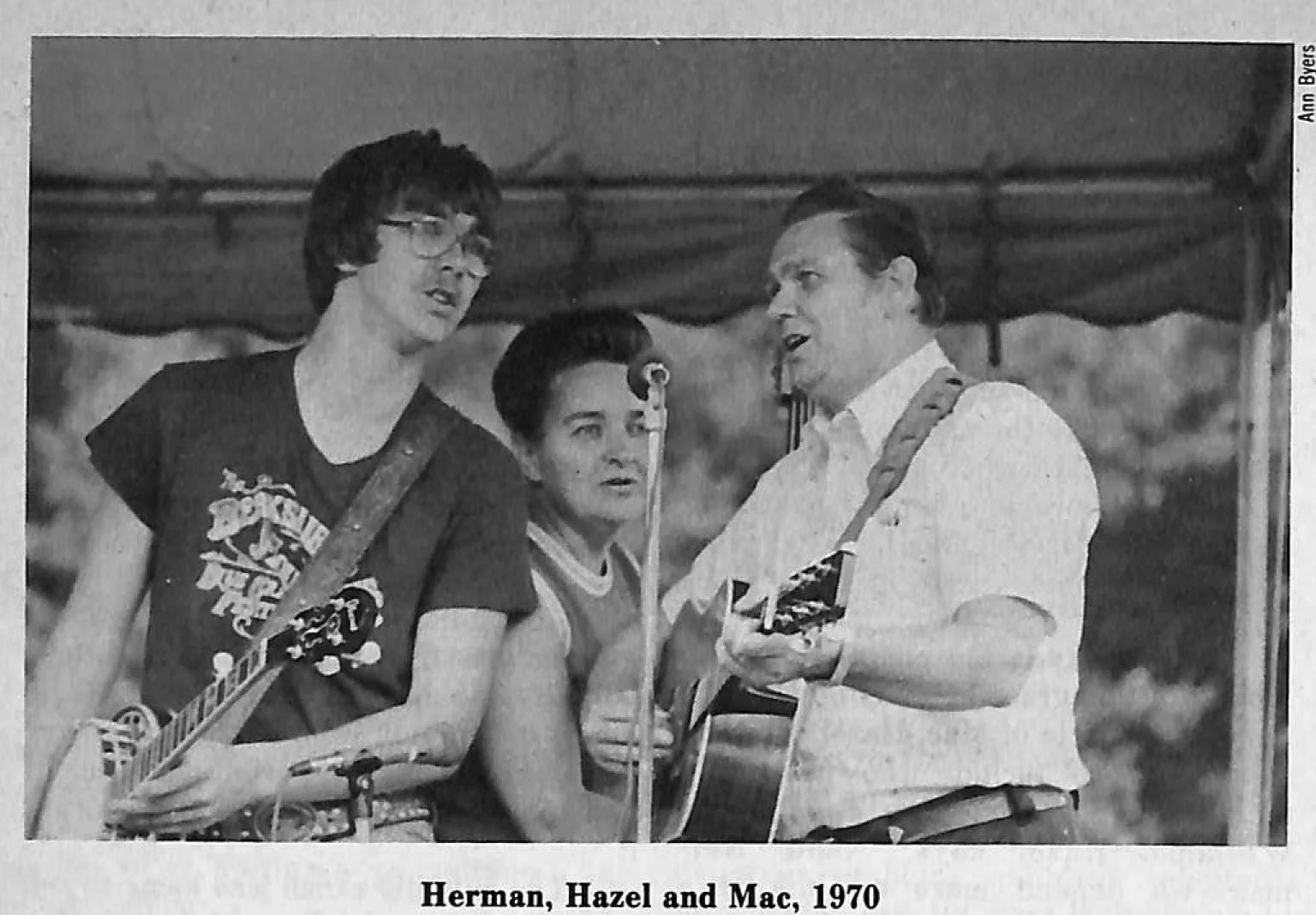
The road to Portsmouth, New Hampshire, was a long one for the McGee family. Mac was born in Wray, Georgia, in 1935, to a farming family. At the age of fourteen he became interested in guitar through his brother, and at fifteen he moved to Roxbury, Massachusetts, where he bought his first ten-dollar guitar. Mac’s mother had played piano in church, and he grew up hearing local gospel groups and the radio stars of WSM and WWVA. Though he enjoyed and emulated country singers such as Hank Williams and Porter Wagoner, Mac actually disliked bluegrass at first. “I couldn’t see why people could like that high-pitched stuff; that just goes to show you how your mind can turn around.” Mac’s voice now has the tone and feeling of a higher-pitched Carter Stanley. He once lived eight blocks from one of the Stanley Brothers’ regular gigs in Orlando, Florida, but never went to see them.
Mac and Hazel met near Syracuse, New York, where her family had moved from Armathwaite, Tennessee. Hazel’s grandmother’s maiden name was Carter, and she is supposed to have been related to the Carter Family. If that relationship was not biological, it certainly was musical, since Hazel’s family sang Carter family material and religious songs. Her mother and uncles formed a country band in New York State, with which Hazel sang, that featured fiddle, steel, two guitars, stand-up bass, and occasionally mandolin.
When Mac moved from Massachusetts to Central New York in 1953 to work in a paper mill, he heard about the singing of Hazel’s mother who, according to everyone who has heard them both, sings exactly like Hazel. Soon after meeting the band, Mac began singing with them, and married Hazel in 1957. By that time, he had joined the Marine Corps, which took the McGees to North Carolina. In 1958, after he quit the service, they moved to Portsmouth, New Hampshire, where Herman was born. Orlando, Florida, was their next home, where their middle son, Kevin, was born. The family returned to Portsmouth in 1961, after a brief stay in New York State.
In the early 1960s in Maine and New Hampshire Mac and Hazel began to do what people such as Tex Logan, the Lilly Brothers, and Joe Val were doing a few miles south in Boston, educating New Englanders to good traditional bluegrass and country music. Mac rented the town hall in Kittery, Maine, once a month for meetings of the “Country Music Organization,” a collection of musicians and friends who met and performed for and with each other. This spawned a series of pick-up bands that played clubs, benefits, and prisons throughout the area. C.M.O. meetings became so much fun that a couple nobody knew once wandered into a meeting, danced and listened all evening, and left saying that it was the best Grange meeting they had ever been to.
Though they had been singing bluegrass style material for years, Mac and Hazel did not become hard-core bluegrass musicians until the late 1960s. During this time they met Roger Green, a musician from the Washington, D.C., area who was stationed at the Pease Air Force base near Portsmouth. After some all-night jam sessions and a few festivals, the McGees were hooked. “It was just like somebody gave you a shot in the arm with a needle,” says Mac. As always, the music was a family affair: The McGees provided a home away from home for Roger Green, and later for Sam Garris, a mandolin player, and his two brothers, who worked for the Marines at the Kittery shipyards. With Sam Garris on mandolin, Joe Pomerleau (whom they met through the C.M.O) on fiddle, Bob Frost on banjo, and Jeff Lynd on bass, White Mountain Bluegrass was born in 1970. Mac played guitar, and at this time Hazel sang, but did not yet play bass. The following years saw several personnel changes, partly because the local military bases, which provided the area with many of its bluegrass musicians, transferred those musicians out of the area with disheartening regularity. Bob Frost and Sam Garris were replaced by Bruce Bortner, then Bob Boothby on banjo, and Al McHale on mandolin. Howard Dearborn (who has probably played bass with every bluegrass band ever to play in Maine and New Hampshire) replaced Jeff Lynd, until Hazel took over the bass chores. In 1975, Herman McGee began playing lead and backup guitar and singing baritone, though “he didn’t always get paid,” according to Hazel. Joe Pomerleau quit playing fiddle for White Mountain in 1977, and was replaced by Tim Farrell for a year, then by current fiddler Smokey Val. When Bob Boothby’s wife’s illness forced him to quit in 1979, Herman switched over to banjo, and Al McHale was replaced on mandolin by John Paganoni, who was stationed at Pease Air Force base at the time. Paganoni is well known as a builder of mandolins (Doyle Lawson and Jesse McReynolds, among others, have played Paganonis), and his fine picking and singing can be heard on White Mountain’s first album, “Ice Covered Birches.” That album also features Roger Williams on Dobro, who became a full-time member of the band after Paganoni was transferred to his current position at the Pentagon.
The family atmosphere of White Mountain Bluegrass extends beyond the immediate circle of Mac, Hazel, Herman and Keith to include the non-family members: Smokey Val and Roger Williams. Hazel says, “Now Herman—we depend more on him than anybody, naturally, because he’s ours, but even Roger and Smokey, they’re there; they just don’t miss anything; they’re actually like part of the family.”
Smokey Val was born and raised in Biddeford, Maine, and at a very early age he recognized bluegrass as something different and special. Recordings by Roy Acuff and Flatt and Scruggs reached Biddeford via the air waves of WWVA Wheeling West Virginia, and Tater Tate’s Maine appearances with Red Smiley were an important influence on Smokey’s particular fiddle style.
During his army days, Smokey realized a big musical return on some small investments: he traded a pack of cigarettes for a mandolin, and later bought a fiddle for twenty dollars from an a.w.o.l. buddy who was being led to the stockade. After World War II, he played with Al Hawkes, touring with Charlie Bailey as the Cumberland Ridgerunners. Not one to switch bands from year to year, Smokey played with Tiny Martin and the Countrysiders for twelve years, and then with the Blue Mountain Boys (Jimmy Cox, Charlie Gilliam, Jerry Dunning, and Richard Gilmore) for fifteen years. He has been with White Mountain Bluegrass for six years now, having met Mac and Hazel through Tiny Martin.
Mac and Hazel play “my kind of music,” according to Smokey, who likes his bluegrass raw, hard and traditional. Unlike many bluegrass musicians, he actually enjoys the devil-may-care atmosphere of bar jobs. He enjoys concerts and festival “if the audience is good,” but sees a decline in the quality and authenticity of the bluegrass presented at modern festivals.
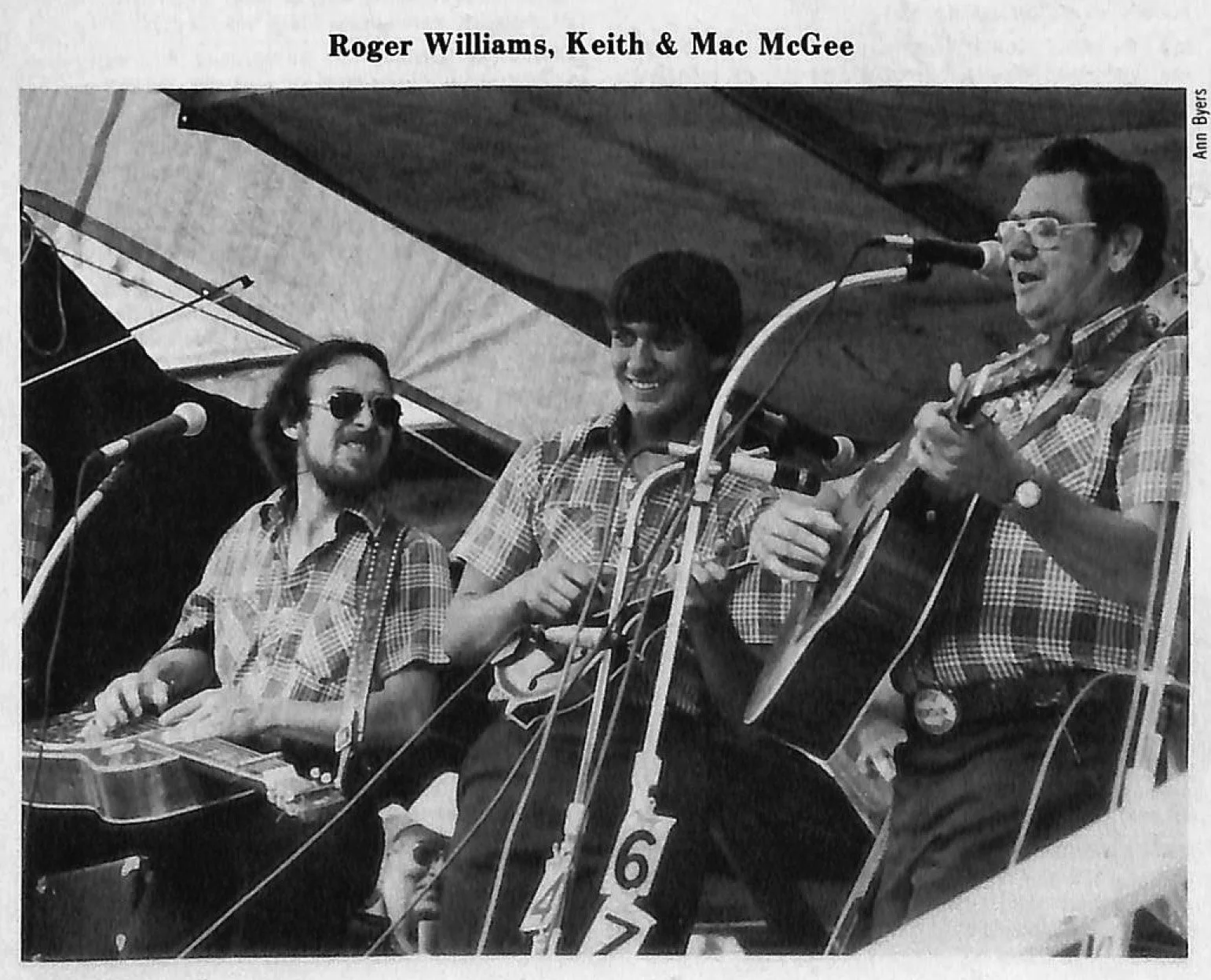
Roger Williams, who can drive the beat on a Dobro better than most banjo players, heard live country music when very young; his mother was a country singer and his father. Curly Williams, earned a fine reputation playing steel guitar with Ray Bradley at Boston’s Hillbilly Ranch. Though he received little direct instruction from his father, Roger remembers one bit of parental advice, “If you don’t learn within six months, forget it.”
The Hillbilly ranch was home to the Lilly Brothers and Don Stover during much of the fifties and sixties and teenaged Roger joined the host of aspiring New England pickers (including Joe Val, Herb Applin, Dave Dillon, Peter Rowan, Bill Keith and Jim Rooney) who listened to, learned from and sat in with these influential West Virginians. Roger’s Hillbilly Ranch contacts remained useful long after the Lillys had left. In 1975 he joined Don Stover and his White Oak Mountain Boys, where he learned, “on the spot,” the essential skills of playing backup and working a microphone. When Stover left for Maryland in the later 1970s, Roger joined Everett Alan and Tennis Lilly (Everett’s sons) in a country and bluegrass group. Then, after a year and a half with Herb Applin and the Berkshire Mountain Boys, Roger was asked by Mac and Hazel to record with them, and fill in on occasional performance dates. John Paganoni had left by this time, and Roger soon established himself as a permanent member of the band.
Roger likes to play for people who are prepared for bluegrass music, and consequently prefers festivals to bars. His reasons for backing up Mac and Hazel on the Dobro, and singing an occasional solo, are clear. “Mac and Hazel are genuine, warm, sincere people —fun to be on the road with, and play with ... they put their heart and soul into music.” Roger’s playing can be heard not only on White Mountain’s two albums, and his new solo album, “Fireball,” but also on “Not a Word From Home” by Joe Val and the New England Bluegrass Boys (Rounder 0082).
There is no doubt in the mind of anyone who has seen White Mountain Bluegrass perform about who runs the show. Hazel McGee will supervise the sound set-up, round up the band members, decide most of the songs to be played, and talk to the audience. She also handles the band’s business and booking affairs. White Mountain’s shows are never lazy, and they never show anything but respect for each other and their audience. Mac and Hazel have very definite ideas on how to run a bluegrass stage show. The main thing, Hazel says, is getting the audience to share the band’s frame of mind. “If you have a good time, then the audience will.” They used to write out lists of songs in the order to be played, but as Hazel says, “When you get up there, and you’re watching the audience’s reaction, you automatically think that the next song you had put down on the program is not the right one to do.” Now they listen closely to that reaction, feature each member of the band during a set, and include some gospel on each program, but make the final decisions on stage. They will do requests if the requester seems sincere, if they feel the rest of the audience would also enjoy the requested song, and if it fits their style.
The first album by White Mountain Bluegrass, “Ice Covered Birches,” was released in 1981 on the Fishtraks label in Rye, New Hampshire. After much debate, the band decided to record those songs that were most requested on their live shows, since the idea of doing an album was itself a response to audience requests. Surprisingly, and to the credit of both the band and its audience, this did not result in an album of bluegrass standards. The title cut is a lyrical, little-known piece by Carl Hoffman that the band learned from a Cliff Waldron 45. It is an ideal vehicle for true bluegrass sentiment in a New England setting:
Ice covered birches on a cold winter's mom,
From the hillside they shimmer and glimmer and shine;
But the branches are broken and their heads are bowed low Like the sad tender heart of that darlin' of mine.
The Stanley sound is represented by “Memories of Mother” and “[That] Beautiful Woman.” Mac’s moving “Suppertime” is sentimental without being maudlin, a rare example of a recitation that really works. The album is rounded out by classics such as “The Old Cross Road” and “Out in the Cold World.” In order to retain complete control over the album, White Mountain Bluegrass financed, produced, and promoted it themselves. According to Mac and Hazel, this decision proved to be wise both artistically and financially: sales have been very good, though the album is sold almost exclusively at personal appearances.
“Last Request” is the title of their second album, released in the summer of 1984. Continuing their commitment to independent production, Mac and Hazel aimed at “more of a live sound” and seem to have put more care into the arranging and mixing of this fine sample of the White Mountain repertoire. “It sounds more like us, says Hazel, whose strong country lead is featured on “Where the Blue Violets Grow.” Other highlights are Mac’s plaintive “Last Request,” the call-and-response gospel quartet “Will You Meet Me Over Yonder,” and the up-tempo country song, “Close the Door Lightly.” Roger Williams, who has just released a Dobro album entitled “Fireball,” shows himself to be a soulful country singer on “Tear Stained Letter,” and provides a solid bass voice in the quartets. This album also marks Keith McGee’s debut on the mandolin.
White Mountain Bluegrass is a part-time band, in the sense that none of the band members wishes to make his or her living solely by music, but their dedication to bluegrass is full-time and professional. Mac McGee is a truck driver who often gets up at two or three in the morning to haul gasoline, then drives one or two hundred miles to and from a playing job that same evening. As Hazel points out, that kind of dedication can hardly be called part-time. “We’ve heard that people doing it for a living put more into it than the ones doing it on the weekends, which can’t be true, because we work just as hard on the music. It’s probably harder for us, because we don’t have as much time as they do.”
Burning the candle at both ends in this way, the McGees are thankful that they can call on family members rather than just business partners for support. Herman says, “We find it easier to call on one another for help —it’s a little bit easier to ask a family member to go along with you than it is to ask another band member that had his own thing going all the time.” Family jokes also make travel time more bearable: “We probably have more fun than most people do when we travel," says Hazel. “We kid one another; it keeps it lively and light, and makes the long trips shorter.”
Because their bookings must be scheduled around daytime job commitments, the members of White Mountain Bluegrass see their musical income as supporting the music rather than feeding their families. “We don’t count on it as income,” says Hazel, “and we’ve told all the people in the band not to. It’s unpredictable. Of course, we all need the extra money occasionally, but as far as counting on it, it’s not a dependable thing.” This is not to say that they will undersell other bands, or play less professionally. It simply means that, for example, the band will drive from New Hampshire, to Virginia to play a Saturday night performance and then drive back again, having used up their weekend and having barely met their travel expenses. A full-time band might play the same Saturday night job, for the same money, but spread out their expenses and turn a profit by playing tour dates on Thursday, Friday, and Sunday, because they need not report for work in New Hampshire on Monday morning. As Herman says, “If I can go away for a weekend, play music for an hour or two, enjoy myself the rest of the weekend, and come home and have the same amount of money in my pocket as when I left, that’s the way I do it.” They set a minimum price, but always consider potential exposure, the possibility of benefiting a worthy cause, and personal satisfaction when deciding to accept or refuse any particular job.
White Mountain’s first exposure to full-time road life came in July and August of 1984, when everyone took time off from his or her day job for a three week tour of Holland and Germany. Despite the trip’s inauspicious beginning, when British Airways lost Roger’s custom-built resophonic guitar somewhere between Boston and Amsterdam, the band enjoyed playing for Europe’s warm and attentive audiences. The tour was arranged by Rienk Janssen of Strictly Country Records in Holland, who has produced highly successful European tours for Joe Val, Bob Paisley, Del McCoury, and others. Joe Val calls him “the shepherd;” Rienk has quietly earned a reputation for showering American bluegrass bands with hospitality, and relieving their worries about travel in foreign countries, often at his own expense.
The White Mountain Bluegrass “family” encompasses a network of friends, musicians and fans that is larger than many festival crowds. Their newsletter, which includes not only White Mountain’s performance schedule but also a chatty note from Hazel, reaches over seven hundred people at least twice a year. In January, 1982, Herman and his brothers planned a surprise anniversary party for Mac and Hazel. They arranged for a booking agent to tell Mac and Hazel to arrive at a hall to play a wedding, and when they arrived, about two hundred musicians and friends were there to wish them well. In January, 1980, Mac and Hazel helped to organize a benefit for a disabled friend, and word-of-mouth advertising brought seven hundred people together in one of the more sparsely populated areas of New England. The talent donating their services for that day included Joe Val, Bea Lilly, Smokey Green, and even Don Stover, who drove up from Maryland for the event. These are only two examples of how, in their twelve years as a bluegrass band, the McGees have grown to be one of the best loved and most highly respected bands in the Northeast, not only for their musicianship, but also for their ability to make bluegrass music a "family” event in every way.