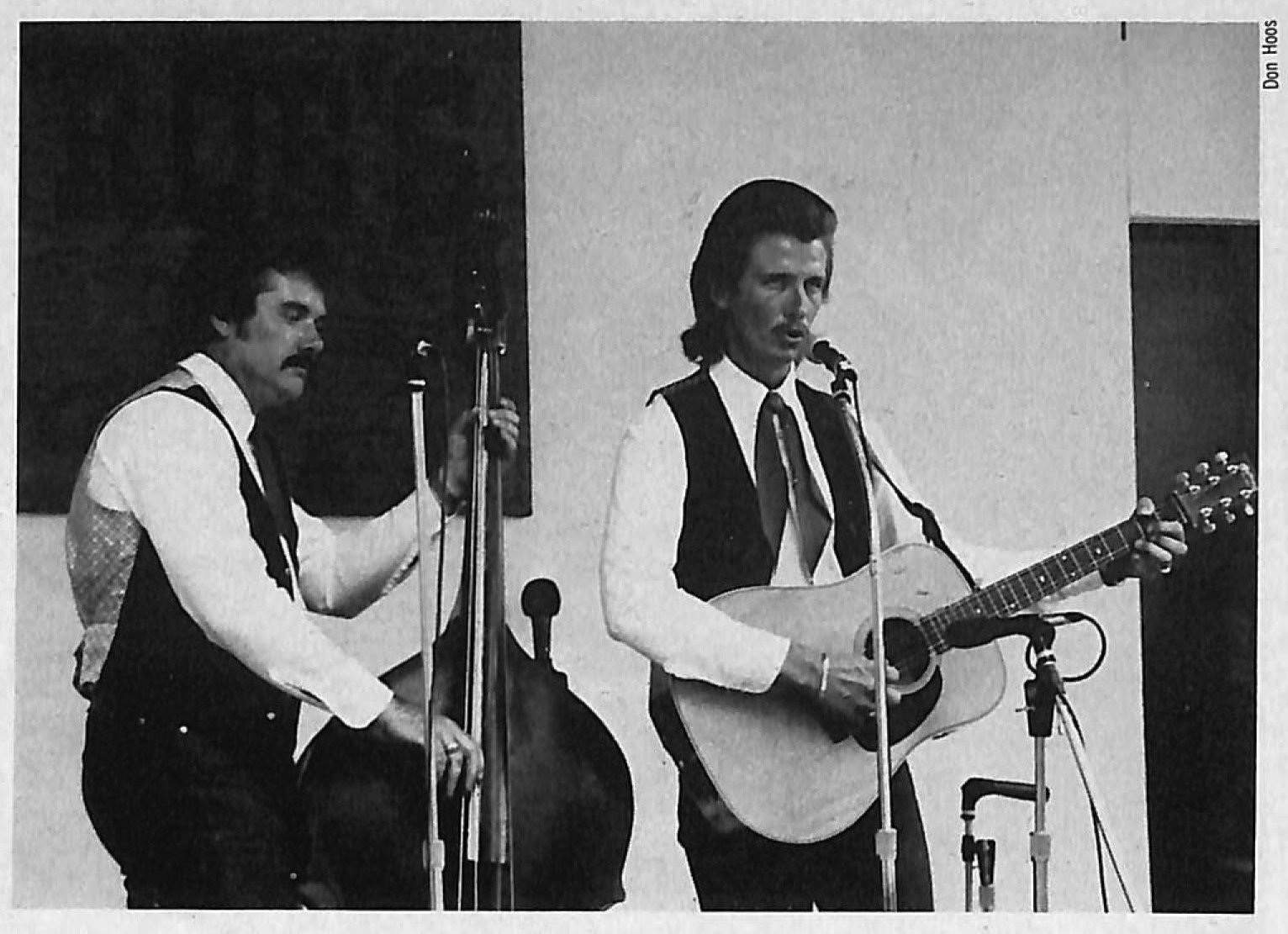
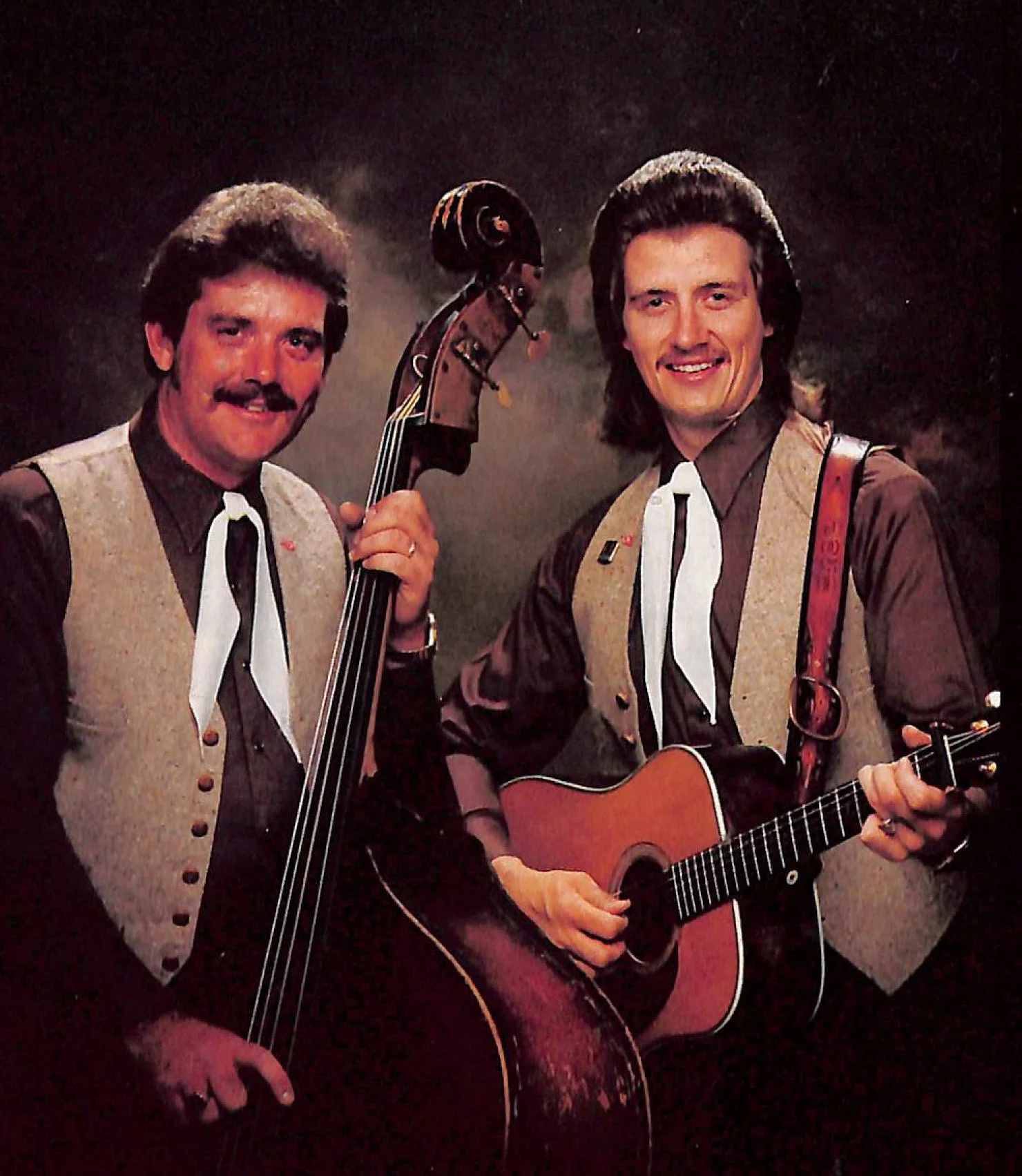
The Crowe Brothers—Mountain Rhythm and Harmony
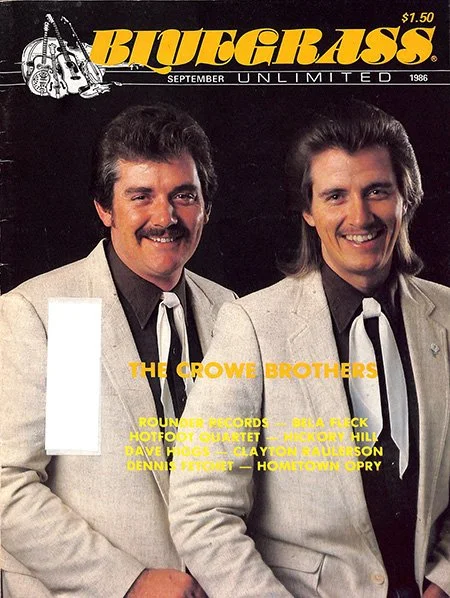
By Art Menius
Reprinted from Bluegrass Unlimited Magazine
September 1986, Volume 21, Number 3
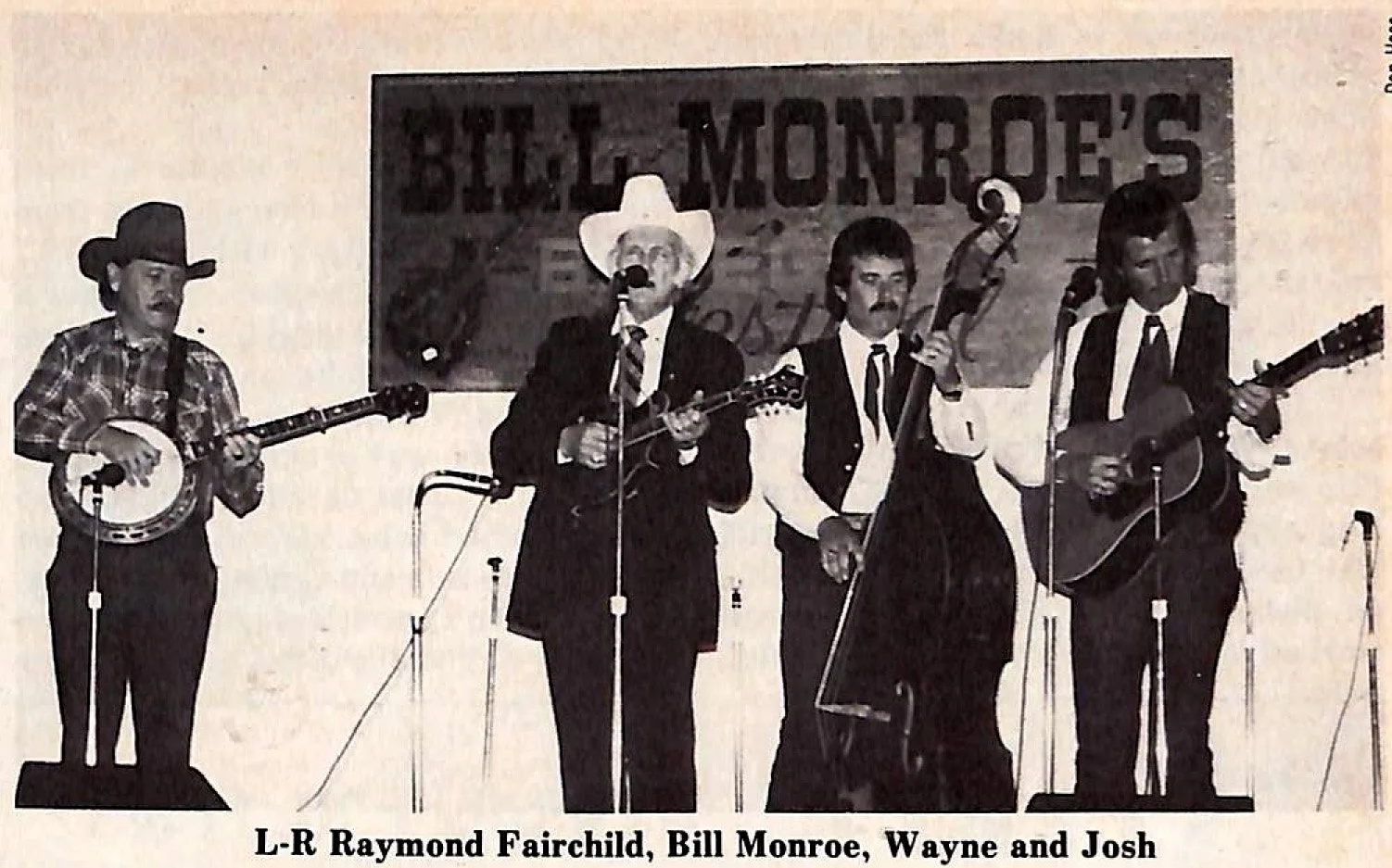
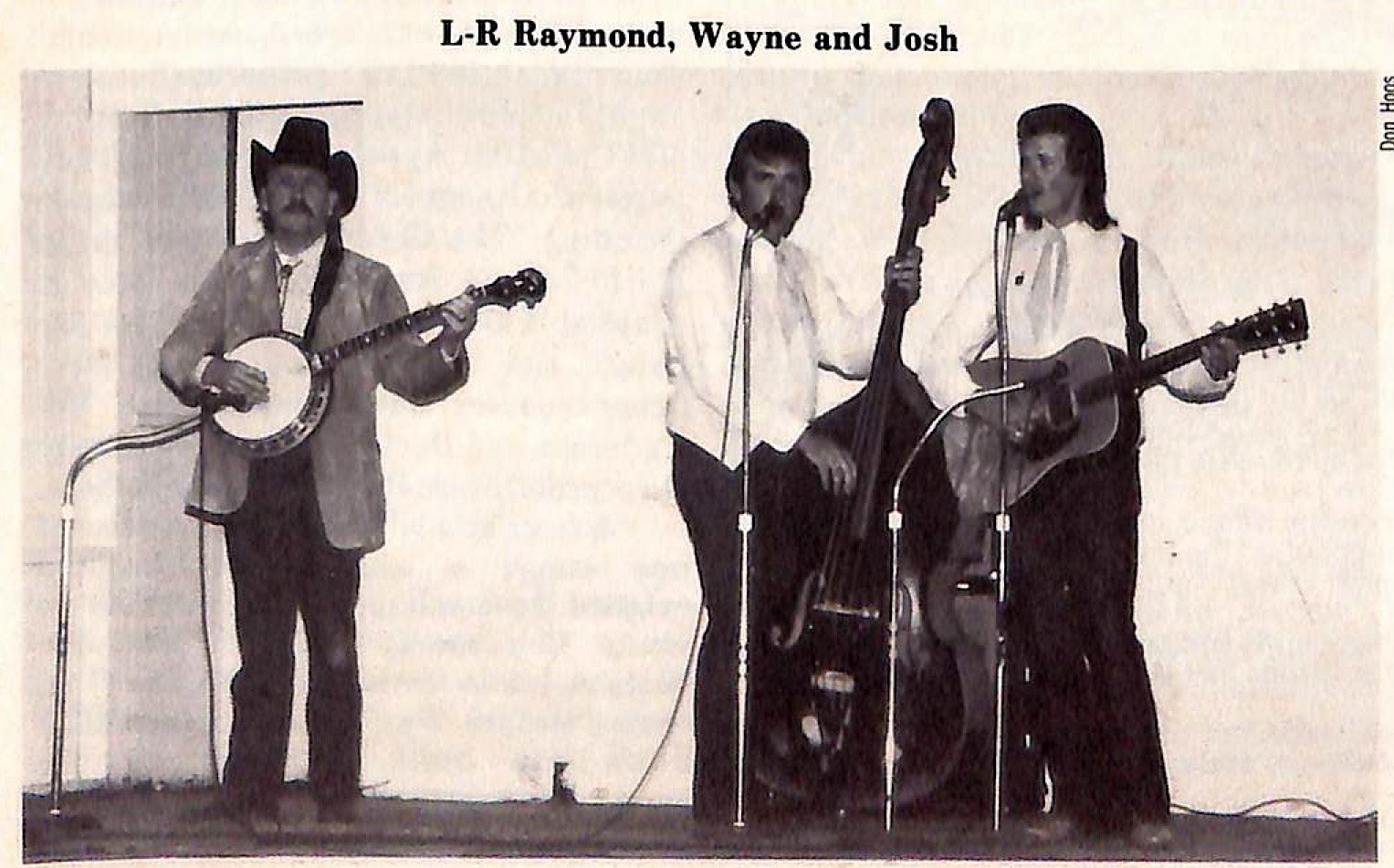
Raymond Fairchild’s rise from pickin’ banjo by the side of the road in Maggie Valley, North Carolina to major festival attraction status in the southeast and midwest speaks of determination, overcoming alcohol, and teaming with north Georgia’s Crowe Brothers. March 1985 marked the tenth anniversary of Fairchild’s association with Wayne and Wallace “Josh” Crowe’s straight-ahead rhythm on bass fiddle and guitar and their Louvin Brothers-influenced duets.
“Josh Crowe is definitely the best rhythm guitar player there is in the world today,” asserted Fairchild, a Jimmy Martin fanatic, over coffee at the stone house he built for his family outside Canton, North Carolina. “In my 35 years of playing I’ve heard a few, and Wayne’s just as good on bass. They’ve got perfect timing, and timing is drive.
“I played with different ones over the years and never could get what I wanted. Then in March or April of ’75 I ran into the boys at a little festival out in Walhalla, South Carolina. When I heard them I knew it was the sound I’d looked for for 25 years... I hired them on the spot, right there.”
“We just sort of got in a jam session,” Josh recalled before their second “Fire On The Mountain” appearance. “I played all night long on the bass fiddle, and he never did recognize me until I picked up my guitar and started playing ‘Lonesome Road Blues’ with him. He stopped pickin’ and just watched what I was doing. From that day on I’ve been with Raymond, and he learned about my brother through me. He liked my rhythm guitar playing. It just seemed to fit in with what he was doing.”
“It’s their speed,” Fairchild explained. “Josh can play all night and never stop. The type of music I play requires speed. Most musicians drag after a while.”
“It just seems like the faster the better,” Josh said without a trace of boastfulness. “I’ve got a wrist action like I’ve never seen anybody else have. One thing the good Lord blessed me with was a loose wrist. It seems like the faster Raymond picks the easier my rhythm gets.
“Up through the years Wayne and I have learned the trait of blending our guitar and bass together under Raymond’s banjo picking. That gives it a tone only another real good picker would notice. It comes from years of working together.”
Josh and Wayne’s years of picking together go back well beyond teaming up with “The King Of The Smoky Mountain Banjo Pickers.” The pair grew up in Clayton, Georgia, surrounded by mountain music.
“We’ve been in the music business all our lives because our daddy was a picker from the word go,” Josh, now a Maggie Valley resident, said. “His name is Junior Crowe. His group was a bass fiddle, guitar, and banjo, three of them, just like our group now, and they called themselves the Sunshine Melody Boys. They got started pickin’ probably in ‘59. They started this radio show in Taccoa, Georgia.”
The following year the senior Crowe's group entered a talent contest sponsored by the Pep Me Up Company. The Sunshine Melody Boys won an appearance on the Grand Ole Opry with their first place finish.
That was more than enough to inspire the younger Crowes (no relation to J.D.), who began learning guitar when Josh was seven and Wayne nine years old. Before too many years passed the brothers joined Oliver Rice’s Blue Ridge Mountain Boys.
“Wayne first joined them on bass fiddle,” Josh noted. “Then he was learning to play banjo himself, so he started off on the banjo, and I took over the bass fiddle. We sung all gospel music at the time. We went around to churches around the country and sung bluegrass gospel music. We recorded one album and an 8-track tape which they eventually put into an album.”
Through the early 1970s Wayne put in nine years and Josh eight with the Blue Ridge Mountain Boys. The latter left first in order to fiddle for Curtis Blackwell and the Dixie Bluegrass Boys. Late in 1974 the brothers formed a group of their own with sister Kitty Marie. She played bass and sang tenor, Josh lead, and Wayne baritone. The family band lasted only a few months before the boys met Fairchild.
In those days the Raymond Fairchild show was his banjo. The Crowes only task was to back Fairchild so that he sounded his very best. “On the first major festival we went to, which was Ralph Stanley’s in McClure, Virginia, we done a 30 minute all instrumental show. A lot of the festivals that summer [1975] were that way. Then we got to singing one or two songs on down the line,” Josh recalled.
“When I hired them boys they sang two songs,” Fairchild agreed. “We did all instrumentals for a couple of years. After a year or two they got to singing duets real good, and we started gradually adding it. They’re powerful hymn singers.”
“We hadn’t sung as a duet before we first started working with Raymond,” Wayne said upon joining the interview. “We hadn’t really tried it and didn’t know it would work.”
The duet notion originated upon parting with Kitty Marie to work with Fairchild. “We were singing about three steps higher with her singing tenor than what it took for me and him to sing duets,” according to Josh. “So we figured if I’m already singing this high lead, and he’s singing that baritone under me, why not just change it over and do a duet. We started blending our voices together, and it worked, and we started learning more songs as we went along.”
The Crowe Brothers, of course, had been listening to duets for most of their lives. “When I was a young boy, I heard the Stanley Brothers,” Josh said. “Two guys my dad picked with, the Chestine Brothers, had a duet team. As time went along I started running up on the Blue Sky Boys and the Louvin Brothers. That just had a tone to my ear that I liked even before Wayne and myself started singing. I always had a feeling inside me for that type of singing.”
As the siblings’ repertoire and confidence grew, their songs became more and more a part of the show for Raymond Fairchild and the Maggie Valley Boys. “We got to adding to it and adding to it,” Josh explained, “Until now it’s just about half and half. Raymond does a lot of picking. We do a lot of singing."
That evolution has created the variety needed to make the three-man group one which can entertain the fans show after show. More change resulted, the most obvious being the 1978 name switch to Raymond Fairchild and the Crowe Brothers, reflecting their equal role in the proceedings. “Raymond could see that Wayne and myself were dedicated to the business,” said Josh.
In addition, Fairchild, the dazzling soloist, began working on back up banjo. “Up until Wayne and myself started putting our singing in the act,” Josh said, “He never took that much time working on picking behind singing. He always worked more on instrumentals. Through the years he’s really changed himself into being a better banjo picker backing singers.”
Fairchild’s lifestyle is also far from the old days. “He’s a changed man from when I started working with him in ’75,” Josh asserted. “He respects his Maker a lot different than he used to. When we’re doing a gospel song, he takes his hat off, which he didn’t used to do. He’s bettered himself all the way around.”
Over the past decade Josh has also given up a bad habit, his weight. “I came out of the cocoon and slimmed down a little bit. When I started playing with Raymond I weighed about 275 pounds. I lost 116 pounds when I first got on the downfall, but I gained ten back to keep me the right shape instead of milling away.”
A constant, however, has been the distinctiveness of Fairchild’s interpretation of the Scruggs style and the Crowes’ handling the brother duet approach. “When we get an opportunity to sing, we get recognized,” claimed Josh. “I guess because it’s something a little different. You can tell it’s the Crowe Brothers instead of the Louvin Brothers or Jim & Jesse.
“Raymond's taught us a lot about music. He told us always to be different. You’ve got Jim & Jesse, so there’s no use trying to be Jim & Jesse. Although we fall back and do some of their old singing, that still doesn’t change the fact that we’re the Crowe Brothers, and they’re Jim & Jesse or the Louvin Brothers or whoever.
“I love Charlie and Ira Louvin, but we’re the Crowe Brothers, and we’ve got Raymond Fairchild picking the banjo. Naturally that picks up the pace a little bit. We like doing it our style.”
Josh quickly credited his brother for the mark of distinction. “He’s got a different low tone lead voice than you can imagine. Under my tenor it makes a different tone that I’ve never heard before. I do the lead singing, but his lead under my tenor when we take the duet really makes us identifiable.”
The Crowe Brothers sing faster and much more "bluegrassy” than the classic brother pairs, but without the excessive instrumentation that appears on the Louvins’ latter day Capitol waxings. If the Crowes’ duets lack some of the evocative mournfulness that characterized the best Louvin Brothers singing, their vocals possess much more mountain soul than the vast majority of their contemporaries.
Their arrangements, choice of material, and, on record, instrumentation, reveal that the Crowe Brothers are traditional country vocalists, keeping alive heartfelt Appalachian singing. They perform a number of Louvin standards including “The Gospel Way,” and “Born Again.” From Jim & Jesse the Crowes adapted “I Don’t Believe You’ve Met My Baby,” and “Two Arms To Hold Me.” Other sources have ranged from Bill Anderson and Buck Owens to previously unrecorded Marc Pruett gospel numbers.
A potentially significant source of new songs is the Crowe Brothers original. Josh and former wife Debbie cowrote “Because of Sin” and “Help Me Walk A Little Closer Lord To Thee” on their “Gospel Way” album. Since 1983 Josh has been working on his songwriting, penning several tunes including the title of the recently released, “The Winds Are Blowing In Maggie Valley” (Atteiram API-L-1636). The brothers sang that one on their second “Fire On The Mountain” appearance.
Josh and Wayne have backed Fairchild on all his recordings since 1975, the most recent being “Raymond Fairchild Plays Requests” (May 1985, Skyline SR-012). They first sang on the 1977 release “Picking and Singing In Maggie Valley” (Atteiram API-L-1580), credited to Frank Buchanan, Raymond Fairchild, and the Crowe Brothers. John Roemer’s praise for their five duets (BU, April 1979) encouraged the Crowes to emphasize their vocals.
In 1981 the first album entirely their own, “The Crowe Brothers Sing Always True” (Skyline SR-004), appeared on Marc Pruett’s Asheville-based label. Featuring Fairchild’s banjo and Arvil Freeman’s fiddling, the record earned a “Highlight LP” selection in Bluegrass Unlimited (November 1982). “That tickled us to death,” Josh confessed. “It really did.”
Three years later the Crowe Brothers returned with a sacred album, “The Gospel Way” (Skyline SR-011), also a BU Highlight LP in August, 1985). Again featuring Fairchild and Freeman, the record included the songs of faith that so well fit Josh and Wayne’s Appalachian duets.
Josh has nothing but praise for producer Pruett. “Even before we started playing with Raymond, Marc knew us from Wayne’s bass playing and my guitar playing, which nobody else had recognized. Marc’s always believed in us, even before he heard our singing ... he’s helped us a lot. If he runs into problems, he works with us. That’s the way to do business.”
Although even piano and drums have appeared on Josh and Wayne’s recordings, Raymond Fairchild and the Crowe Brothers have resisted adding to their unusual three piece outfit. Josh explained: “When you put another instrument with the three of us, it makes it good sometimes, but you can tell it takes away from what we’ve worked at all these years. We’ve got something different, why not just keep it that way?” Albums and some two dozen important festivals a season aren’t the only wide spread exposure for Raymond Fairchild and the Crowe Brothers. They’ve headlined “Fire On The Mountain” twice and shared a Liberty Flyer broadcast with the Country Gazette. Nashville Network viewers also caught them on “Pickin’ At The Paradise.”
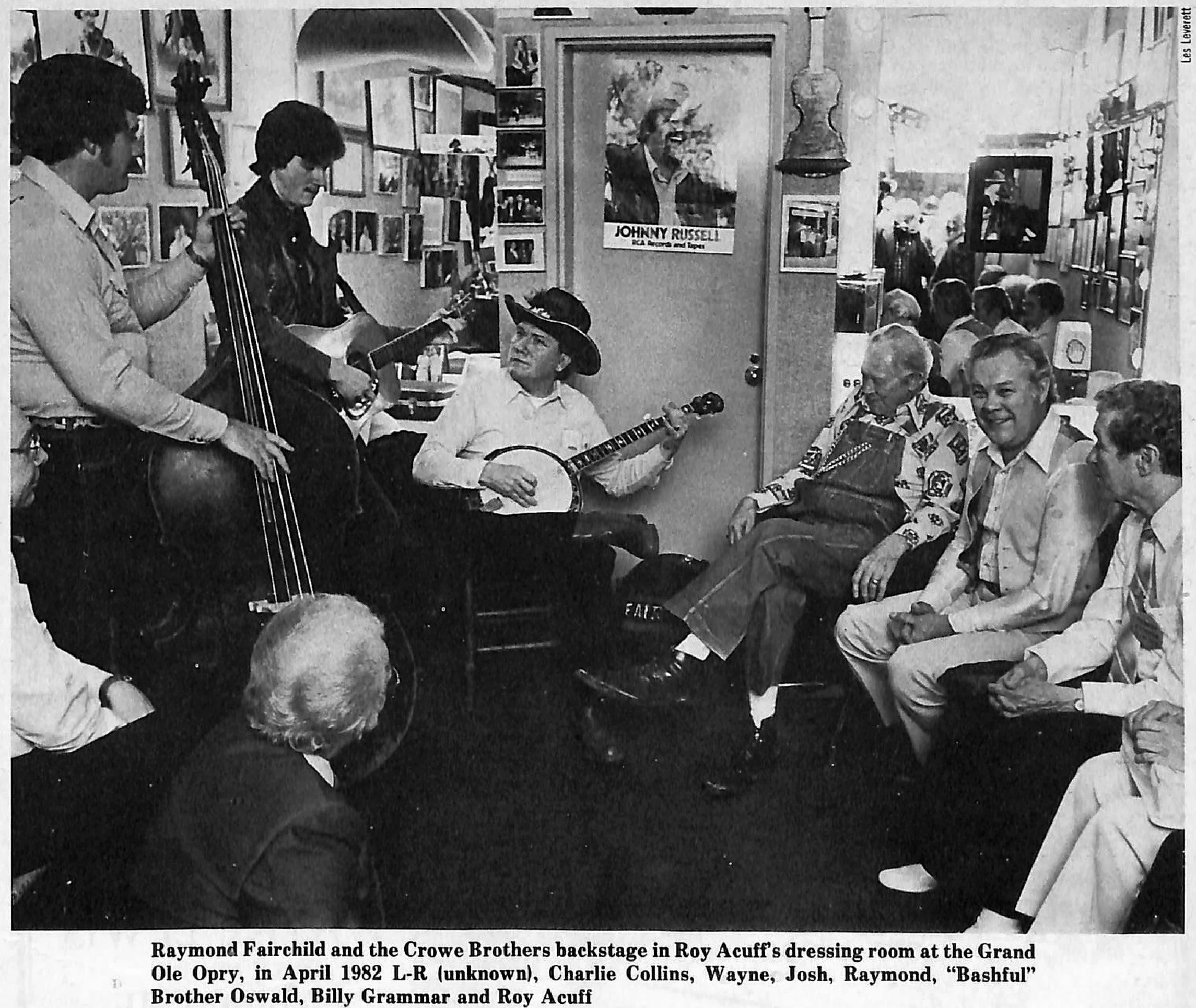
Then there’s the Grand Ole Opry. Roy Acuff has been a fan of Fairchild’s banjo picking for years, even loaning him the Smoky Mountain Boys for his first album. “We’ve played the Opry at least four times a year since ’78,” said Josh, “And we always go over and do the Midnight Jamboree from Ernest Tubb’s Record Shop.”
“We’re up there some years six or seven times,” Fairchild added. “But we’re still waiting on the big chance — being members of the Grand Ole Opry.” “We love the Grand Ole Opry,” Josh agreed. “That’s always been a goal. Hopefully someday Raymond, maybe all three of us, can be members. We believe in our hearts that day will come.”
Meanwhile, their guest shots have been great exposure. “Wherever we go people say they’ve heard us on the Opry or saw us on ‘Fire On The Mountain,’” Wayne said.
As significant as their music is the camaraderie that has developed during the decade the Crowe Brothers have worked with Fairchild. “It’s like family now,” Fairchild claimed. “We’ve been Master Masons for the past four years. That helped bind us even closer. It’s more like three brothers than two.”
The man with the fancy banjo credited his singing rhythm section with a high degree of professionalism. “It’s been like I want it for the past ten years. These boys have been 100% dependable. When they came with the rhythm they’ve got, it made my sound like I always wanted it. I treat them right, and they treat me right.”
Besides their long-range target of the Opry, Raymond Fairchild and the Crowe Brothers mostly want to keep “working regular and staying with it.” They’ve yielded their May-October residency at Maggie’s Stompin’ Ground to the Rizin’ Fast band. “As far as playing at one place on the side of the road seven nights a week, that’s all over,” Fairchild announced. “We’ve got all the work we need from April to November, but we’d sure like to pick up some winter bookings.”
That should be possible with their crowd-pleasing combination of mountain duets and super charged instrumentals. As Josh said, it’s a distinctive two in one show. “We play with Raymond, and he picks the banjo, but he plays with us when we’re singing. It’s two bands for the price of one, and there are just three of us.”