
By Alama J. White
Reprinted from Bluegrass Unlimited Magazine
December 1987, Volume 22, Number 6
Pat Enright
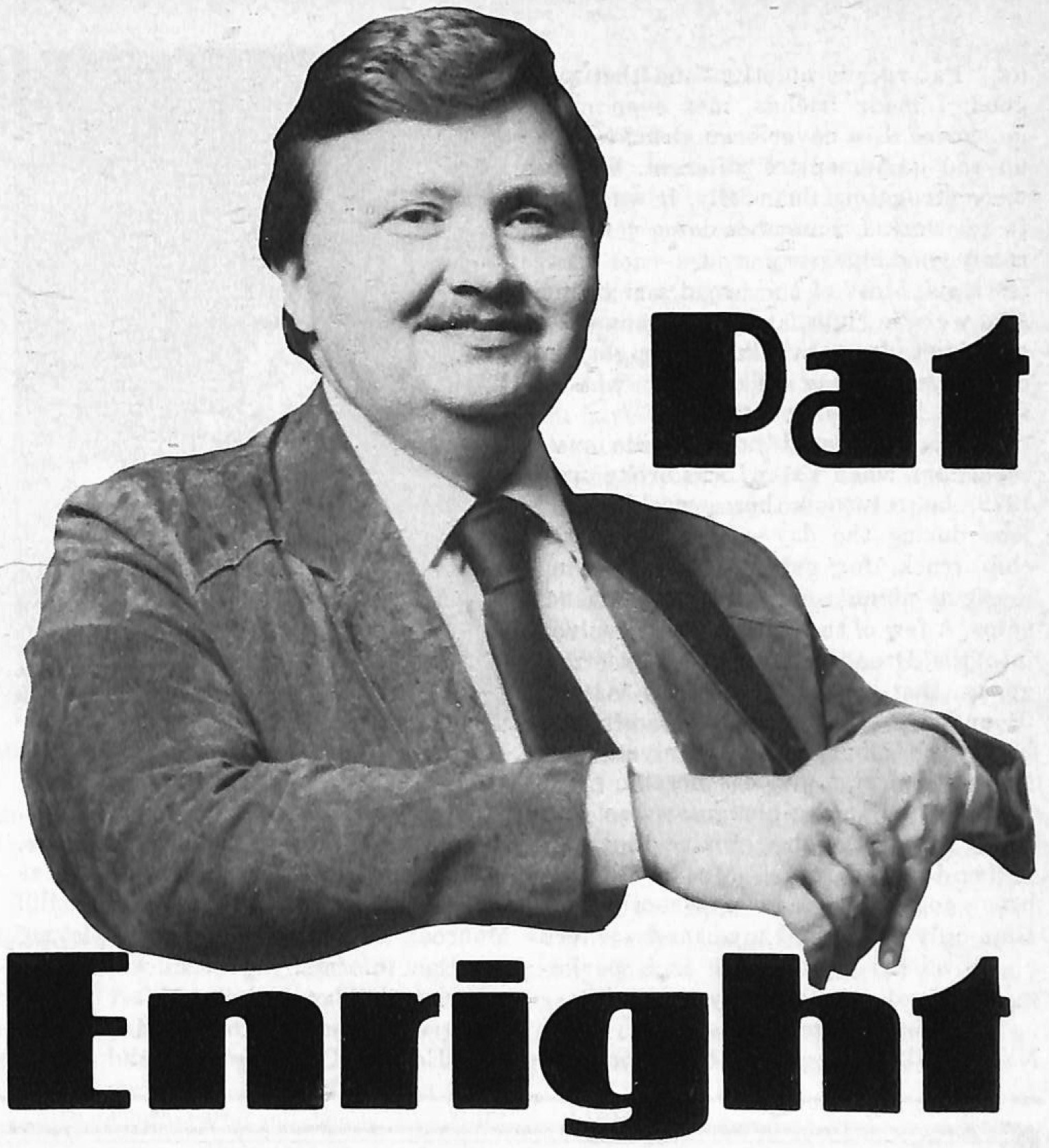
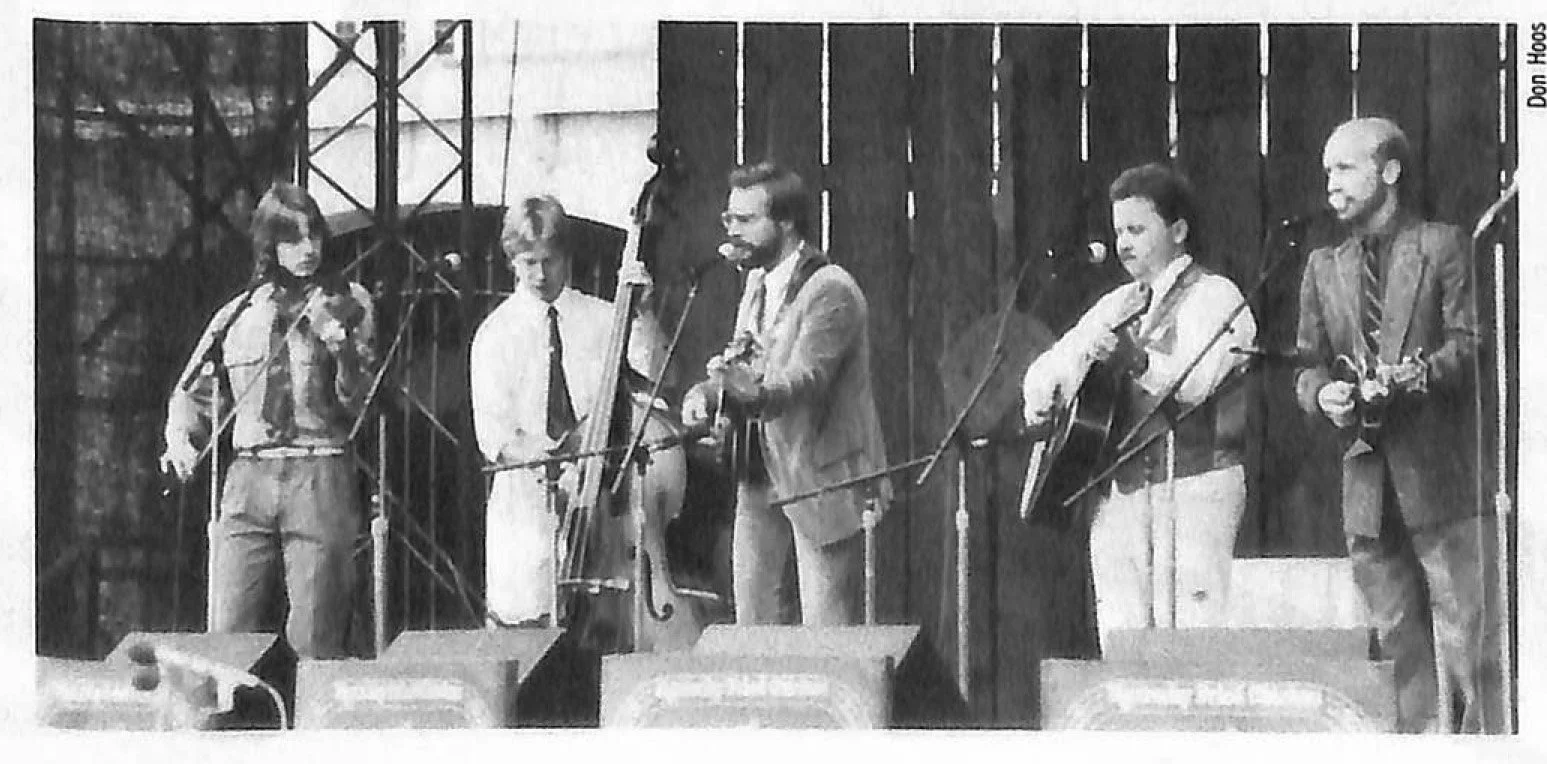
The wind is cold, the misting rain unpleasant, yet few people in the festival crowd pack up their folding chairs and call it a day—next on the program is the Nashville Bluegrass Band. Enthusiastic applause greets the band’s appearance on stage, and Pat Enright smiles appreciatively. After ten years of hard work and lean times, the singer that Tony Trischka has called “the man with the hundred megaton voice” is finally doing what he has always wanted to do: sing and play rhythm guitar in a top bluegrass group.
In the late seventies, Pat joined Tasty Licks in Boston for one year and considers that his first truly professional experience, though previously he had been in various bands in California. “Tasty Licks was the first band I went into that I didn’t help start,” he explains. “I was hired as a sideman, guitar player, and singer.” Pat smiles, remembering. "They were working full-time in the northeast and had a teenaged banjo player named Bela Fleck.”
Pat’s love affair with bluegrass began in 1965, the year he joined the Navy. Prior to that, while growing up in Huntington, Indiana, he and his older brother had listened to a lot of late-night radio, including gospel, rockabilly, and rhythm and blues. Pat recalls being drawn to all kinds of music. As a teenager, he often went to Fort Wayne to hear folk music in the coffeehouses there—a fact that is revealed in his unique and often bluesy vocal style.
At the age of seventeen, he graduated from high school and moved to Cleveland, where he studied architectural engineering, working days and attending classes at night. Facing the draft, he chose to join the service, was stationed in Washington, DC, and one day heard the sound of banjo music coming from the laundry room. Enter Paul King, who introduced Pat to live bluegrass. “We went to see the Country Gentlemen at the Shamrock Club in Georgetown where they played every Tuesday night,” Pat says, relaxing outdoors one afternoon last summer, “and I saw Bill Monroe at the Philadelphia Folk Festival, also in 1966. I got hooked from that exposure.” He already played a little guitar, having received one for graduation—though a few chords were all he knew, he promptly wrote home for it.
Discharged from the service in 1969, he moved to the San Francisco Bay area of California, where he and King shared a house and discovered a wealth of bluegrass music. “High Country, still an active band, was going strong at that time. And there were two or three clubs that had bluegrass on a regular basis—traditionally-oriented bluegrass.” That exposure and meeting those musicians had a profound effect on him; Pat started singing and playing with King on an amateur basis, and eventually they got together with Joe Zumwalt and picked up a few jobs. Mostly low key, playing for the door. “I think we made seven dollars for the whole band the first time we played. But I got to be on a stage,” Pat continues, adding that he almost became a fixture at the Freight and Salvage Coffee House in Berkeley. Soon he had a band—The Phantoms of the Opry, voted by the San Francisco Chronicle one of the top musical groups in the Bay area. “It was something,” he says, “to be a bluegrass band in San Francisco and be included with the Grateful Dead. Any kind of music was accepted, could survive and have an audience. That was a fertile time. All kinds of musicians performed in the local clubs, with all kinds of approaches.”
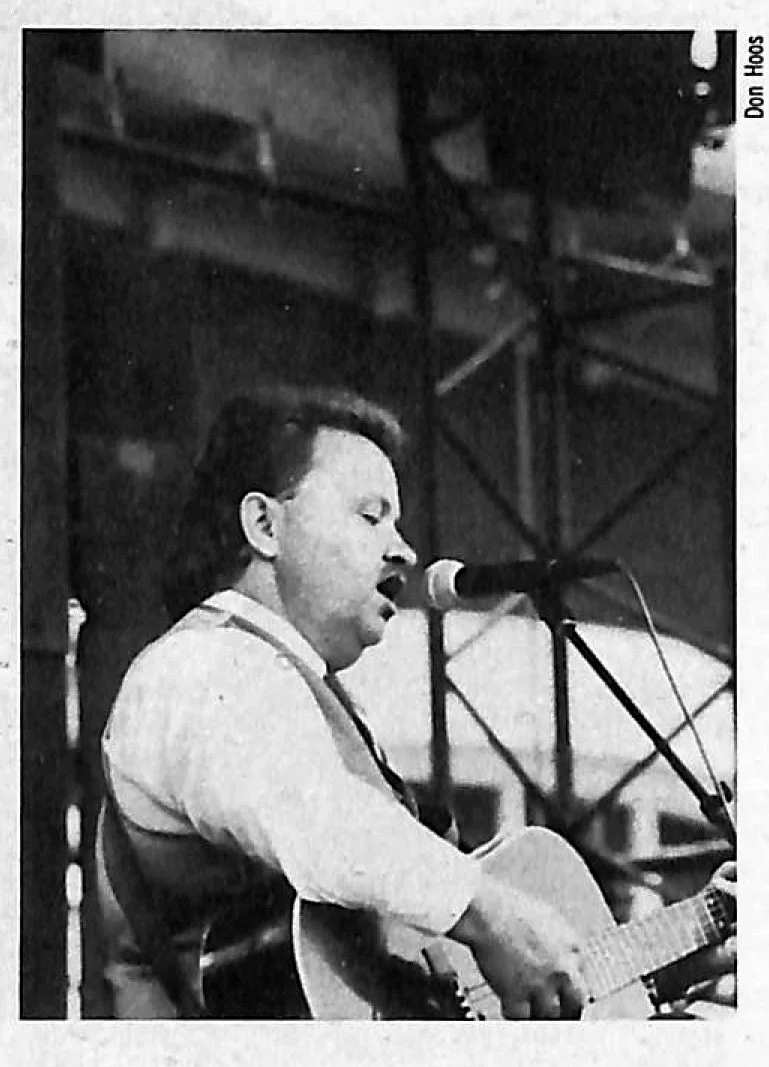
By the mid-seventies he was certain he wanted a career in bluegrass and decided to move to Tennessee, closer to the source of the kind of music he wanted to play. There was, friends reported, a lot of informal bluegrass going on in Nashville, drawing an abundance of excellent young musicians. The move proved wise: the vitality of the small club scene in Nashville provided him the opportunity to play with some excellent bluegrass musicians like Kenny Baker, and Vassar Clements. On Friday and Saturday evenings, performers from the Grand Ole Opry would drop by the Station Inn to jam. It was there Pat met Alan O’Bryant, which eventually lead to the formation of the Nashville Bluegrass Band.
But first Tasty Licks and the year spent in Boston. “Before I joined, the band was very experimental,” says Pat. “Bela’s playing, for example, was really unorthodox. He and I spent a lot of time listening to tapes of live Flatt and Scruggs shows from the fifties. Their sound was powerful, alive, fresh—and in its own way extremely experimental within certain boundaries, which Bela appreciated immediately. We had to find a common ground in order to go out and play music, so we did. And I think we played some good music together.”
The band released two albums, “Tasty Licks” and “Anchored To The Shore” (Rounder 0106 and 1020, respectively, with Pat on the latter LP), but the year proved difficult. “We traveled a lot,” Pat recalls quietly, “and that was good; I made friends, met even more musicians. I’ve never been afraid to pick up and go someplace different. But we were struggling financially. It was hard to get work. I remember doing very few really good bluegrass venues—not many festivals. Most of the bread and butter gigs were in clubs, and sometimes when we hadn’t played even half the night, the owner would say, ‘This isn’t what. I wanted, I wanted country-rock.’”
Too, Pat missed the Nashville music scene, and when Tasty Licks broke up in 1979, he returned there, working odd jobs during the day—driving a potato chip truck, for example —and playing music at night, renewing former friendships. A few of those friendships evolved into the Dreadful Snakes, an informal group that released “Snakes Alive!” (Rounder 0177) early in 1984, a straight bluegrass album that received considerable airplay and has become a collector’s item among bluegrass fans. Pat, Bela, Jerry Douglas, Blaine Sprouse, Roland White, Mark Hembree-together in an apparently one- time-only effort showcased—where else?—at the Station Inn in a performance regulars still fondly remember.
Almost simultaneously, the Nashville Bluegrass Band came about, as Pat says, “Kind of by accident.” He, O’Bryant, Mike Compton, and Hembree (when he was off the road with Bill Monroe) frequently wound up playing together informally. “We all knew each other, and Alan had been part of the Bluegrass Band, which was Butch Robbins, Ed Dye, David Sebring, and Blaine Sprouse. They had done a few years’ work and made some contacts.”
One contact was with a New Jersey promoter who was organizing a tour called “Grand Ole Opry Music,” fronted by Minnie Pearl. Given an offer to put together a band and join the tour, Alan promptly contacted Pat. “We had always talked about forming a band,” recalls Pat, “so we got Mike and Mark and the four of us did 9,000 miles together. We played one-nighters, three songs each night. Pretty grueling, but not too bad, really—at least we had a bus.”
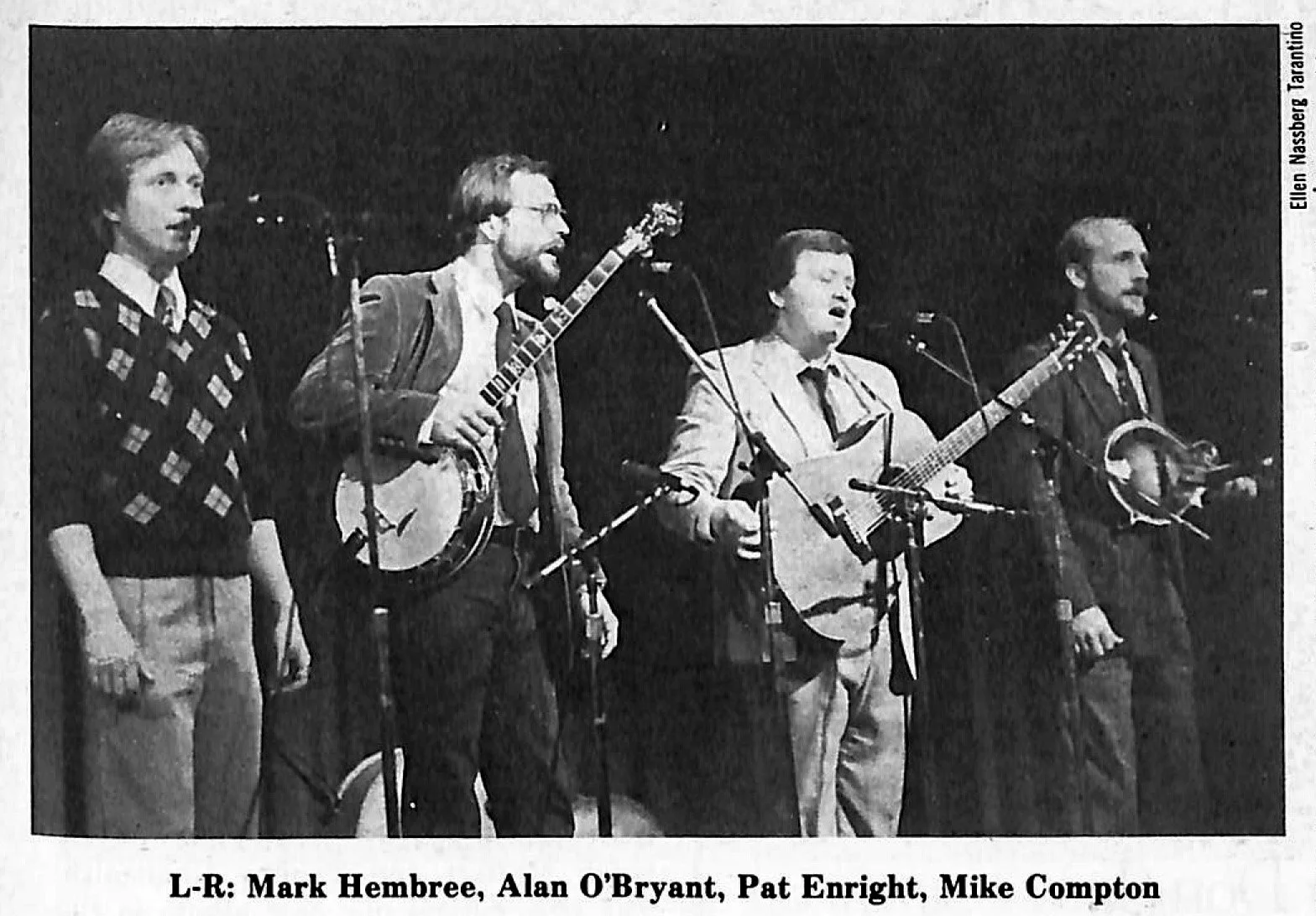
They also had a good sound, one that appealed to them as well as to the audience, and when the tour ended, the foursome decided to keep working together.
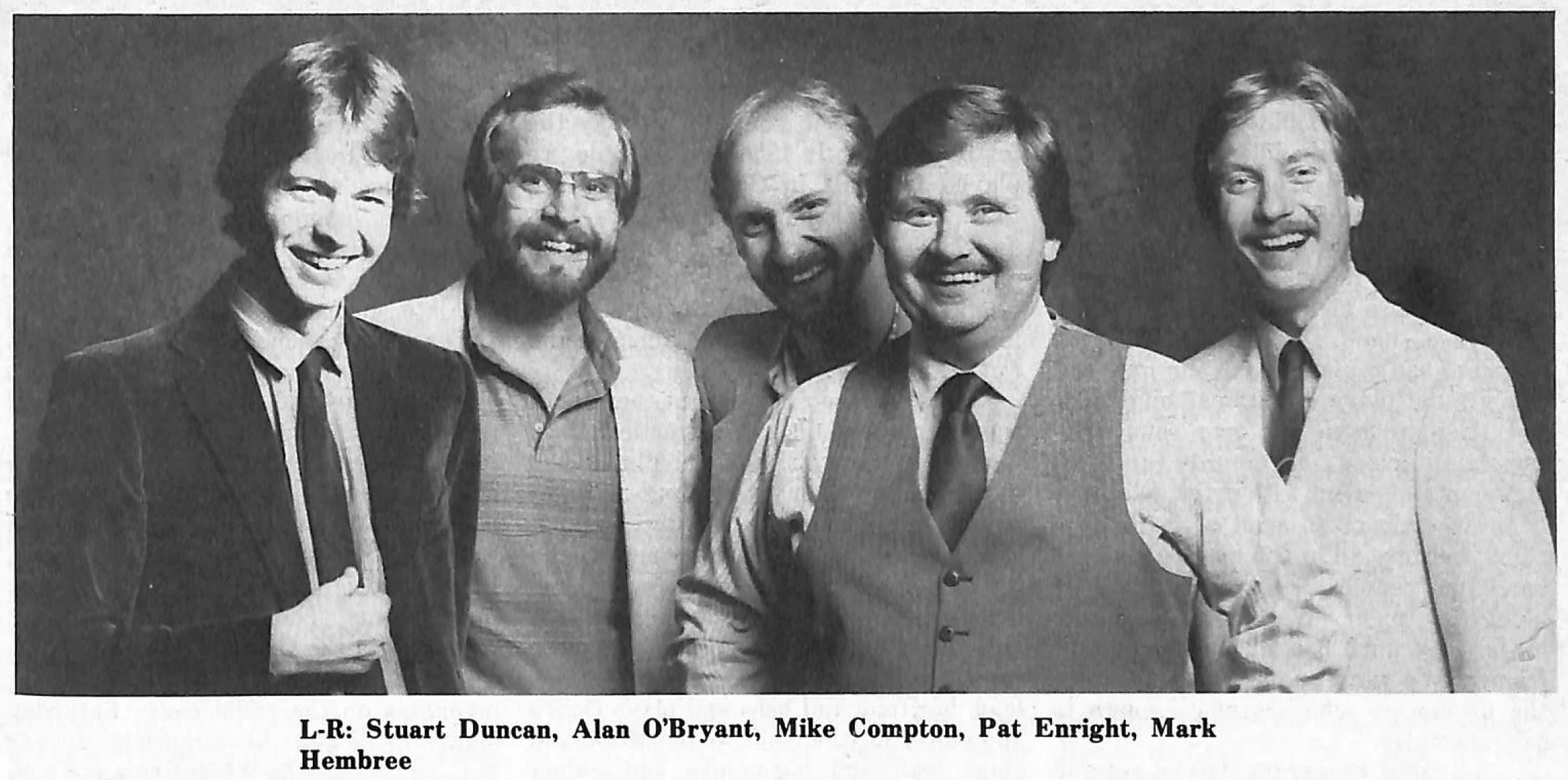
As might be expected, the first year was the toughest financially. “We just about didn’t make it,” says Pat, who credits his wife, Patty, a dental assistant, with providing him the emotional and monetary support necessary to survive the early years. Still, the group’s relatively fast rise is something of a phenomenon in the bluegrass world. In 1985, the group added California native Stuart Duncan as fiddler and released its first album, “My Native Home” (Rounder 0212). (Recorded before Duncan joined the band, the album features Nashville fiddler Blaine Sprouse.) In the summer of 1986, the band toured Europe and Japan, became the first bluegrass band to perform in mainland China, and released a second LP, “Idle Time” (Rounder 0232) to good reviews. In August, the band released “To Be His Child” (Rounder 0242), an album of gospel tunes rooted in variety: black, white, urban, country- mountain: “A wide spectrum,” as Rat Puts it. The LP includes numbers like the Stanley Brothers’ “Are You Afraid To Die?” as well as one original tune.
Presently, the band is collaborating with Pete Rowan on an album set for release in early 1988. The recording, which consists mostly of Rowan originals, is a collection of Celtic folk, bluegrass, and country and is something of a departure for the band. The group has also been working with David Grisman on a traditional bluegrass album featuring various artists, including Ricky Skaggs.
“It has definitely been hard, but for almost four years,” Pat confides with a happy note in his voice, “I’ve finally had the luxury of just playing music.”
Pat, you sing lead and harmony seemingly effortlessly. When did you discover that talent? Or is that a discovery singers make?
It sure is. I remember wanting to sing from an early age, but I never had any formal training. It’s something I just gradually got into. From time to time, I’ve considered singing lessons. Especially after hearing John Cowan’s comments and suggestions (at a bluegrass festival harmony workshop). He's obviously trained and knows about certain physical aspects of singing I was only vaguely aware of. He made an impression on me. Someone who sings hard like I do could undoubtedly benefit from a vocal coach. It would definitely preserve my voice.
What about bluegrass music initially attracted you?
I tend to like roots music. Bluegrass is rooted in blues, gospel music, country music, the music of the British Isles, and so forth. It’s like jazz in a way; free within certain boundaries. The most suc- cesful and influential musicians, like Bill Monroe, have, either consciously or unconsciously, been aware of that, I think. Bluegrass is just simply the best outlet for me.
How did you become involved with Tasty Licks?
I got a call from Jack Tottle, who was the band’s leader. He explained who they were and what they did. I’d seen their name in Bluegrass Unlimited, though I’d never heard them play. Jack is very knowledgeable about traditional bluegrass and has played for over twenty years. I think he wanted to move the band in that direction. I said I would give it a year, and I did.
Was the decision to give music a full-time chance difficult to make?
Extremely. But I’ve become more at peace with myself in the past few years than I ever was before. My upbringing was to get an education, have a career. In choosing music, you have to forget all that and go ahead with it because you feel that’s absolutely what you should do. You have to decide once and for all that you’re going to do whatever it takes to make a living at music until maybe it becomes obvious that you have no business doing it.
How did Stuart become involved with the band?
Stuart’s twenty-four, has been playing since he was about seven years old, and probably has more musical experience than anybody in the band. He came to Nashville on Bela’s suggestion. We played some with him informally then finally sat down one day and said, ‘Look, we’d sure like to play music with you if you’re interested.’ He was, and we were ready, though we hadn’t been actively looking for a fiddler; we could barely afford to keep the four of us going. But he was available and it was a good move. He's a great musician.
When the band is arranging parts for a song, how do you determine who will sing lead and who will sing harmony?
There’s really no set rule. We have a feel for what suits each of us. A quartet is usually the same: I sing tenor, Alan sings lead, Mike sings baritone, and Mark sings bass. If it’s a song that works best with a hard sound, I might sing tenor. If it’s a lighter song, Alan will sing tenor.
Can anyone who can sing and read music sing harmony?
If they sing on pitch, sure, they can read it. But harmony isn’t something you want to write down. I’ve always thought music—the way I want to do it, and the way I think the band does it—breathes. There’s a lot of room for variance even within four parts. We don’t ask anyone in the band to sing a certain way in order to sound like a perfectly stacked blend. We allow ourselves some freedom.
From performance to performance then, the presentation of a particular song might vary?
Absolutely. We’ll change the tempo, we may go so far as to give it a different feel. That’s the way we grow, we might discover something better that way.
Is finding suitable material for the band ever a problem?
So far, we’ve been lucky. People send us good material. ‘Idle Time’ has two new songs by Nashville songwriters, Hugh Moffatt and Tommy Goldsmith. The title cut on our new album is the Duck Creek Quartet’s ‘To Be His Child,’ a stark, unaccompanied quartet sound. Truthfully, though, the Nashville music scene is not geared to bluegrass music. Songwriters want to write hits and there’s obviously a formula for that. When a songwriter gives us or Hot Rize or New Grass Revival a song, it’s usually one they think is the typical bluegrass song. Writers would do well to submit songs to acoustic or bluegrass groups without making them stereotyped. Bill Monroe is a good example of a songwriter who never restricted himself to hackneyed themes and wrote some very personal, sometimes disturbing, songs. That was simply the way he was expressing himself.
What about the Snakes? I think we need a performance.
I’d love one, too. But everyone in that group is so busy these days, it’s impossible to get everyone together to play or record. Actually, that band was meant for our own enjoyment. Bela and Jerry Douglas produced the album.
Hasn’t Bela produced the Nashville Bluegrass Band’s first three albums?
Yes, and he had a lot to do with the way they sound. ‘My Native Home’ of necessity was fairly low-budget. Bela was responsible for getting out of us the best we could do under the circumstances. We decided from the outset that we wanted someone we trusted with a good ear who knew how we sound and how we want to sound. Someone who would be in that room and free us from a lot of the decisions. Sometimes you just can’t make an objective decision about a performance; I can’t. I can’t listen to myself on tape and say, ‘That’s great, I couldn’t sound any better.’ It’s painful.
You need someone to say either, ‘I know what you can do, and you can do better than that,’ or, ‘You did a great job.’ And we couldn’t ask for anyone better. Bela’s extremely easy to work with and he brings out the best in us. We recorded ‘My Native Home’ and ‘Idle Time’ in the same studio with the same engineer and producer. ‘To Be His Child’ we recorded at the Cowboy Arms Hotel and Recording Spa with Bela again producing.
What do you do when you’re not recording or on the road?
Relax, rehearse, learn new material. There’s always plenty to do. That and actually performing take up most of my time. Unless you’ve got someone hired to do the preliminaries for you —like setting up the stage —so that you can just show up on stage, you have to take care of everything yourself. So I’m pretty busy. I don’t have-time for any hobbies. I like to be home; I don’t go out much.
Do you think there’s a rise in the popularity of bluegrass music these days?
Definitely. I see it on the road and playing some of the festivals. I think people are a little burnt out on popular music. People are ready for a change. A lot of the musicians who are suddenly attracting notice have been around for several years now. There are a lot of fine young musicians around and a lot of them are here in Nashville, which is just another good reason to be here. But it has been only the last five or six years that Nashville music people have looked around and realized that there is a huge audience that likes bluegrass and related music. I think a lot of people in the music business are becoming wise to the fact- that there is a huge audience out there for different kinds of music and that they ought to tap into it. You can’t ignore Jerry Douglas, Mark O’Connor or Bela Fleck. They’re just too good. Jerry, Mark, and New Grass Revival all have major label contracts now, with complete control of what they do. That’s a good sign. Bluegrass isn’t just regional music and hasn’t been for a long time.
I expect to get more from playing with the Nashville Bluegrass Band than I have from anything else I’ve done. We’re all excited about the band. Worn out and frazzled, but excited.