
Olen Gardner—Little Preachin’, Little Teachin, Lotta Pickin’
By Sue Wade
Reprinted from Bluegrass Unlimited Magazine
November 1979, Volume 14, Number 5
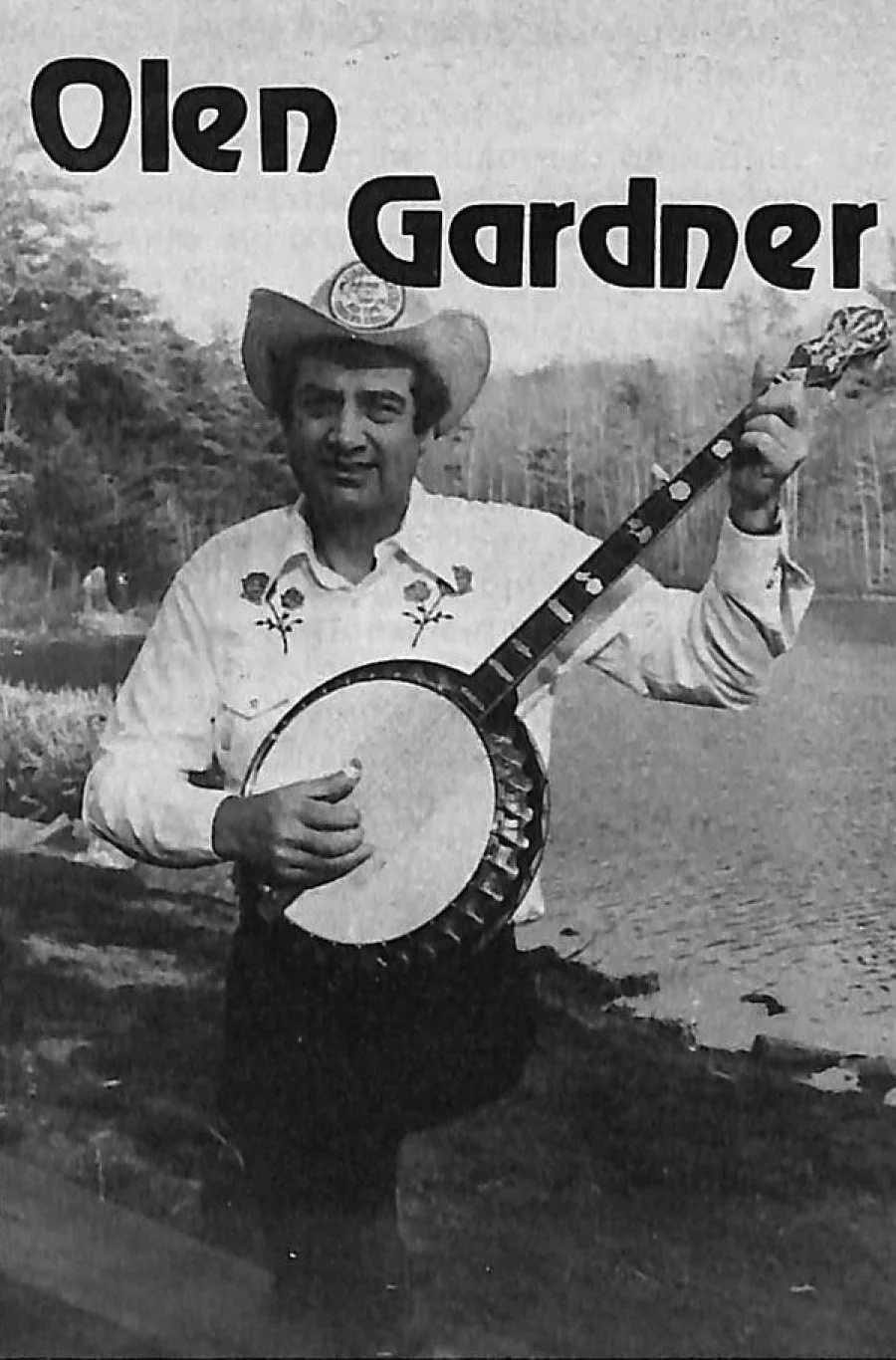
“I used to carve my tops and trucks and other toys out of wood,” Olen Gardner recalls. “You used the resources around you. It was just the most natural thing in the world, if you wanted something, to make it.”
Necessity may have been the mother of invention back then, but the premier musician-craftsman of Carroll County, Virginia, still crafts, carves and repairs his playthings — only now, his playthings are some of the finest banjos and guitars in the field of bluegrass music.
Raised on a Carroll County farm, in the mountains of southwest Virginia, the 42-year-old Gardner has built something else besides instruments: a sterling reputation as a preacher, a teacher, and a first-rate picker in his native Appalachia. In the basement of his home, where tools of his craft line the walls and various bluegrass instruments await completion or repair, he welcomes occasional visitors and talks casually about his diverse career.
“Since my father was killed by an automobile when I was four, and I was the baby of the family,” he says, “I was reared by my mother. There were eight boys and one girl in the family, and all but an older brother had married and left home when I was born. My father and my grandfather were both Primitive Baptist ministers, and the Primitive Baptists don’t allow music in the church, I doubt if the church ever knew my father played.”
In 1957, Olen says, “I became a Christian in the Missionary Baptist Church and got away from the music. It wasn’t really a conflict with the church, but more or less a change in environments.” Ten years later, in 1967, he decided he wanted to play again, but he didn’t have enough money to buy a banjo, so he made one.
“I had an apprenticeship under a violin maker as a young feller, and had since learned about tool and die work, machining, plastics molding, metalworking, and had experimented with varnishes and pearl cutting. I had all I needed to do it.”
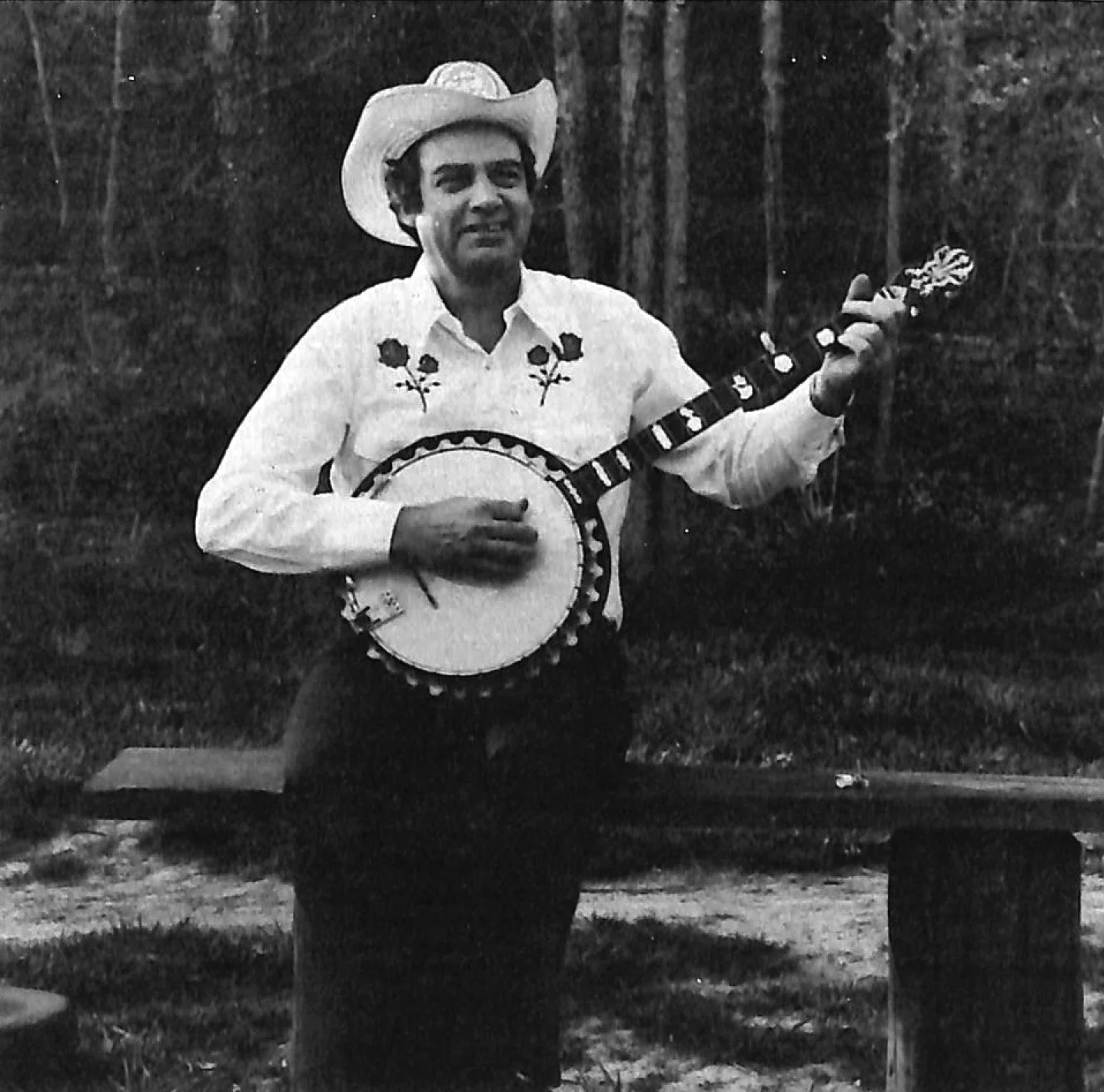
His banjo, which took 250 hours from start to finish, is made of tiger-tail maple and has hand carved pearl inlays decorating the neck. His Southern pride can’t be hidden as Olen looks over his craftsmanship and says, “I think the craft is more comfortable than performance. Used to be, in the older days, the head of the banjo was made of cat skin, and the strings were cat gut or the entrails of other small animals.” Reaffirming the sad-but-true, he points out that banjo building was “hard on cats.”
True grit, or country spunk, or individualism...whatever you choose to call it...whatever it is in a man that makes him search his heart for what he believes is right and then makes him stand up for it, is manifest in Olen Gardner when he explains why he gave up the ministry after 13 years. “My wife became in love with a bluegrass musician and left with him. The church, a Southern Baptist church, investigated the circumstances, rendered me blameless, and asked me to stay on as a minister with a 100 percent vote. I told them to let me tell them what my plans were and to see if they still wanted me. I told them that I had some little girls and a little boy, I was lonely, I told them I planned to date again and in case I ran into that woman I loved, and I felt loved me, and if there’s compatibility and love with our children, I intended to remarry. And they said ‘oh’....So that ended my ministry, plain and simple.”
His eyes reveal hurt and discouragement, and the voice of this mountain man takes on a frank and almost bitter tone: “Genuine family love and motherhood for my children meant more to me than the institution did. The institution (the church), has been a struggle ever since, a burden to me and my family, lotta hurt.... They were just not mature enough to accept my remarriage.”
As an afterthought, Gardner says he feels young people of today may not be finding fulfillment in the church, and in his opinion, that is the reason they don’t attend. “In the contact I have with the high school kids askin’ them what turns them on and what turns them off, I think they are more sensitized to genuineness and substantial love...love that proves itself, more than a generation or two ago.”
Olen talks to these younger people at Christiansburg High School, where he teaches architectural and mechanical drafting. He studied at Virginia Polytechnic Institute for awhile, and now is taking courses there again, working toward his degree. He did not graduate earlier, he says, “because I had too many other irons in the fire.” He already has earned an associate degree in business from Virginia Western Community College in Roanoke.
Besides teaching at the high school, and working on his instruments, he also teaches classes in bluegrass banjo and guitar through New River Community College in Dublin.
Not least of Olen Gardner’s talents is his skill as a storyteller. “Ole Charlie (Charlie Monroe) would take spells of cussin, and sometimes I’d get it because I was managing the band and if anything went wrong Charlie had to cuss somebody out. He’d cussed me out before we were gettin’ ready to play this one night, and it made me uncomfortable, so I decided to tell him about it.
“There was a heavy snow on that night and the roads were real bad. We got up to Fancy Gap Mountain where I was to get out. Usually, I’d go to the back and pick up my instrument and then take the key back to Charlie.
“Ole Charlie would just barely roll the window down enough to get the key back in. Well, I decided I’d just tell him I wasn’t gonna put up with any more of these cussins, and I asked him to come back with me and talk. Now, the rest of the band members were stretchin’ their necks cause Charlie was bigger than me, and had a bad temper. Anyway, to Charlie, us goin’ back together meant we were gonna fight.”
Olen pauses, like all country storytellers do, and then recalls Monroe walking back, taking off his hat, then his coat, and rolling up his sleeves. “I don’t remember what I said, but I was talking the whole time and had planned to hit Charlie over the head with a banjo that was once owned by Charlie Poole. I remember thinking about how much I thought of that banjo and the fact that I was about to use it for a weapon. I don’t know if I got my point across, or if the cold night air cooled Charlie off, but he shook my hand and said, ‘We’ll try to get along better from now on.’ That was as close to an apology as anything I ever heard Charlie say.”
Then, with a look of happiness and contentment, Olen talks about bluegrass: the beginnings of bluegrass music, the quality of tone in hand made banjos, the history of the modern banjo, and the contributions and influence of the Monroe brothers, the Van Epps brothers, The Ossmans, and the Bradburys.
Sleeves rolled up and settled in his easy chair, he plays an excellent “Soldier’s Joy” and says that the original name of the song was “Payday in The Army.” The banjo Olen uses for playing clawhammer tunes and classical banjo music is a classical banjo that was played in the Philadelphia Orchestra in the 20’s. “It was worth a thousand dollars then,” he says, and tells of an advertisement that said you could put your $1,000 banjo in the back seat of your $500 automobile. Grinning, he adds, “It’s hard to tell what it’s worth now.”
He goes on to tell about fiddler’s conventions and the use of drugs there. He says that the drug culture sends fears all over him. (“You buy something on the street and Lord only knows what’s in it.”) By comparison, he seems to believe that mountain moonshine is much safer: “I never was afraid of liquor. The people who made it were clean, gave good measure, and took pride in their livelihood. Alcohol, in years past, had as its redeeming value its use as medicine.”
Going back to bluegrass, Olen gives insight on how Earl Scruggs happened on the “Foggy Mountain Breakdown,” and why “Fox On The Run” is difficult for most bluegrass bands to play. His favorite bluegrass song is “Sweetheart, You Done Me Wrong.” “Notice the grammar in that,” he says.
The old pieces to him, are special because they tell stories. “The only thing I can think of lately that tells a story is the song about Mr. Peabody’s coal train and the legend of Green River.” Then, recalling the name of the song, “Paradise,” written by John Prine, he says that he and Prine spent some time playing together at Lakeside Park in Roanoke. “He (Prine) teaches banjo and helped me out a lot with methods of instruction,” Olen says.
He talks about Tom T. Hall, Earl Scruggs, The Carter family, Kris Kristofferson, and John Hartford and then, tells about a law suit between Arthur Smith and Eric Weissberg’s publisher over “Dueling Banjos.” It seems that Arthur wrote a song which he and Don Reno played in 1954 called “Feudin’ Banjos,” and Weissberg took the song note for note and called it “Dueling Banjos.” Smith won the suit and received a substantial sum of money as a result. “It didn’t make sense anyway,” Olen explained. “The original piece used two banjos rather than one banjo and a guitar, so “Dueling Banjos” really didn’t fit.”
Olen and his band, The Appalachian Ramblers, play at state parks during the summer, and at special events such as the Governor’s Inauguration this year and the visit of Queen Elizabeth to Jamestown. Their album, “Olen and Frances Gardner featuring Buddy Pendleton and Wayne Henderson,” is now being released for the third time. Olen’s wife Frances, plays guitar and leads the singing of “Amazing Grace” on the album “like the Primitive Baptists do it,” Olen says.
In addition to all the other things he enjoys doing, Gardner still finds time to manage the judging of the World Championship Festival in Union Grove, North Carolina.
Gardner says that women have been left out of the bluegrass field (except for the Carters), and he wonders why. “There’s no need for it,” he says. “It’s always Boys. Bluegrass Boys.”