
The New Deal String Band
By Alice Gerrard
Reprinted from Bluegrass Unlimited Magazine
September 1997, Volume 32, Number 3
“We liked folk music; we just liked every kind of acoustic music we could find... we discovered they were going to have this bluegrass festival in Roanoke, Va.... We pulled up at the festival and we realized it’s 9 a.m. and there’s tons of jamming going on. Boy that was all we could do was just to get parked...find somebody to pick with. What I liked most about those festivals was I met a whole bunch of people that were like me.”-Sam Bush in High Lonesome-The Story Of Bluegrass over footage of the New Deal String Band jamming, immediately followed by a segment of them on stage at Camp Springs, N.C., performing “Love Potion No. 9.”
From about 1967-1972 the New Deal String Band, from Raleigh, N.C., was one of the first of the young southern bands who were pushing the edges of traditional bluegrass music outward lo encompass repertoire rarely if ever heard before in bluegrass music - songs like “No Expectations,” and “Friend Of The Devil.” Although the Charles River Valley Boys had recorded “Beatle Country,” no bands were actively playing the bluegrass festival circuit in the South, featuring material that hadn’t been “blessed by Monroe or done by Flatt & Scruggs,” as New Deal bass player Bob White put it. The New Deal boys were middle class, longhaired (for the times) college students from the South, whose “hippie” looks often got them into trouble with audiences. “If you had a chance to play before you got hit upside the head, you’d be okay,” said Leroy Savage. “Back in those days,” Buck Peacock added, “people would just hate you for the way you looked, if you had longhair, I mean—I’ve been threatened so many times. But if you played bluegrass it was like all of a sudden you were their buddy.”
Bill Malone in Country Music USA said “Many people who heard the New Deal String Band (one of the first ‘hippie’ bluegrass bands, from Chapel Hill, N.C.), the Earl Scruggs Revue, or the New Grass Revival, could scarcely listen to their music without thinking ‘Why doesn’t somebody cut their hair?’” Neil Rosenberg in Bluegrass, A History, said “The New Deal String Band at Berryville...were...able to excite the admiration of a wide swath of the audience while at the same time incurring the displeasure of some of the conservatives, if not just by their looks...by songs like the Bob Dylan tune...that brought some boos from the audience.”
Many fine musicians came in and out of the New Deal String Band over the course of the band’s tenure: fiddler Kenny Kosek (shown in the film segments, first with Al McCanless during the jam session and then on stage as the New Deal fiddler); guitarist Jack Lawrence (now playing with Doc Watson); Jim Field, guitarist and singer with the Charles River Valley Boys; fiddler and pianist Bob Hoban (who went on to play piano with Tom T. Hall); banjoist Rick Rirnan; banjoist and harmonica player Derwood Edwards (who later joined Loretta Lynn’s road band); Jim Watson, bassist with Robin and Linda Williams; bass player Mike Boykin; guitarist Ben Runkle; and banjoist Bob Isenhour.
There were predecessors to the New Deal String Band—bands like the 6 and 7/8 String Band with Al McCanless, Derwood Edwards, Snuffy Smith, and Ray Blackwell, and a band that competed under the name New Deal String Band at Union Grove in 1963 or ‘64 that included Jim Field, Al, Ray, Snuffy, Derwood, and Buck Peacock. This may have been the first time the name New Deal String Band was used.
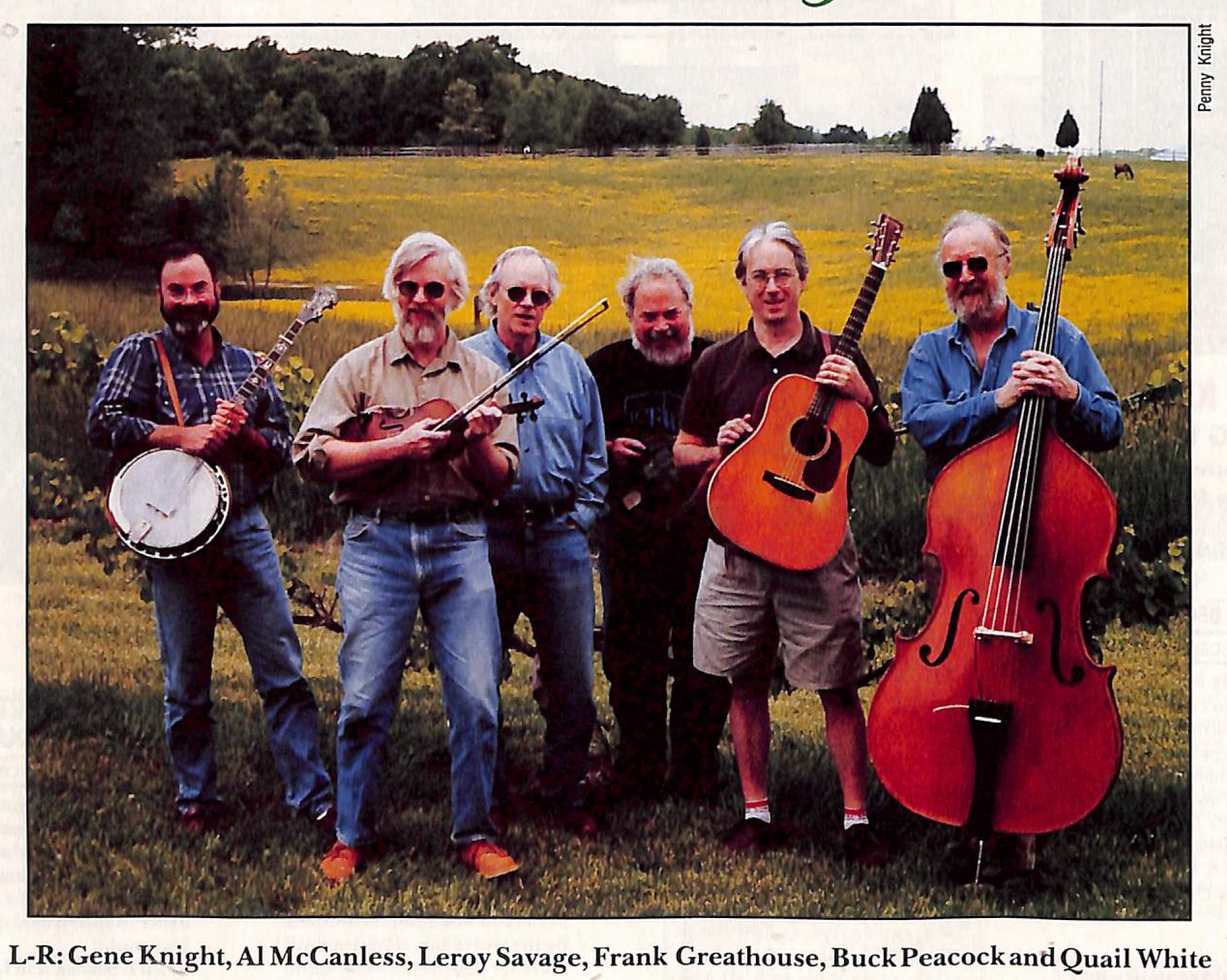
The band that finally jelled somewhere between 1967 and 1968, and recorded as the New Deal String Band included William Emerson “Buck” Peacock on guitar; Leroy Savage, guitar and vocals; Gene Knight, banjo; Frank Greathouse, mandolin; “Fiddlin’ Al” McCanless, fiddle; and Bob White “Quail” on bass.
All were from middle class backgrounds, influenced as much by the Kingston Trio and Peter, Paul and Mary, as by Flatt & Scruggs and Bill Monroe; they were educated, and college bound. “We were all kind of folkies in part,” said Leroy. “I think all of us with the exception of maybe Al came into bluegrass music via folk music. I was listening to the Greenbrier Boys and the Dillards before I actually started listening to Ralph Stanley and Bill Monroe...[and] as soon as Bob Dylan’s first album came out, it was hard-core from then on out. No New Christy Minstrels, Kingston Trio, no Brothers Four; it was Dylan, Mark Spoelstra, Dave Van Ronk, John Hammond...”
Born and raised in Rocky Mount, N.C., Leroy sang in several choirs during high school. He went to Louisburg College in 1963 and met Tommy Edwards who played guitar and banjo, and sparked Leroy’s interest in playing. “We had a little folk trio, matching shirts and little suede vests,” Leroy remembered. “I played the autoharp, and Tommy played guitar. We were all reading Sing Out magazine at the time. 1963 was my age of awakening—Union Grove, Galax, Newport Folk Festival. It was bluegrass from there on out.”
Frank Greathouse, mandolin player with New Deal, and a high school friend of Leroy, was also from Rocky Mount. Jim Watson described Frank’s appearance in the New Deal band as “the one that always looked great with a cowboy hat because his hair was so frizzy, his hair stood straight out, so the hat would come down and then this hair would stick out under it—kind of like Bozo the clown.”
Like the others, Frank listened to the Kingston Trio; he played the piano accordion, then started learning guitar and listening to Flatt & Scruggs. “I remember watching them every Saturday afternoon right after Porter and Dolly,” he said. “Leroy, who was a bad influence—as my mama would attest to her dying day—sort of turned me on to other bluegrass people like the Stanley Brothers, who are still my favorites, and Bob Dylan, and songwriters.
“In 1964 I went to the Union Grove [N.C.] Fiddlers Convention with Leroy. That was my first big rebellion—I was supposed to stay home and go to church on Easter Sunday, and I said ‘I’m not doing that, I’m going to Union Grove with Leroy.’ He walked into my house and my mama came up and said, ‘Leroy Savage you are the worst lookin’ thing I’ve ever seen in my life,’ and Leroy said, ‘Thank you Mrs. Greathouse.’ And we walked out and got into Chancey Hill’s green and white ‘56 Plymouth and off we went...It was probably the first serious event that predisposed me to becoming a bluegrass musician.”
“Fiddlin’ Al” McCanless grew up in Salisbury, N.C., on an 1,800-acre cattle farm. His first instrument was a harmonica which he bought for 50 cents. He and his high school friends, Buck Peacock and Bob Isenhour, who had just started learning guitar and banjo, formed a group called the Muddy Creek Ramblers.
“This was during the hootenanny craze, and we’d go to the radio station on Saturday afternoons. They had open mike [and] there was a woman who came in and played a Peter, Paul and Mary record real slow and she’d sing along with it. Garland Shuping, the banjo player, was a little kid, and he’d come out and play, and me and Bob and Buck, and Bob’s little brother, Tommy Isenhour.”
Al went off to the University of North Carolina at Chapel Hill in about 1964 and in his sophomore year took up the fiddle. “I just started sawing away. Bob had lent me some recordings of Gaither Carlton, so I really started playing old-time music before I played bluegrass.” Al was attracted to bluegrass music by the instrumental sound, especially that of Bill Monroe. He listened to the fiddling of Kenny Baker, Benny Martin, Chubby Wise, Buddy Pendleton, Joe Greene, Howdy Forrester, and had only been playing fiddle for about two years when the New Deal String Band formed.
“Tommy Thompson [founding member of the Red Clay Ramblers] was the first person I ever heard play old-time music in person, and that was a couple of years after we’d been playing bluegrass,” Al said. “I really like that kind of music. I never liked bluegrass more than old-time or vice versa. I got a Hollow Rock String Band record and I learned every tune on that thing—I loved it.”
In 1969-70 Al, Tommy Thompson, and Jim Watson formed an old-time band, the New Academic String Band which existed simultaneously with the New Deal String Band. Later, in 1973, Al played on the Red Clay Ramblers’ first record, “The Red Clay Ramblers With Fiddlin’ Al McCanless.”
Buck (William Emerson) Peacock, also from around Salisbury, played rhythm guitar with die New Deal String Band, and was introduced to bluegrass music in high school by banjoist Bob Isenhour. He was about 17 when he first started playing guitar, and credits Charlie Waller and Gene Meade as being his guitar heroes.
“I can remember the first time I ever heard anybody play the guitar live, it was like a pure moving experience. The whole idea of somebody being able to make music come out of this instrument really touched me.
“What got me interested [in playing] was the folk music thing— Peter, Paul, and Mary, the Kingston Trio. ...But the fact that Bob Isenhour played so much bluegrass, that was the direction I ended up going. I was exposed more to rural bluegrass music than anything—Salisbury’s just up the road from Union Grove and some other little fiddlers’ conventions, and we used to go to all those fiddlers’ conventions—Union Grove and Cooleemee, Elkin, and Cool Springs and Mocksville, all during the summer....”
Bob White (“Quail”), bass player with the New Deal, was originally from Staunton, Va. “I played piano and clarinet in a band when I was a kid. Reno and Smiley were playing every other Saturday night at the Verona [Va.] Rollerland Skating Rink. And I was there a couple of times when they played, but at the time people [from my background] were going off to the Shenandoah Conservatory...I was [also] real tuned in to jazz, and when I heard bluegrass for the first time I realized that it had to be connected. I started playing the bass pretty early on.. ..went to Fincastle [and heard] George Shuffler and John Palmer, and I was just transfixed...
Gene Knight played banjo with the New Deal. He was raised in Raleigh, and in high school played trumpet and French horn, and worked on learning the banjo by listening to Don Reno and Red Smiley recordings. When he was a freshman at NC State, he took some banjo lessons from Derwood Edwards who was living at Ashe Ave along with some other musicians. “It’s always amazed me that there were that many people with that much talent in one house at the same time...I was hanging out there at parties, trying to learn. At that time of my life that’s all I cared about.”
The mid to late ’60s was a period, in the Raleigh-Durham-Chapel Hill area (as in other areas), when the folk boom, connecting with the burgeoning interest in old-time and bluegrass music, was creating a musical renaissance. In the same way that the Hollow Rock house near Durham was central to the area’s old-time music renaissance, a big, two-story white house at 106 Ashe Ave in Raleigh was central to the bluegrass renaissance. Mainly used by students at NC State, all the members of the New Deal String Band (and others) lived there. At one time, Gene Knight remembered, as many as eight or nine students living there were musicians. “It was like the [NC State] Design School-Ashe Ave.-bluegrass sort of thing going on,” said Buck.
“I came to [NC] State in ’64,” Quail said—a chino-wearing Bass Weejun- wearing, short haircut, gonna be an engineer-so strange. I remember standing in the chancellor’s yard telling him I was gonna go to the moon. I went to the moon alright... At midterms I went over to the cafeteria to get some coffee and Buck and Rodney Hutchins, Dale Lee (“Newt”)...were sitting in the basement playing the fool out of some bluegrass music. And I went the next day to a pawn shop and bought a guitar.”
“Newt was the bass player for the 6 and 7/8 String Band,” he explained. “He was in the Stoney Fork Valley Boys with Vic and Rodney... Do you remember him preaching upstairs at Ashe Ave? [imitates a revival preacher:] “And I was walkin’ down the road—
And I heard the thunder come and saw the lightnin’ strike—
And it struck one of Earl Johnson’s fattenin’ shoats—
And I said, you friends—
If it can happen to Earl Johnson— it can happen to you!...’ ”
“All these hippies that played bluegrass lived there,” said Al. “Derwood, Vic, Newt, and Rodney had a group called the Wautauga County Squirrel Shooters. I went to Carolina, and we started going over [to Ashe Ave.] on weekends; they had these big parties that just went on all night long—it got to be the happening place ’cause there was music and good times, and you could meet people there. So that’s where we learned to play, basically, every weekend. Another person who was living in Raleigh at the time,” he added, “was Buddy Pendleton. He was in truck driving school and he’d come over on weekends and play music with us. He was my inspiration when I started playing.”
“It was like party central in Raleigh for years,” added Frank. “It was a big crossroads...on Saturday night the doors would just open up and everybody’d come out on the porch and play, and people would wander in from State, Meredith, the Pancake House, you name it.”
“I lived in the dorm the first year,” said Quail, “and in my sophomore year moved down to Ashe Ave to be with the gang. “When we weren’t playing we’d go over to Durham and play at Tommy Thompson’s house, and to Chapel Hill and play at the Quadrangle and pass the hat. The Triangle area was so hot—it was just one of those magic times,” he continued. “In one loom at Hollow Rock, Barry [Poss], Sharon [Sandomirsky], and Eric Olson would be playing, and Alan [Jabbour] and Tommy [Thompson] and Bert Levy... and we’d walk in—we’d just disperse and play music.”
“One room’d be in the key of D and one would be in the key of B,” said Leroy.
The Sidetrack, a coffeehouse owned and operated by John Peden, opened in Raleigh in about 1963, and it became the musicians’ hangout of choice—the place to see John Hammond, Doc Watson, Len Chandler, Pat Sky, Buffy Sainte Marie, and others. After the Sidetrack closed for the night they’d go to Ashe Avenue and play bluegrass music ’til the wee hours of the morning.”
“[About 1965] bluegrass was happening,” said Quail. “Doc Watson was happening, Jim Kweskin was swingin’ through doing ‘I Dreamed About A Reefer Five Foot Long’ from 1927, and Bill Keith was doing his banjo thing...it comes up to Ashe Ave...and all the Hollow Rock phenomenon—there was an amazing mix of string music going on, pushing all of us toward getting into a band.” As the New Deal String Band gradually coalesced into the core band in about 1968, there were plenty of local venues where they became known, and where they developed large local followings. They played at fraternity parties, hootenannies, on radio and local TV, at the Lamplighter, the Keg, the Frog and Nightgown. They were the first band to open the famed Cat’s Cradle in Chapel Hill when it was behind Breadman’s, according to Leroy. “And all during this time, said Buck, “we were playing fiddlers’ conventions — Union Grove, Galax...that’s all we did was play music. The closest we came to a home venue, was the Pickwick in Chapel Hill—we played there one night a week.”
“The place was packed every week,” said Jim. “The [band] was really cooking; they were playing regularly, they were doing old-time bluegrass but also mixing in Rolling Stones and Beatles stuff done bluegrass style. That was one of the things the New Deal String Band did, was songs like “Don’t Pass Me By,” and “Expectations...” “We came together at a time when there were only 12 or 14 groups making a living [at bluegrass music]” said Quail. “We came out of Chapel Hill bustin’ at the seams, ready to travel, and hit the festival circuit.”
Jim felt that the New Deal String Band, being from the South, had a stamp of authenticity, especially to those up north, that nobody else had, “whether or not it was true,” as he put it. “You all were learning it off records just like [the Red Clay Ramblers] were, [but] the whole perception of being from the South made it seem more authentic.”
“It’s not that someone is more authentic,” added Quail, “but the end result is a connection with the crowd and die people that are listening that takes on a life of its own."
Jim described the New Deal sound. “They might take material from other places but it was definitely done in pretty much a straightforward bluegrass style. Frank was ahead of his time. He played really weird stuff, and he could really play straight ahead stuff. His playing was much further out than anybody else playing bluegrass in those days, and more in a blues kind of way. Quail was way ahead of his time as a bass player, and Peacock played [guitar] out of A shape a lot to get the open strings. He was a fine rhythm guitar player. Between him and Quail [the band] had a great rhythm section.”
Frank agreed. “I think what made die band continue and grow,” he said, “was it had a hell of a rhythm section— it was like an airplane taking off...and everything we did, weird and unweird sounded like bluegrass.”
“At the time we were really probably the first truly hippie bluegrass band,” said Leroy. “You did have the New York Ramblers, but they didn’t really have long hair or outrage anybody...and we were doing Grateful Dead songs, Paul Siebel, Rolling Stones, Bob Dylan...”
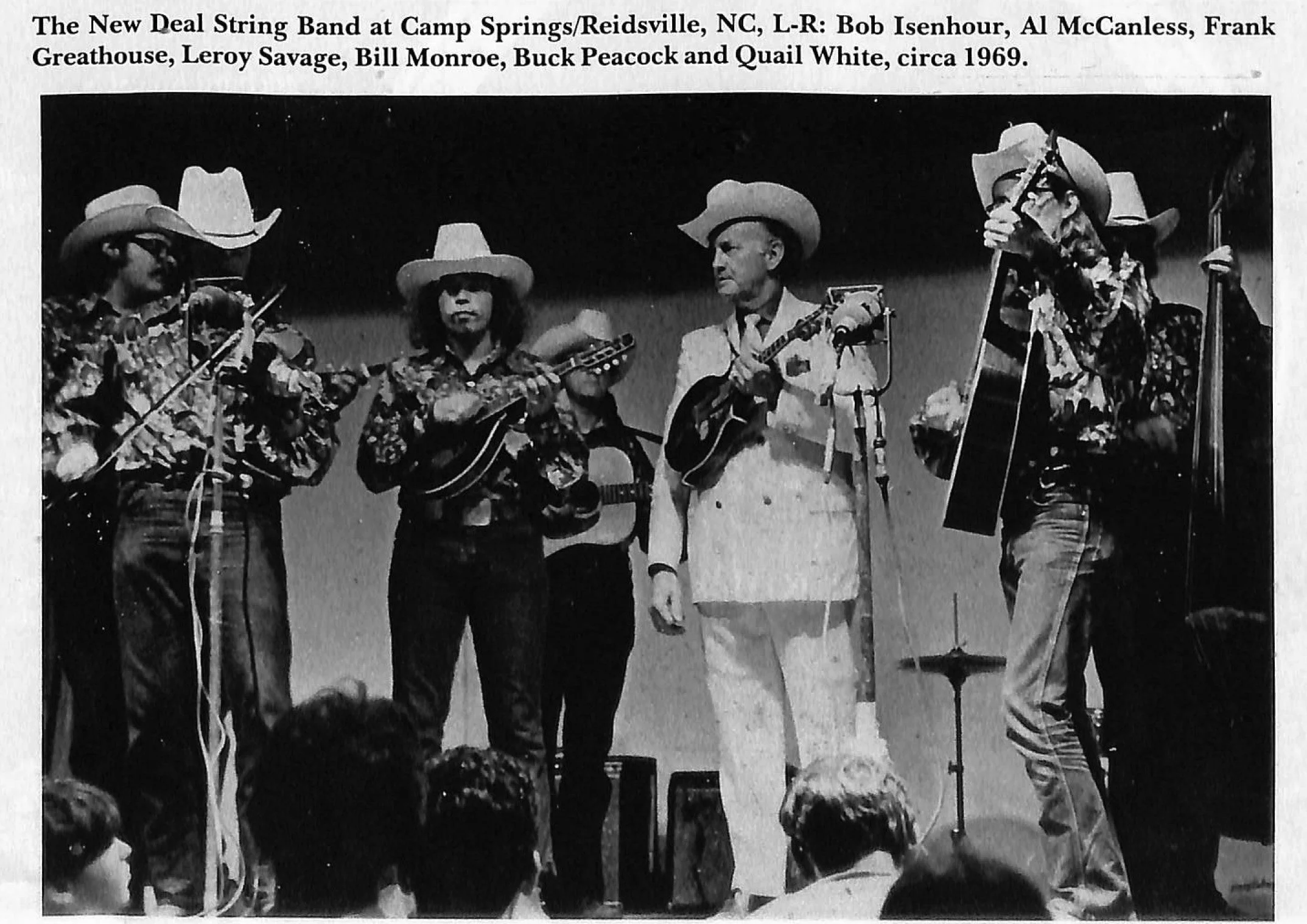
“Everybody was listening to rock and roll but we were all playing bluegrass, and we kind of wanted to combine the two things,” said Al. “A lot of other people were doing the same thing, like the Charles River Valley Boys.”
“I don’t think there was a sense that we were carving out new territory,” added Quail, “as that there was a sense that the things that we did had their own place. Everyone was real aware of what was going on with the rest of the world, so it wasn’t just string music that was impacting our lives, there was a whole other pop culture thing that was very much a part of our lifestyle...back then you had to do your own thing. So our own thing was whatever we were listening to other than bluegrass. You could say that’s what happened with Bill Monroe. Bill had so much blues influence in his music, because that’s what he heard.”
The band played college and club gigs, and private parties, sometimes opening for groups like Sea Train, Goose Creek Symphony, and Poco, often traveling as far north as Bennington, Vt., in Quail’s ’67 Starlight Microbus, sometimes taking bets on whether or not the bus would make it.
On Dec. 2, 1969 the New Deal String Band played at Bill Graham’s Fillmore East, in New York City for a “new talent” night, and did extremely well. The audience loved them. “Unknowns show names a rock thing or two” headlined a blurb by Nancy Erlich in Billboard (Oct 10, 1970): The crowd greeted the New Deal String Band, a North Carolina bluegrass group, with an enthusiasm that contained elements of both sophisticated sarcasm and envious admiration. The fact remains that bluegrass is some of the funkiest stuff around, and the band and their material showed a kind of basic honesty that leaves an urban audience cheerfully confused.”
A scout for Sire Records was in the audience, was impressed, and talked to them about cutting a record - Sire would fly them up to New York, put them in a hotel-pay for everything. In early 1970 they went to New York and started recording. It was their first experience in a recording studio, and the engineer’s first at recording bluegrass, according to Buck. “They had no idea how to mix bluegrass...we did most of the nuts and bolts producing.”
In general the LP was well received, garnering a review in Billboard under the “Popular” category as a “special merit pick.”
“Bluegrass music isn’t usually talked about in the same breath as rock, but when the group is young and professional, and does Dylan’s ‘One More Night’ and the Stones’ ‘No Expectations’ right along with Bill Monroe and Jimmie Rodgers, then something’s happening here. Gene Knight on banjo and Al McCanless on violin, are two fine bluegrass swingers. And the whole group stars on ‘Whitehouse Blues,’ ‘Prisoners Song’ and more.”
Bill Vernon, in the Nov./Dec. 1970 Muleskinner News said: “Various major record labels and indeed producers of commercials, have lately been dabbing in bluegrass, using a banjo here and a fiddle there. But it’s been quite some time since a major record label (Sire is affiliated with London Records) has issued a whole LP of bluegrass music by a previously little known group. As the notes point out the New Deal String Band is a city bluegrass band and this is city bluegrass, but of a high order, with a personal urgency to it that is parallel to, though rather different from the best traditional classic bluegrass. Everyone here can really pick, and there is a great deal of well thought out, yet solid, supple, creative musicianship here, unlike many city groups of the ‘60s. The New Deal String Band doesn’t try to floor the listener with facile, flashy hot licks. The timing and the approach may be urban but the results are credible. The vocals by Leroy Savage are sung in a strong, smooth tenor pushed to its limits and occasionally just a bit beyond, in a style reminiscent of John Herald’s work with the Greenbrier Boys or reminiscent of some of the more straight-ahead vocals by the Kweskin Jug Band. Ardent traditionalists may not like this LP and some may have to find new terms on which to accept it. But the New Deal String Band is a far better than average group and this is an LP to be reckoned with.”
Having this recording out (bluegrass Sire Records SES 97024) made it easier for them to get booked at bluegrass festivals, and they were often hired by Carlton Haney and Jim Clark.
“[They] were the only two promoters who used us on a regular basis,” said Leroy—“and the only two who actually paid us. Carlton always loved the New Deal String Band for some reason. He said “These boys have got the rhythm.”
“He also thought I should be dressed up in an ape suit, and be put in a cage and play the mandolin, and be the ape man of bluegrass...” added Frank.
Most of the band felt that hostility toward their appearance was more prevalent at fiddlers’ conventions than at bluegrass festivals. Leroy got “punched out” a few times at fiddlers conventions. “Some drunk would come up and knock me up the side of the head...just because [I] had long hair.” In another more humorous incident Jim Watson recalled the time he was sitting next to a local woman at the Union Grove Fiddlers’ Convention while New Deal was playing a set during the determination of winners. “We were listening to the music, talking and having a big time. Leroy was singing in fine form. We asked [the woman], ‘Do you like this music’? And she stopped for a moment and listened real close, and said, ‘She sings good don’t she?’ ”
Frank remembered a jam session at the Galax Fiddlers’ convention where Leroy was attracting the usual admiring crowds with his high, powerful singing. “This guy was standing around and kept saying, ‘Leroy sing “Ruby,” Leroy, sing “Ruby” all night long, and finally Leroy turned around and said (to get him off his back), ‘I don’t know the words to “Ruby,” ’ and this old guy said ‘Hell, there ain’t but two words - Ru and bee.’ ”
“I don’t remember any hostility [at bluegrass festivals] to tell you the truth,” said Al. “I think everybody was a little paranoid back then, about having long hair. But every time we’d go on stage... we looked like a bunch of hippies for sure. And then Leroy would burst into ‘Little Birdie’ in the key of A—he could sing it up high, really straining his voice—and everybody’d go crazy. The people who liked traditional bluegrass liked us because we were young and looked funny, and then of course all the young people identified with us too.”
“People always liked to jam with us,” said Buck. “I jammed with Chubby Wise and people like that, and it was not unusual to go to a jam session and Don Reno’d be sitting there playing, and nobody ever complained about us playing. They liked us playing. Leroy would sing a song and everybody’d be amazed—so we had a lot of respect from just plain musicians. Once [people] heard us play, it didn’t really matter what we looked like because we actually did play pretty good bluegrass music, just plain bluegrass music...”
Every traveling musician has his or her own share of memorable gigs, and the New Deal was no exception. At various and brief times they worked with managers and agents-one of whom got them a string of “the four worst jobs we ever played.” One was at a rock and roll club, and when the owner asked them where their drums were they knew they were in trouble. Another was the non-commissioned officers club at Fort Lee, Va., when “Vietnam was in full bore.” as Quail put it.
“We drove in, set up,” he said, “and Frank had a ’fro that was about eight inches from his head; Leroy sang ‘Okie From Muskogee,’ and after that we were okay, but the gig was so crazy—it was just such a social interface, there was so much tension in the room—that Al couldn’t stand it anymore; he leaped down off the stage and ran through the crowd playing his fiddle—it was amazing! The night McCanless just went crazy...but they loved it at the end of the night.”
There were gigs that were more fun like the 10th wedding anniversary gig at a “Scottish castle” complete with turrets, tapestries, and 25 rooms near Waynesboro, Va., and the Chicken Packers New Years Ball in Douglas, Ga. “We played and they loved it,” said Quail. “String music once again, well executed, knocks ’em dead. As strange as we were, and as hard as we worked to be strange looking, the music usually overcame all of that—because the band was hot. I sort of reveled in the differences and the ability of music to transcend all that, which it did, repeatedly.”
Around 1972 the band began to wind down. There had been several personnel changes—Gene Knight left to go into the Navy and Bob Isenhour took his place on banjo; Al McCanless quit and Bob Hoban took his place on fiddle until he and Buck left to go to Chicago where they formed the band Rosebud, subsequently moving to Atlanta; Quail left to join Eddie Adcock and the IInd Generation.
According to Buck, there had been plans to make another recording which Sire would put out. “We were going to do a Heaven and Hell record. “One side was going to be all gospel songs and the other side was going to be [songs like] “Friend of the Devil” and “Oh Death”— it was a concept album. [But] Sire decided not to do it. They didn’t understand us. They really didn’t know what bluegrass was, they just knew that at the Fillmore we had brought the house down with ‘Orange Blossom Special,’ and we got a good writeup in Billboard, so they thought they had something here—something new, which if they’d stuck with it and developed us they could have probably turned it into a money maker. We thought of taking [the record idea] to another company but our problem was we were never real focused on what we were doing...” According to the band members, differences of opinion on the direction they should take (they experimented with going electric for a while), personality clashes which, unresolved over time, took on more significance, lack of a business sense and commitment to being a full-time professional bluegrass band, lack of enough money as band members’ needs for financial security increased—all these led to the gradual demise of the band. In many ways they were conflicts that all bands go through sooner or later, and sometimes the only resolution is had by breaking up.
All the band members except for Buck, still live in North Carolina. Al and his wife, Millie, and their three children run a family pottery business, Dover Pottery, in Seagrove. He plays the fiddle with the Bluegrass Experience, an Irish group, Celtic Jam, a rock ’n’ roll band, Steel Country, and with Alice Gerrard. Buck lives in Atlanta, Ga., where he owns a bicycle shop. He is heavily into antique bikes and bike memorabilia. He plays bluegrass once every two or three weeks, and as he puts it, “It’s a fun band with no aspirations of making the big time.” He plays guitar in the Hot Club of Atlanta, a weekly ’30s swing music jam started by Frank Hamilton (of Weavers fame). Buck plays at a music club in Decatur, and he and his wife, Judy, have three children. Leroy lives in Green Level, is a partner in the Deli Box restaurant, and a member of the occasional Green Level Entertainers bluegrass band. Quail has been living in Boone since 1974. He is Assistant Director of International Programs and foreign student advisor at Appalachian State University. He plays in a band called the Meat Camp Art Supply “when there’s only four of us; when we have the full complement of seven, it’s Alric and the Smokey Mtn Visigoths. We call it ‘bent mograss’ when it’s the big ensemble...” He and his wife, Pat, have two children. Frank and his wife, Phyllis, live in Wilmington, where he owns a sign and display business. He enjoys sailing and plays in a band called Big Slinky and a World of Trouble. Gene lives in Marshville, and manages a diagnostic lab for a poultry company. He and bis wife of 25 years, Penny, have two children. He plays music “about once a year,” and is looking forward to the big New Deal String Band reunion and the chance to play a whole lot more.
The New Deal String Band reunion concert is set for September 26, 1997 at the Art Center, 300 G East Main, Carrboro, NC, 919-929-2787.
[On behalf of the band, the article is dedicated to the memory of Bob Isenhour who died on March 16,1996.]