
Charlie and Ira — The Louvin Brothers
By Suzy Lowry Geno
Reprinted from Bluegrass Unlimited Magazine
March 1983, Volume 17, Number 9
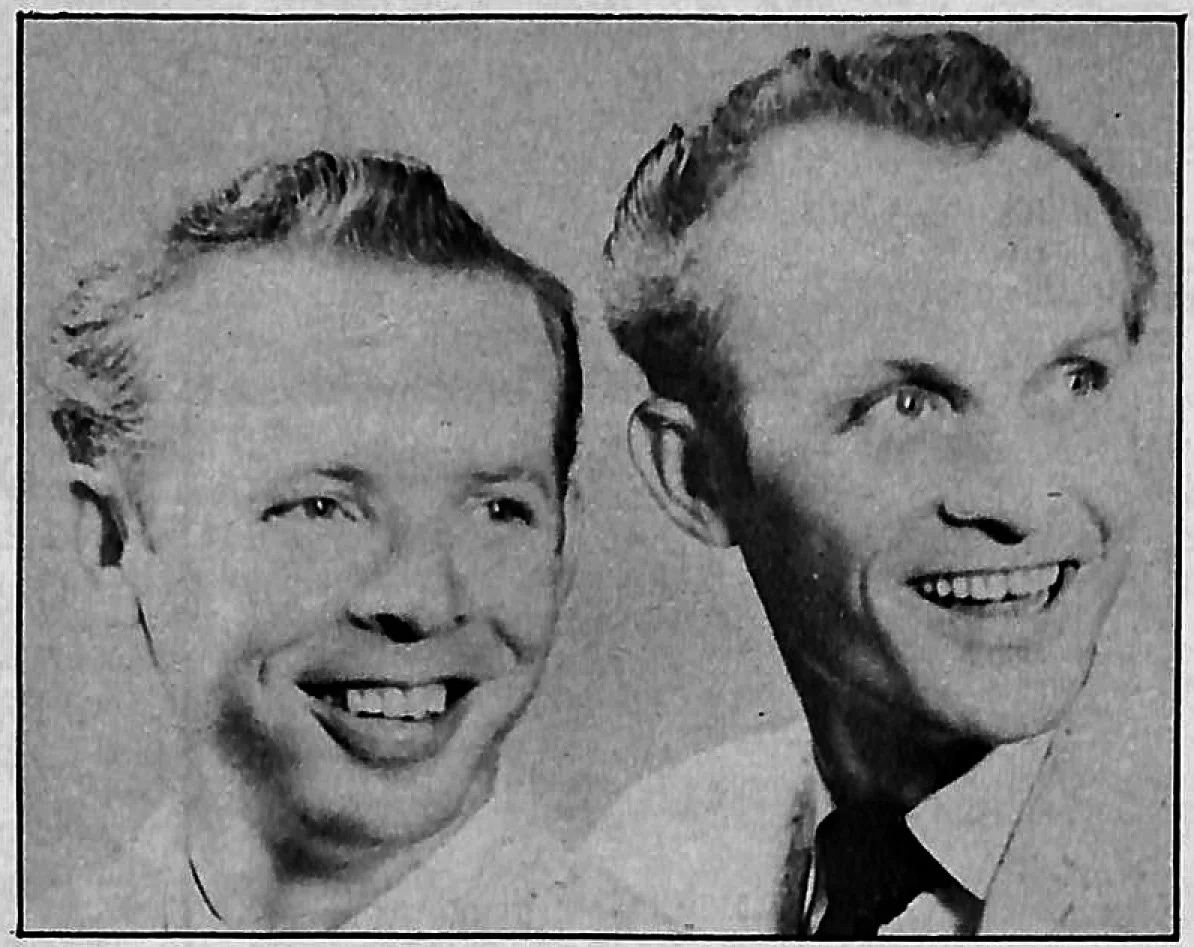
During the mid and late 1950s, Ira and Charlie Louvin were riding the crest of their popularity as a duet, and they seemed to be enjoying every minute of their hard-earned success. They had reached the pinnacle of being regular performers on the Grand Ole Opry. They were voted “the most programmed duet” by disc jockeys across the country for five years. They had written hundreds of songs which were published by the prestigious Acuff-Rose Publishing Company.
Ira Louvin's name is frequently mentioned along with those of Bill Monroe, Bobby Osborne, John Duffey and Red Allen as one of the greatest tenors in all of traditional music. In 1956 alone their single recordings of “Hoping That You’re Hoping,” “I Don’t Believe You’ve Met My Baby,” and "You’re Running Wild” all made the top ten charts!
They had begun as two fresh-faced country boys singing simply as they played guitar and mandolin, displaying true and intense emotion in their gospel as well as their “love” songs. Yet their natural sound later became overshadowed by studio musicians and other Nashville frills in the recording studio. Their careers also became clouded with personal problems that finally led to the downfall of the Louvins as a duet. They disbanded more than a year before Ira and his wife Anne died in a Missouri head-on collision that killed four other people. What really happened in the lives and careers of these two giants of early string music?
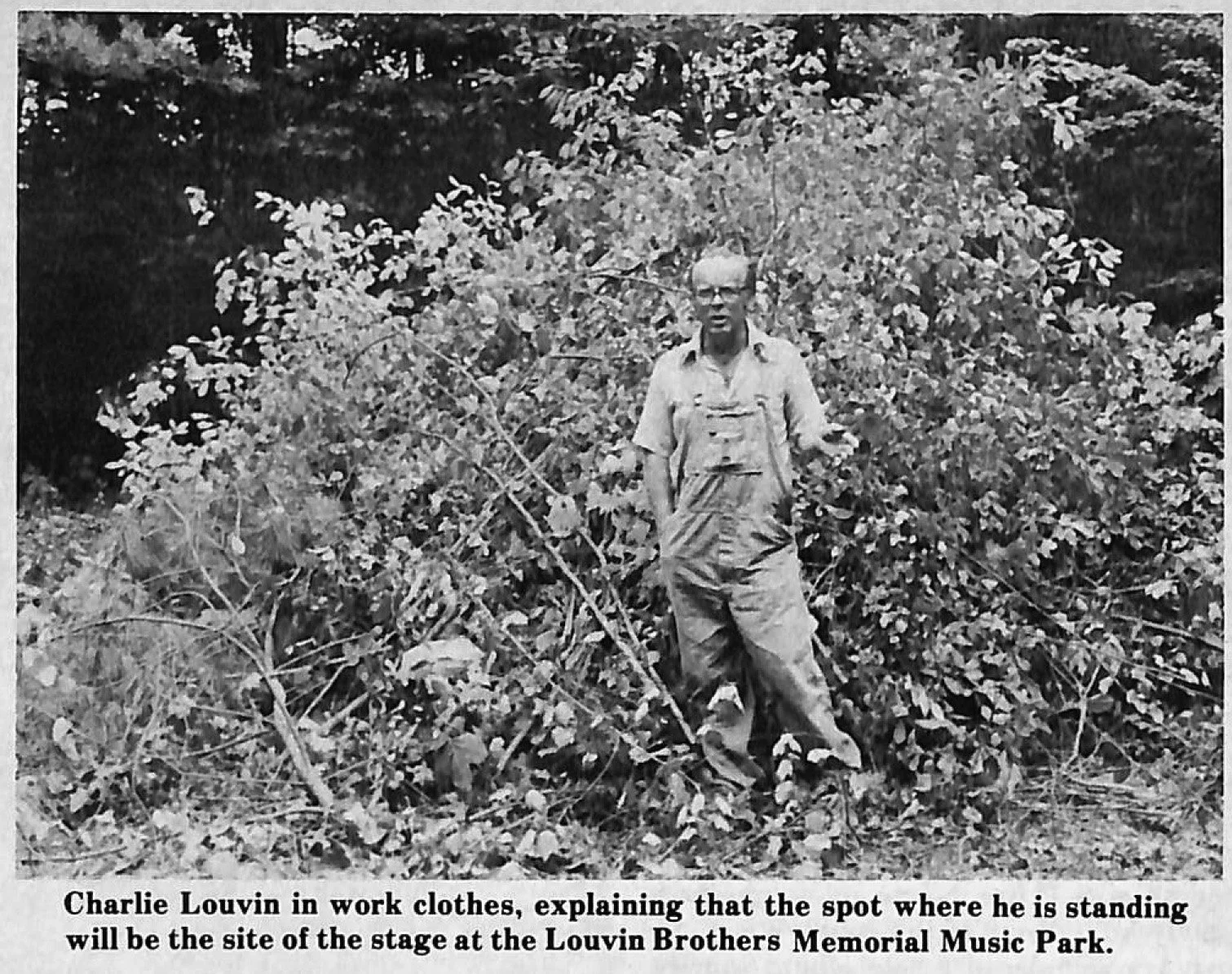
Recently Charlie Louvin slid from the seat of his new Allis Chalmers tractor at his birthplace farm near Henegar, Alabama. He mopped the perspiration from his temples before he began talking about Ira and his own dreams for the music park which he is building in Ira’s memory.
“You know, Ira and I were just simple country boys. There were seven of us kids in the family and we were what you would call ‘dirt poor.’ I’ve often wondered if maybe that’s why Ira had problems later on. The music life has a lot of ups and downs but sometimes it’s the successes that are the most hard to handle. Music was our lives; maybe more so for Ira than for me. No matter what we tried or what other jobs we held, our lives centered around our music.
“I’ve been singing for as long as I can remember. When we became teenagers, our daddy thought that we were spending too much time with our music. But the more he talked against it, the more determined we were to sing and play. On Friday mornings, we’d go out the front door as if we were going to school. Ira would circle back, sneak in the back door, and ‘borrow’ daddy’s old banjo.
“At noon on Fridays, the teachers would let us open the partition separating the two rooms of the school and we’d all sing and play for the rest of the day. We sang old songs like “Kneel At The Cross,” “Are You Washed in the Blood,” and other songs we had heard all of our lives. When daddy found out, he decided that we might as well just stay home on Fridays and help with the farming.”
Charlie and Ira’s father, Colonel Loudermilk, played drop-thumb, clawhammer banjo in the Uncle Dave Macon-Grandpa Jones style. He stuck to his belief that music was for recreation and that farming would have been a more honorable profession for his sons. But Charlie later had the pleasure of introducing his father on the Grand Ole Opry on three separate occasions and he counts those as some of the proudest moments of his life.
Charlie and Ira’s first “professional” appearance was at a fourth of July celebration in 1941 in Flat Rock, Alabama. Charlie was 14 and Ira 17. They sat in the middle of a “flying jenny,” a large wooden circular platform. People paid a nickel for a five-minute ride. They sat on old church pews lining the circle, a mule provided the pulling power and Charlie and Ira were the merry-go-round’s music. They played two songs during each ride and worked all day for the grand total of $2.00 each.
Ira soon married and moved to Chattanooga. Charlie followed a short time later and together they discovered the weekly amateur contest at the old American Theater on Broad Street. The grand prize was a 4:30 a.m. live, fifteen minute radio show on the then 250-watt WDEF. The catch was the fact that you had to win three Saturdays in a row.
The first two Saturday nights, Ira and Charlie won easily with their comical renditions of “Hole in the Bottom of the Sea” and “Johnson’s Old Grey Mule.” The third week they sang what would one day be one of their most remembered hits, “Knoxville Girl” —and the radio show was theirs.
For six months, they rushed to do the radio show each morning, hurried home to eat breakfast, and then worked a regular shift at a cotton mill. When show dates began pouring in because of the publicity of the show, the boys decided that the “big time” had to be right around the corner. They quit their jobs at the cotton mill, and, just as quickly, the atmosphere seemed to change. Things just seemed different when Ira and Charlie found themselves depending on their music for everything.
Their experiences did give them ample time to hone their talents to perfection as they performed as a duet or with groups such as the early Foggy Mountain Boys, (no relation to the later Flatt and Scruggs group). It was also during this time that Charlie and Ira decided that the long name of Loudermilk might be hampering their career. They changed their professional name to the much shorter “Louvin,” hoping that it would be easier for the public to remember and pronounce.
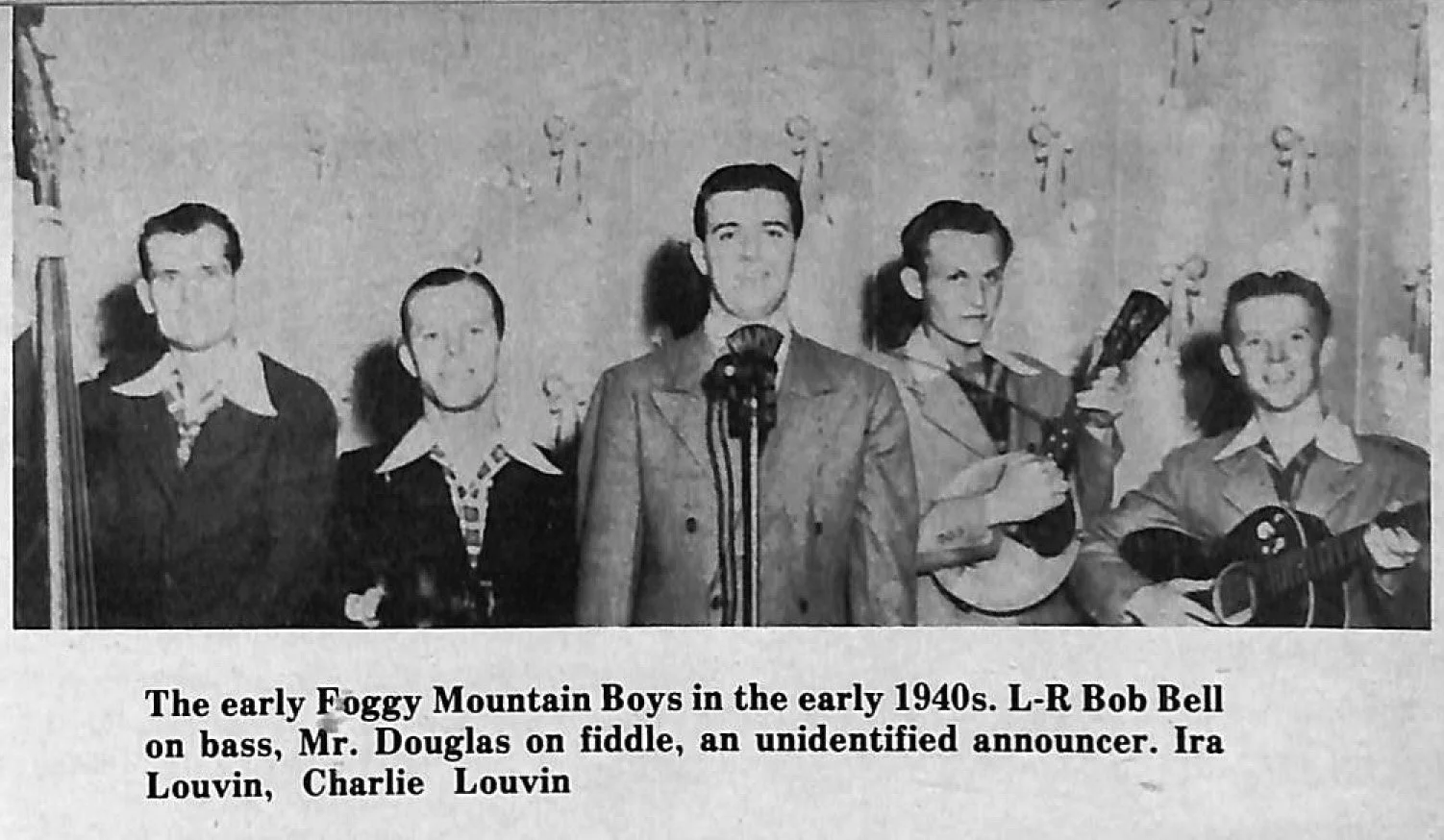
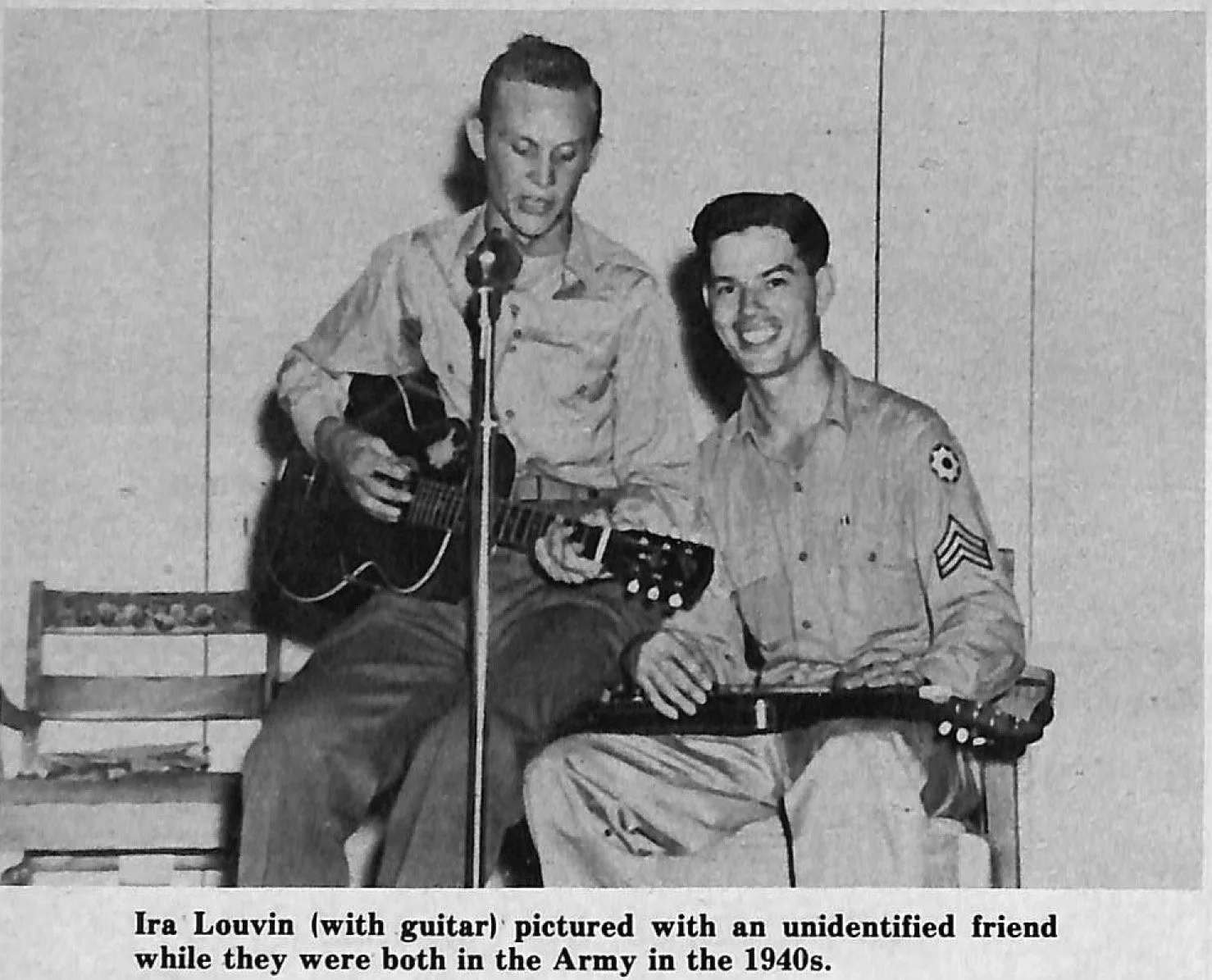
Ira was drafted. Then in 1946, Charlie entered the Army-Air Force RA’s. When he got out of the service, he found Ira working in Knoxville, playing mandolin and singing bass with Charlie Monroe’s group. Ira’s voice range was so wide that he had no trouble singing an adequate bass to Charlie Monroe’s even higher pitched group.
Ira quit Monroe’s band and he and his brother put together a radio show for Cas Walker on WROL in Knoxville. They still barely made ends meet financially but 1947 was a red-letter year as a “hand full” of their songs were published by Acuff-Rose.
One morning, Ira and Charlie were sitting in a diner sharing a box of corn flakes for breakfast. A man walked in wearing a tailored suit, a gleaming white Stetson, and diamond rings on both hands. He introduced himself as “Smiling" Eddie Hill.
“We didn’t know then that the fancy clothes, the diamonds, and the big car were all borrowed,” Charlie laughingly recalls. “But Eddie was good for our careers. He got us two daily radio shows on Memphis’ WMPS and every day from 1:00 until 1:15, we sang on the air with Eddie as the Lonesome Valley Trio.”
“I got married in 1949 and those regular paydays were really helpful. We started at $20.00 for a seven-day week and worked our way up to $50.00. In one day, the station received over 4,000 pieces of mail about our show.”
In 1950, Ira and Charlie hosted the popular, “Mid-Day Merry-Go-Round” in Knoxville. But after Eddie Hill moved to Nashville to work at a larger station, times for the boys became rough once again. Charlie and Ira finally took the civil service exams and went to work for the Memphis post office. On weekends, they played any show, club, or church that asked.
So many times, fame and fortune seemed to be just one jump ahead of the Louvins. With Fred Rose’s influence, they recorded a number of sides for MGM. The songs clearly illustrated that their unique harmonies had been greatly influenced by earlier brother duets and the Carter family— but they could not be accused of copying anyone. Their sound and style was truly their own, perhaps influenced more by what they had seen and felt as poor youngsters in the country, than by any group or person that they had heard.
In early 1952, WMPS’s program director George Faulder hoped to syndicate a radio show similar to Charlie and Ira’s daily program. They called the shows “Songs That Tell A Story” which was also the title of their just-published Acuff-Rose songbook. But the show only lasted for three weeks on its test station, WZOB in Fort Payne, Alabama. George Faulder left WMPS for a better job in Texas and without his connections, financing for the syndication never came through.
(Six of the original tapes of these old radio shows were released on a commemorative album, “Songs That Tell A Story” on Rounder Records in 1978. They are fine examples of the purity of the Louvin’s sound with Charlie and Ira accompanied only by their guitar and mandolin as they sang such songs as “What A Friend We Have In Mother,” “I’ll Never Go Back,” “The Family that Prays,” and the old Monroe Brothers’ classic “Sinner, You’d Better Get Ready.”)
1952 turned out to be a pretty good year as Ira and Charlie landed a recording contract with Capitol Records, but once again there was a catch. They were limited to recording gospel songs because Capitol already had one “country duet” in Jim and Jesse McReynolds. Ironically, Jim and Jesse had landed their Capitol contract by their singing of a Louvin Brothers’ song: “Are You Missing Me?”
Charlie and Ira recorded their “Tragic Songs of Life” album in 1952. Capitol later released an album with “The Family Who Prays” as its title and consisting primarily of songs written by Ira and Charlie, such as, “Love Thy Neighbor As Thyself,” “Born Again," and "Preach the Gospel."
Disaster of a sort hit once again in 1953 when Charlie was recalled to the service for duty in Korea.
“To put it mildly, I didn’t want to go!” Charlie says. “Our careers seemed to be just taking off. And I felt that I had already served my time, but I lacked one month of active duty in my previous service. They must have really wanted me. Betty was three months pregnant with our first child and I was only three weeks shy of my twenty-seventh birthday, which was the age cut-off date!”
Charlie shipped out three weeks after the release of “From Mother’s Arms to Korea.” While in Korea, Charlie once again met Jesse McReynolds and they often performed together to ease the tension brought about by the daily brutal conflict and the disruptions in their own careers and personal lives.
When Charlie returned home in 1954, he had the first of three bouncing baby boys waiting for him. Betty had even more good news waiting — she had saved all of the royalties from Capitol and Acuff-Rose. For the first time, they had money in the bank and their mobile home and their car were paid for.
Ira was working in the Memphis post office and hosting a gospel music radio show. Charlie remembers, “I went back to work at the post office but Ira said that we needed to decide once and for all if music was to be our career. At that time, I was happy with my little family and I think that I could have just gone on working at the post office and playing music on the side. But music was the compelling, driving force in Ira’s life. He said that he had heard that Birmingham was the place to be.
“Now, every group or performer has to have a big Silver Eagle bus or a fancy van. Back then, all singers had to have Cadillacs. So, I bought a Cadillac and we headed for Birmingham. Radio station WVOK was then owned by Mrs. Bill Bends and we had a sponsored program there. We made $100.00 a week but by the time that we hired a bass fiddler and lead guitarist, we didn’t have anything left for us. But we felt certain that we’d make it up in show dates.
“We didn’t realize that Rebe [Perkins] and Rabe Gosdin had sung so many Louvin Brothers songs that people in the Birmingham area thought that we were copying them! I believe that if we cut a record at ten in the morning, they had it ‘covered’ by noon.
“Everybody thought that we had it made because of our recording contract and our radio show —but we didn’t. In just six months we had gone through all of our savings, sold our trailer, and almost starved!
“In a last ditch effort, we decided to try the Opry one more time. From 1947 to 1954, we had auditioned for Jim Denny [Opry manager] at least fifteen times. Anytime we were in Nashville, we went by. Sometimes we had to borrow Lonzo and Oscar’s guitar and mandolin but we never let an opportunity slip by. Hank Snow, Roy Acuff, and Ernest Tubb had already recommended us to Jack Stapp but he just couldn’t seem to fit us in.
“Like so many others at that time, we were caught in the middle. Gospel musicians shied away from us because we played mandolin and guitar. Country didn’t want us because we had sung so much gospel. We were in a category that just didn’t fit. I’m afraid that young people today just don’t realize how early bluegrass musicians had to struggle to even put food on the table. We were misfits in our own world, and, at that time, the rest of the world just lumped most of bluegrass, country, and a lot of gospel, all together under the label ‘hillbilly.’
“Finally, Ken Nelson called Jack Stapp and told him that if he didn’t want us on the Opry, the Ozark Jubilee certainly did. At that time, the Opry was really concerned about the competition from the Jubilee, so Jack said to tell us to come on up. He didn't realize that Ken was bluffing.
“Even on the Opry, we were limited to gospel for a long time. We finally lost that stereotype when we recorded “When I Stop Dreaming” in 1955. The next year we had three top ten hits.”
The Louvins then had a string of hit singles and albums in both gospel (“Weapon of Prayer,” “He Included Me,” “Thank God for my Christian Home”) and secular music (“Call Me,” “My Baby’s Gone,” “If You Love Me Stay Away,” “Ruby’s Song,” “Childish Love,” and many others).
“But even though we began making $1,500 a night for some shows, (a phenomenal figure to us in the late ’50s), we began to get more than a little frustrated,” Charlie said. “As we moved on toward and into the ‘60s, it seemed our records became more modern sounding. On many of our recordings, they added all sorts of studio musicians and Nashville back-up singers. Ira’s fantastic mandolin breaks and much of his playing was completely lost. Sometimes, we sounded almost too good to be us."
According to Charlie, the omission or make over of their natural sound and lack of recognition for Ira’s true musicaltalent, hurt him deeply. But Ira’s problems were not confined to those concerning his artistic expression in music. His deeply religious upbringing made him acutely aware of his three failed marriages. His problems with alcohol deepened. He sometimes became rude on stage—the complete opposite of the sensitive, compassionate man that was really Ira. He often missed show dates completely and the fans and the money began to dwindle. Ira and Charlie began to argue about the directions which they wanted their careers to take.
On their last show together on August 18, 1963, they were paid only $250.00 which barely covered expenses. Charlie finally accepted the idea that “promoters won’t buy trouble” and he reluctantly launched his solo career with “I Don’t Love You Anymore” as his first big hit.
Ira soon started putting the pieces of his own life back together. He and his fourth wife Anne began enjoying their newly built home in the country.
Ira completed a solo album shortly before his fatal accident. Anne wrote several of the songs and Ira had been enjoying a better state of mind and had written three himself. It seems now that it was almost prophetic that the last tracks of the album included “Life Is Too Short,” “The Bottom of the Bottle,” “The Master of the Universe,” and “The Right Side of the Road.” All were recorded on March 4, 1965 and the album was titled upon release: “The Unforgettable Ira Louvin.”
Three months later, on Father’s Day weekend, Anne and Ira were sitting in the backseat of a car, returning from Kansas City where they had been to check on a proposed show. No one in the car had been drinking. Suddenly they were hit head on by a car whose two occupants were later judged as being nine times over the legal Missouri alcohol limit. All six in both cars were instantly killed.
Charlie sadly remembers: “Ira’s drinking had nothing to do with the accident, but his problem certainly did cause the break up of the Louvin Brothers. It’s ironic that his life ended because of someone else’s drinking.”
After Ira’s death, Charlie recorded an album “I’ll Remember Always” in Ira’s memory. Jim and Jesse McReynolds recorded a Louvin Brothers Tribute album in 1967.
Charlie continued recording and appearing as a country act. During his stay on Capitol records through 1975, his songs remained on the charts for the incredible length of over eight years.
He recorded numerous duets with country singer Melba Montgomery (with whom he shares a Grammy award) and he also recorded “Love Don’t Care” with Emmylou Harris, who also performs many other Louvin hits. Charlie adds that perhaps the highlight of his life was when he accepted the award in 1979 as he and Ira were inducted into the Songwriter’s Hall of Fame, the highest award given songwriters.
Charlie’s latest recordings have resumed much of the old-time sound. Among his latest releases is “Northwind” which he recorded with Jim and Jesse McReynolds. But even with his busy recording schedule and appearances throughout the United States, Europe, and Canada, Charlie’s primary concern during the past few months has been the building of the Louvin Brothers Memorial Music Park. He tells why: “We’ve got to bring the music back to the people. There’s just too many ordinary people like my mama and daddy who can’t drive to Birmingham or Chattanooga, hunt for a parking space that will cost them $5.00, and then pay $10.00 to $20.00 for a ticket to a show of packaged, canned music.
“The bluegrass festivals have proven that audiences and performers can once again feel the closeness, the togetherness, that Ira and I felt when we played and sang on Friday afternoons at Spring Hill School. It’s that special feeling that folks had when they gathered on their front porch, propped their feet on the rail after a hard day’s work, and sang and played away their heartaches and troubles.”
Ira and Charlie Louvin will always be remembered by bluegrass fans as two whose lives and music best illustrated the true natural emotions, hopes, and desires that throbbed and sometimes even tore apart the hearts of everyone who has faced life’s struggles and enjoyed its triumphs.
Although Charlie continues his career now labeled as a “country artist,” his songs, his lifestyle, and his dreams constantly evoke memories of two, straight-off-the-farm fresh scrubbed young men who hitch-hiked into Tennessee and forever entered the hearts of true music lovers everywhere.