Mike Lilly
By Robert Leach
Reprinted from Bluegrass Unlimited Magazine
November 1986, Volume 21, Number 5
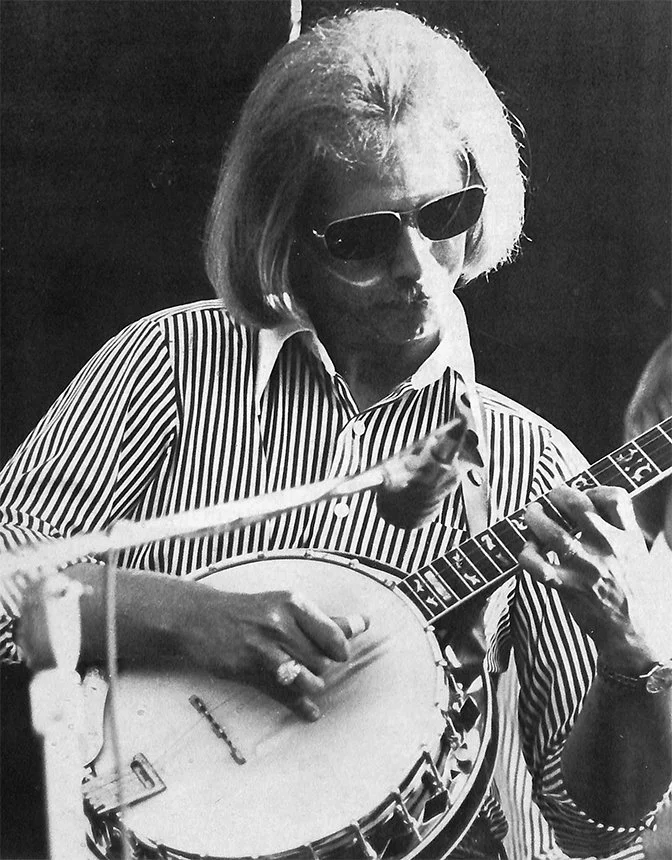
Mike Lilly has long been regarded by many as one of the world’s foremost bluegrass banjoists. Few who have heard him in concert would argue that his technical prowess, creative ability, and devastating power of attack are anything short of awesome at times. As a gifted instrumentalist and prolific recording artist, his contributions to bluegrass music have been substantial.
On and off stage Lilly exudes an enormous amount of energy and shows a high degree of individuation in all his opinions and activities. He’s an inscrutable one of a kind character that seems to be guided by some special star of his own in bluegrass music.
What probably paved the way for Mike’s early acclaim as a super-picker was his precocious mastery of the difficult Reno style of banjo picking, more specifically, Mike shared Reno’s love for improvisation on the instrument. When Lilly hits the stage he kind of explodes musically—frequently creating new licks and arrangements on the spot for the audience.
“I’m always taking chances when I’m picking,” says Mike. “I’m always trying to mix things up a bit. I never really know how I am going to play a tune before I start. Some licks I hit I won’t know I played at the time. Somebody will tape me picking. I’ll go back over the replay and hear some new lick I hit. Now I play ‘me’ better than anybody I know, but it will be all I can do sometimes to figure my own new lick out later!
“Although the new licks keep coming, continues Mike, “I’m not playing a lot of the wilder stuff I used to years ago. I’m feeling and hearing the music a little straighter and more traditional now. On the ballads and tear-jerkers I still play me’ and some occasional Reno and Osborne, but I try to work it in more sparingly to get a more tasteful sound. Of course on the faster stuff, Scruggs is hard to beat. The last several years I’ve been playing a little more of the Scruggs style banjo than I did ten years ago.” Mike reverently credits his father, Bob Lilly, as the most important influence in initiating his long and serious involvement with bluegrass music.
“Dad originally mined coal in Harlan County for a living. It was hard work but his first responsibility was always to support our family and I respect him for that. When I was four, he moved our family north to Dayton, Ohio looking for a new line of work. So we’ve lived in Dayton ever since we left Kentucky in ’54.
“It was Dad,” says Mike, “that really taught me how to play the banjo. He picked the banjo himself and was a real Don Reno freak. I was eleven when he got me started. My hands were so small that he had to cut some picks down to size special for me. The first tune he taught me was 'Home Sweet Home’ —then ‘Cripple Creek’ and ‘John Henry.’ ”
Young Mike Lilly turned out to be a very quick learner on the five string banjo. Mike soon found himself accompanied by his father on guitar and younger brother Keith on mandolin. Less a bass player, the Lilly Family Band managed to fall into a number of radio, TV, and country music showcase performance situations in the southern Ohio area.
“We played a lot of shows like that for about a year,” recalls Mike, “but by the time I reached twelve I was burnt out on the banjo! I laid it down five years to play guitar in some rock bands. When I hit seventeen though I suddenly picked up the five again and got interested in bluegrass music once more. I got a job right off picking for a Dayton bluegrass band called the Powell Brothers.
“I got Red Spurlock’s place on banjo when he left them. The band included Ed Powell on guitar and his brothers Jack on bass and Odell on mandolin.
“One of the things I learned playing with the Powell Brothers was how to sing baritone. By the way, I’ve always thought Eddie Adcock was the best baritone ever in bluegrass music.
“A second thing I learned picking for the Powell Brothers,” explains Mike, “is what a tough business bluegrass music can be at times. One night just a mess of truckers and cops got into it in this one Dayton bar we had been picking at regular. We were picking on stage and looking down at them boys. They were going at it like cats and dogs. Before it was over, some cop got mad and fired his gun. His bullet grazed me in the leg and went right through Jack’s new bass. Lord, I cut my teeth on some good ones that night!”
After his stint with the Powell Brothers, Lilly teamed up with Dayton Dobro man Gene Sweet and continued to work the Dayton east end ‘tavern circuit.’
“Believe it or not,” claims Mike, “the name of our group was the Bluegrass Unlimited. The rest of our group included Oliver Whitsan on guitar and Art Wydner on bass. I guess it was around 1968 when we all got together.”
It was during his association with Gene Sweet that Lilly first met mandolinist Wendy Miller. Their meeting would prove significant insofar that Wendy and Mike over the next few years would produce a lot of good music together.
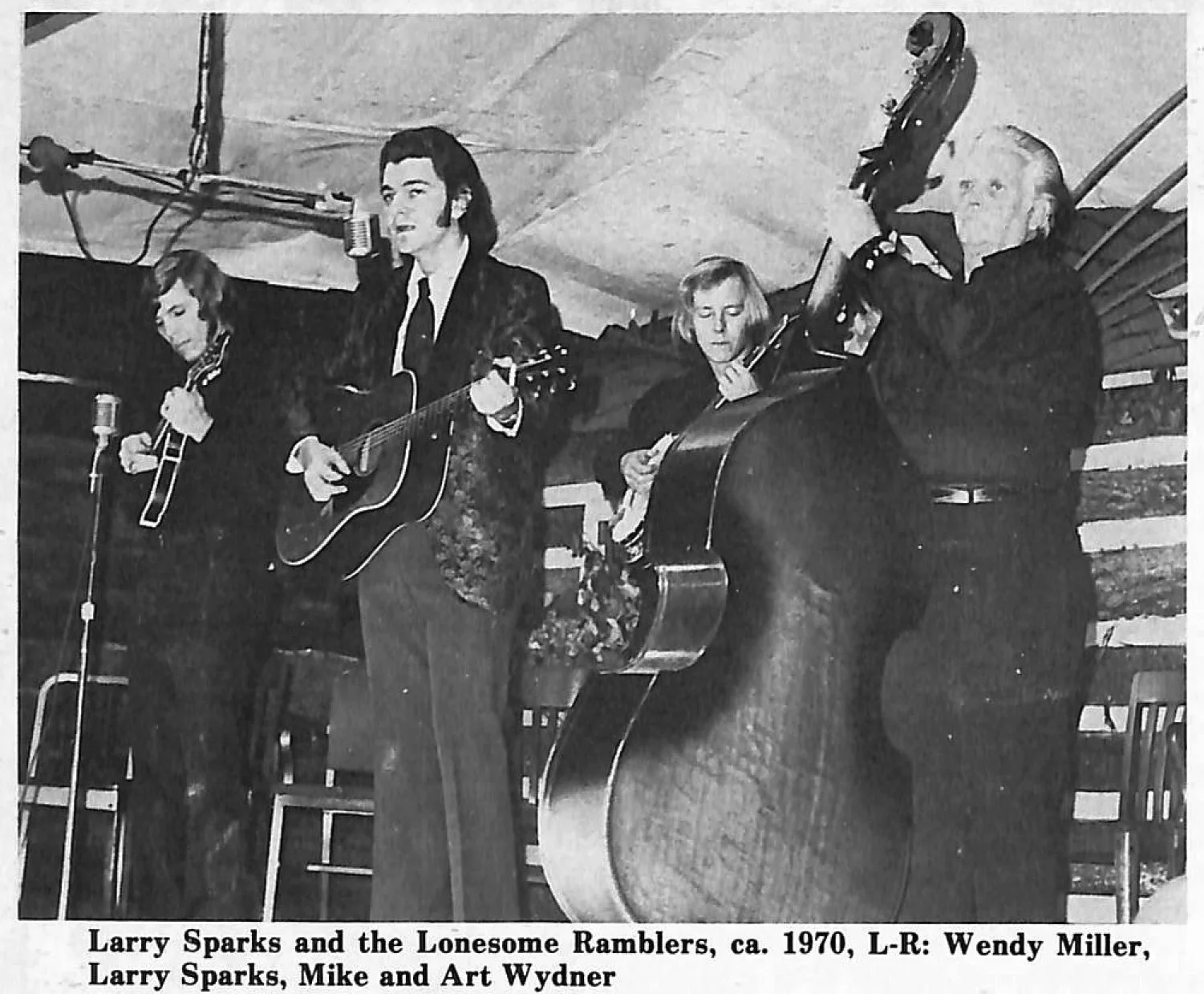
“I met Wendy in 1969,” explains Mike. “Wendy had been doing some picking with Larry Sparks. Wendy touched base with me to tell me that Joe Isaacs had just left and Larry was looking for another banjo man.
“I think it was in late 1969 when I joined Larry,” adds Mike. “What can I say about Larry Sparks? I just love the man’s singing. Who wouldn’t? And of course he’s just one hell of a guitar picker.
“Larry Sparks and the Lonesome Ramblers stayed busy all the time. Even way back then, Larry Sparks was a hot item. The band would play one show and get four new bookings out of it. I should mention that Art Wydner was Larry’s bassist at this time. Larry, Art, Wendy, and myself—we all clicked personally. We had fun and that came across to the audience in a good way for us.
“Wendy and I added something a little different on top of Larry’s lonesome Stanley sound back then,” exclaims Mike. “I played ‘me’ with again a little Reno, Crowe, and Osborne thrown in. Wendy played his straight Monroe style mandolin. I think our mix made for an interesting and exciting sound.
“Those four years I played with Larry were great. I loved his music but my musical tastes were beginning to turn more in the direction of what the Country Gentlemen were playing at this time. They were doing stuff that was more complex like starting in a B chord and ending on an E chord.
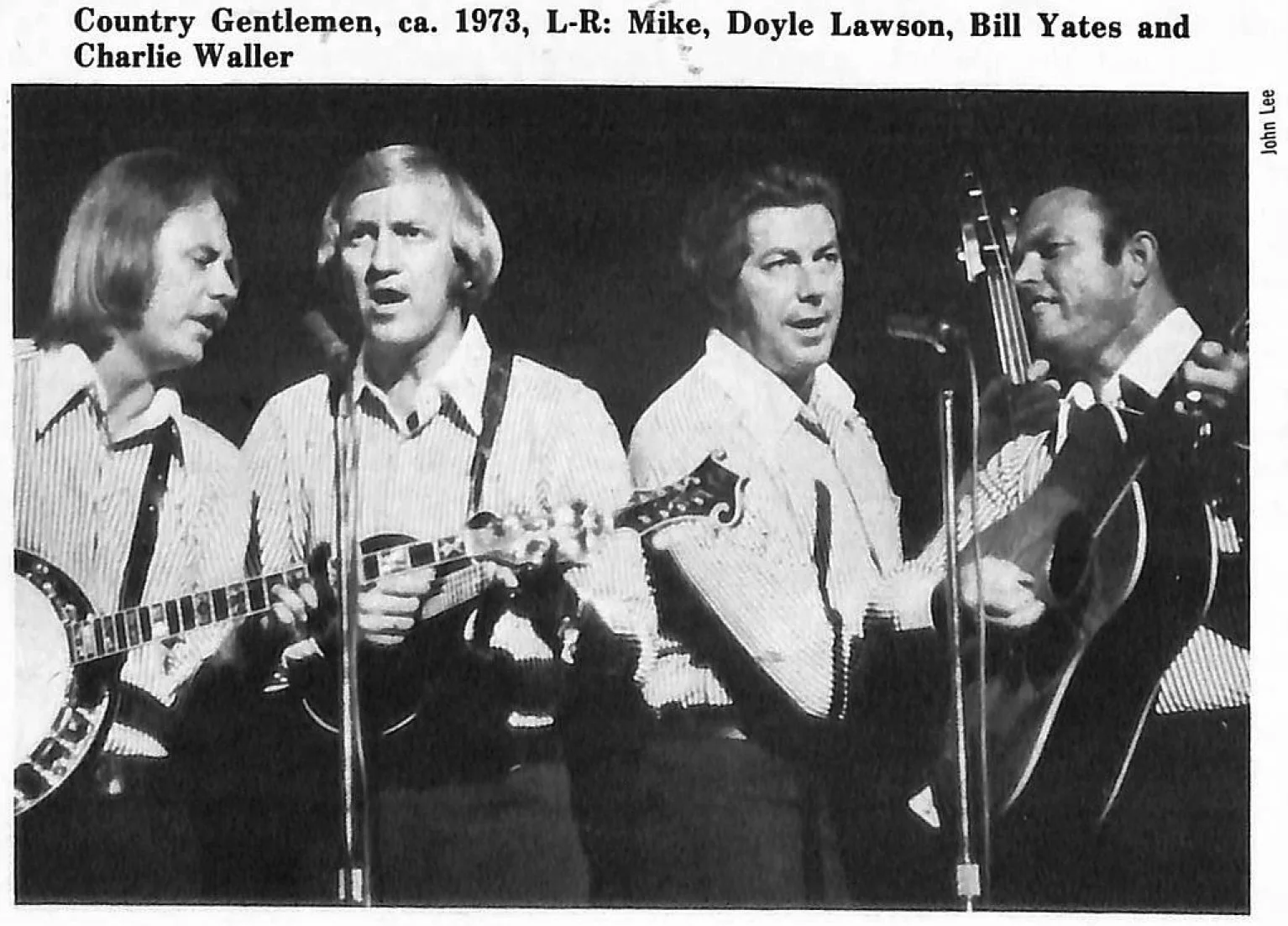
“I stayed with Larry until May 24, 1973. On that day, my birthday, I joined the Gentlemen at Ralph Stanley’s festival.
“At this time the Gentlemen had Doyle Lawson, Bill Yates, Charlie Waller, Jerry Douglas, and Ricky Skaggs. I succeeded Bill Emerson.
“The first gig I played with the Gentlemen was at the Country Palace in Columbus, Ohio. They got me there a few hours early to break me in on their material. I walked in there and laid it down on the banjo the way Adcock had done it. I think it shocked them a little bit.
“Playing with the Gentlemen was just a super experience. About seven months after I joined them though, my wife at that time had a bad miscarriage. I loved all the Gentlemen to death but with me in D.C. all the time, and her back in Dayton going through that—it was too hard on everybody. I had to quit. In looking back on things, I regret having had to give those guys such a short notice. At any rate I called them, Skaggs drove me to the airport —and that was that.”
Upon his return to Dayton, Lilly decided to call it quits for good in bluegrass music. He took a job as auto mechanic for a local 76 station with all intention of settling down to a normal and sequestered lifestyle.
“But,” says Mike, “about a year later I stumbled into a Valley Ramblers concert on the way home from work. Noah Crase, Paul Mullins and the boys were picking at one of those shopping center grand openings nearby. The place was packed and those boys were just flat burning it right to the ground! Crase saw me out in the crowd. Even though black with grease from head to toe — he told me to come up and pick some on his banjo. I did and the crowd really showed their appreciation. I got the bug again to get back into bluegrass music right then and there.”
Lilly rejoined Larry Sparks in August 1975 but by March, 1976 he and Wendy were ready to cut out on their own. “Larry knew Wendy and I were leaving,” says Mike. “He knew Wendy and I had already signed a contract for a European tour. He had us already replaced before we gave our notices. It was a friendly and professional parting.
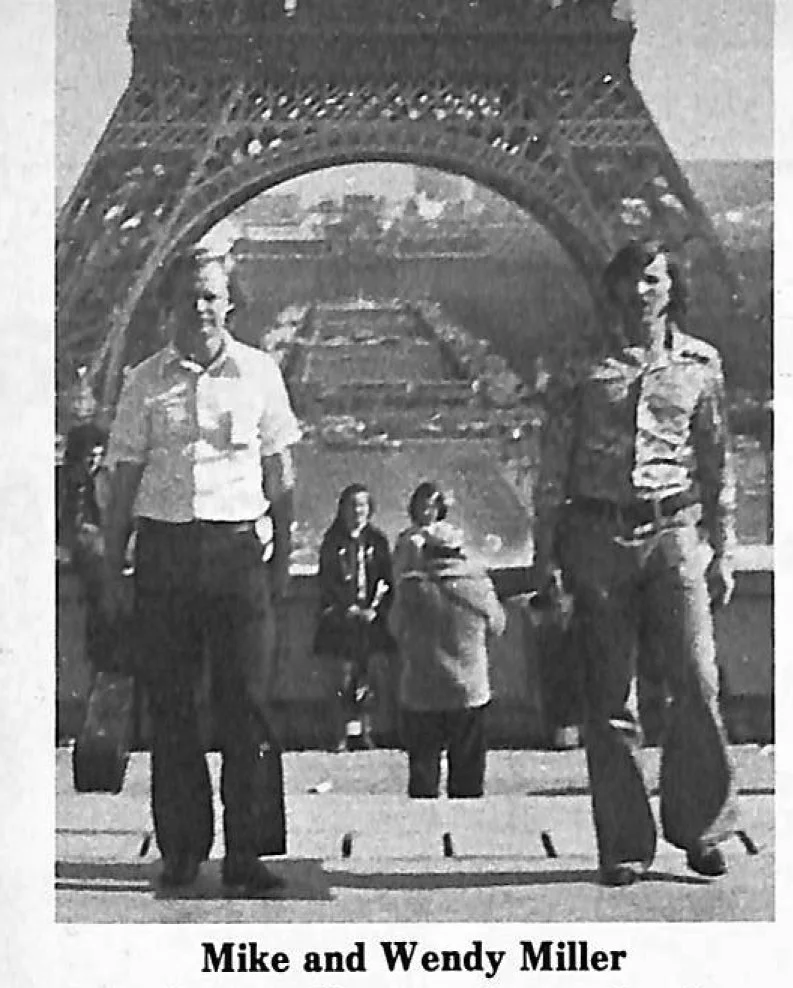
“Wendy and I arrive in Europe March 19th and stayed till the middle of May. Although we toured seven countries, our base of operations was Paris.
“We picked up a French bass and mandolin player. I had to work with them a long time to break them into the material we were doing. They were fine musicians but they were into ‘hot licking it’ just all the time. They didn’t understand traditional bluegrass like Wendy and I played. You got to kick back a little and play to the song and not over it—particularly with traditional bluegrass.
“You know,” continues Mike, “Bill Keith was and still is a big name in banjo picking in France. They love that melodic style of his. One of the reasons that I think they wanted me to pick over there was that my banjo style is so very different from his.
“Wendy and I had a great time in Europe. We were treated very well and got some good press write ups. I even lost forty pounds! I’m still getting calls from those folks for a repeat tour.
“When we returned to the states, Wendy and I and our band, the Country Grass, stayed busy. Wendy after awhile thought he’d switch over to the Russell Brothers Band and pick some ‘boogie grass’ as I call it.
“I kept the band going myself until 1982. Except for my bass player, Glenn ‘Cooky’ Inmann, I went through too many sidemen to list here. I did do several more albums and stayed as busy as I personally wanted to.”
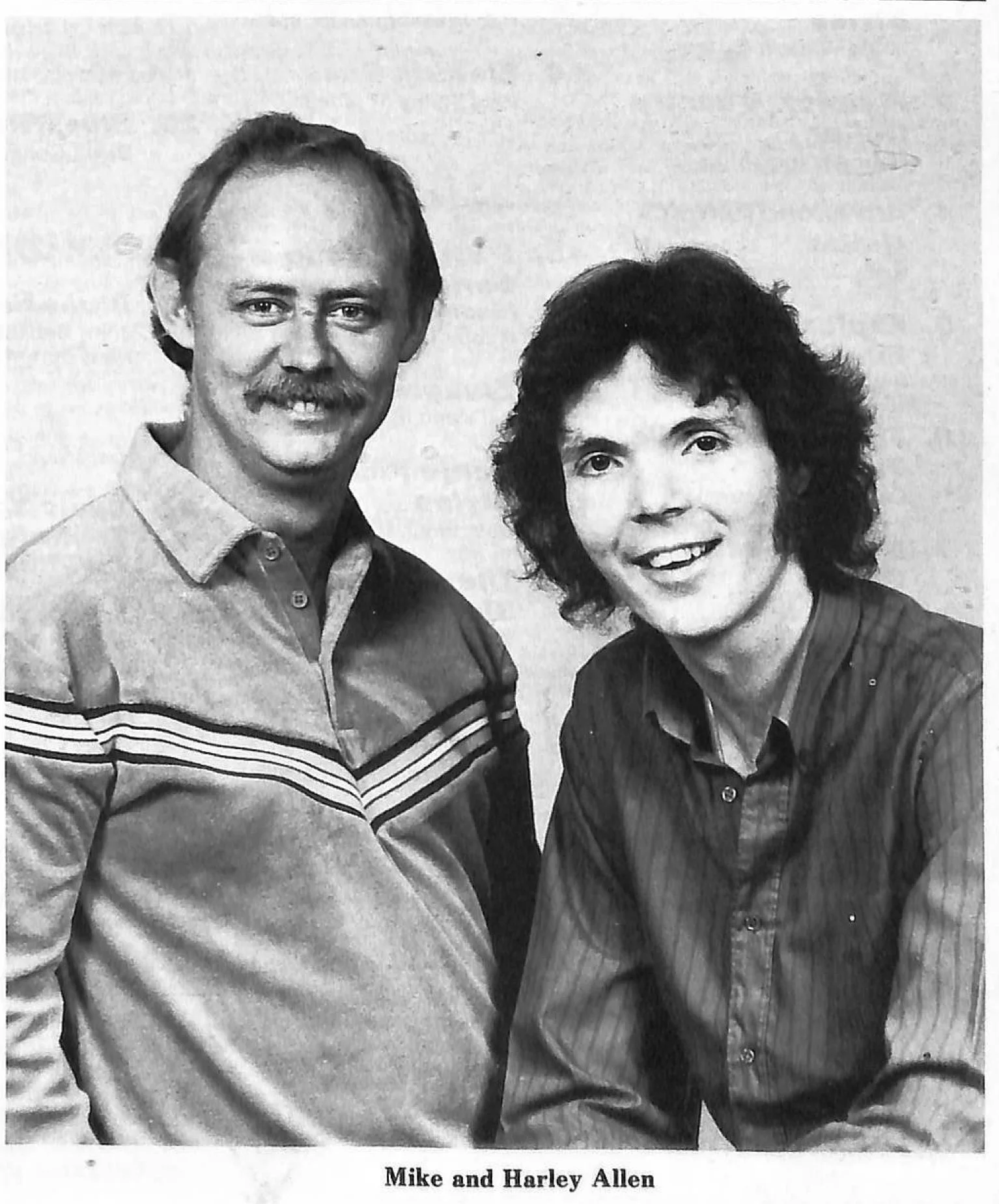
Mike abruptly disbanded the Country Grass in ’82 and fulfilled the remainder of his booking obligations either as a solo act or using pick up bands. He then got an idea to call Harley Allen (son of Red Allen and of Allen Brothers band fame).
“We put together a temporary group to see what would happen. With Harley’s brother Ronnie on bass and Rick Stacy on mandolin helping us out on short notice, we booked a couple of festivals for the fun of it. We called ourselves the Allen-Lilly Band. We were very well received.
“Three years later that’s what I’m still doing, picking with the Allen-Lilly Band. We’ve currently got Gene Townsend picking mandolin for us and Wendell Barrett on bass. Harley’s singing lead and tenor, Wendell’s on baritone, and I sing some lead.
“Harley and I think a lot alike musically. When we’re singing a tear-jerker or slower ballad, we concentrate totally on the harmonies. When we’re playing something hot we still try to keep it as smooth as possible. We also try to be a little different in both what we play and the way we play it. If you just do other people’s material and arrangements, you’re just helping somebody else out.
“A lot of people have told us that the Allen-Lilly Band is going to be the new group that is going to make it. I hope so. When we hit the stage we’re cuttin’ it as best we can for the people that come to hear us. I think that it’s starting to show for us in bookings and record sales now.
“Regardless of what the future holds in store for our band, I personally hope I will continue to have the good fortune to play bluegrass for many years to come. Next to my family, its the most important thing in my life. I can only thank God that he’s given me the talent to play this wonderful music.”