
James Monroe
By Pete Kuykendall
Reprinted from Bluegrass Unlimited Magazine
July 1973, Volume 8, Number 1
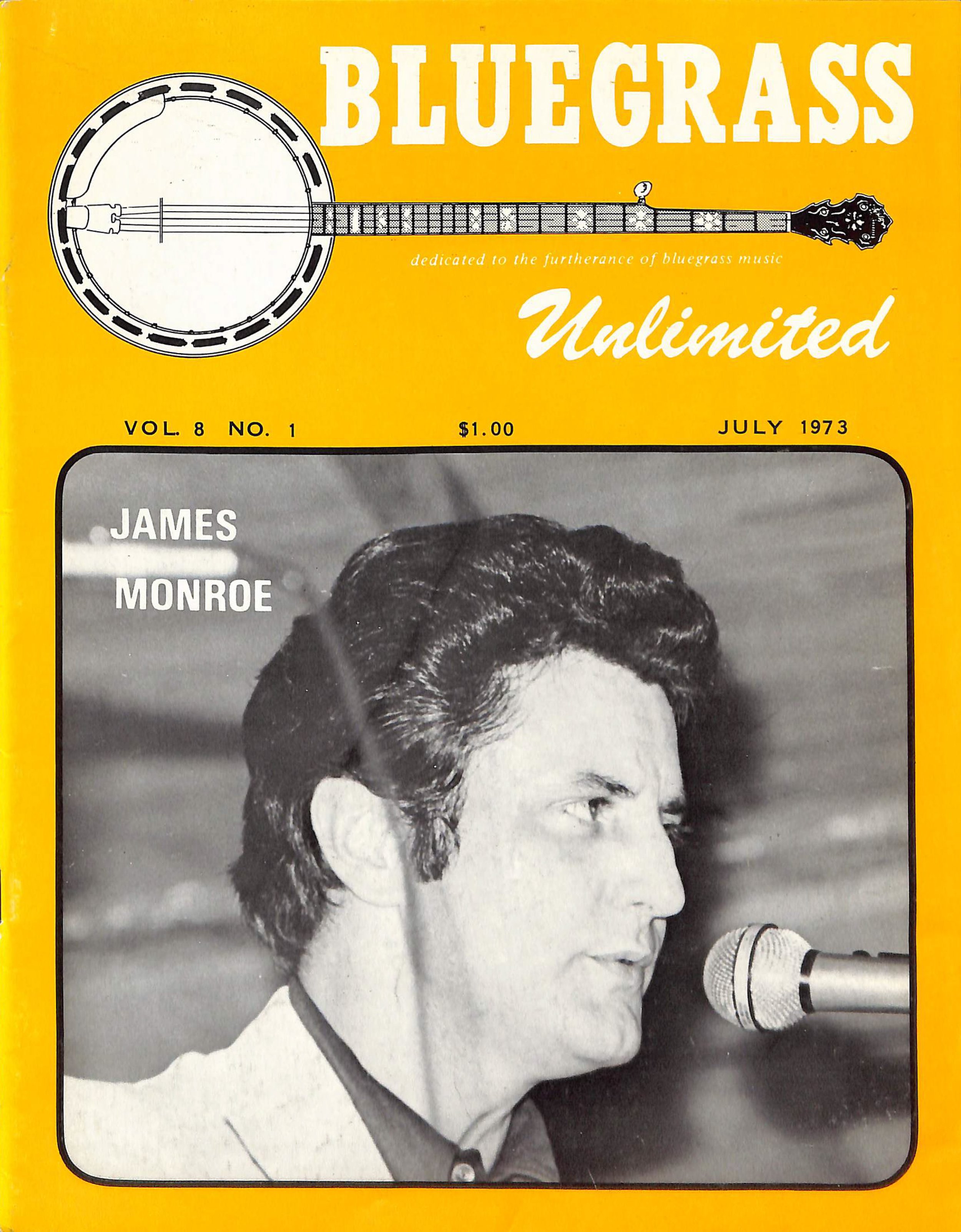
Probably one of the most talked about people in bluegrass recently has been James Monroe. After spending a number of years paying his dues as a member of the Blue Grass Boys, in 1971 he started his own group. He, if for no other reason than being the son of the father of bluegrass music, has had many people watching his every move. Carrying a tradition and a name that has been synonymous with traditional styled music, his steps and sounds have been watched extremely close by almost everyone concerned.
“They are watching you more. They are watching closer to see what you are going to do and what you are going to sound like and how you will come on with your show. It seems to me that it is double pressure. Someone who is not the son of somebody would not feel it as much. It just seems like they watch you more. Maybe I am just imagining a lot of that, I know, but I still feel the pressure. I know I would watch Hank Williams, Jr. even if I had never seen him before just to see what he would sound like. I would be watching and listening a lot closer than I would somebody else.”
At thirty-two years of age James Monroe has now started his own group, The Midnight Ramblers, and has begun to feel the taste of the hard work involved in earning a living from the music business. He has been playing music for almost nine years but wasn’t involved in show business always. “I worked in construction, hanging sheet rock - I did that for almost two years - and worked at Rudy’s sausage company and at a machine company in Nashville. Then I tried to get into booking (shows) for a while.”
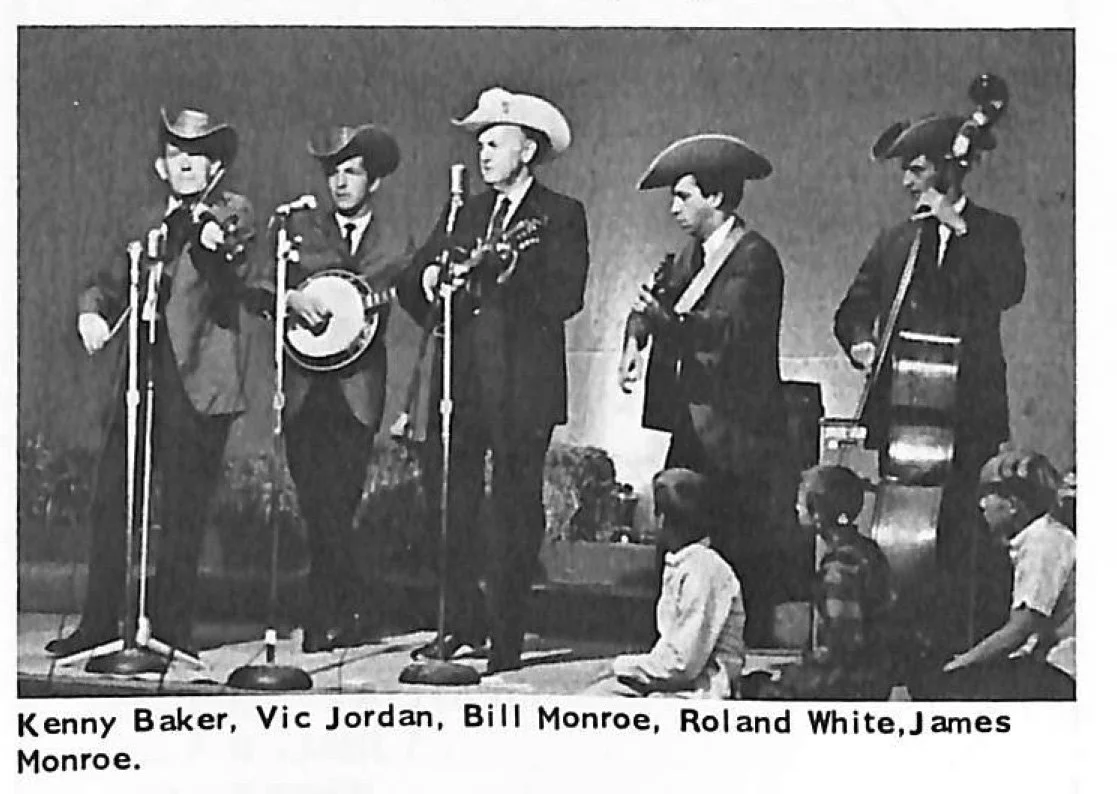
“I used to listen to Bill on the Opry. I remember that Wall-Rite show he used to have. When I was a kid, I always liked to listen to him. I always looked forward to that guitar run kick-off on ‘Watermelon on the Vine’. I thought that was great. I remember Clyde Moody, (Lester) Flatt and all of them doing that run. They used to come out to the house and rehearse and I would watch and listen to them.”
Back when I started out on bass, Pete Rowan, Richard Greene and Lamar Grier were with the Blue Grass Boys. They were doing a lot of different things with the timing in what they were creating. I think bluegrass is a lot like jazz in that respect. It has certain basic guidelines but there is plenty of room for a good musician to create. Pete, Richard and Lamar were doing stuff with the timing that I didn’t understand. It was all I could do just to hang on. It was killing me. I love music now though it’s not only bluegrass that I like. I like jazz and soul and some country.”
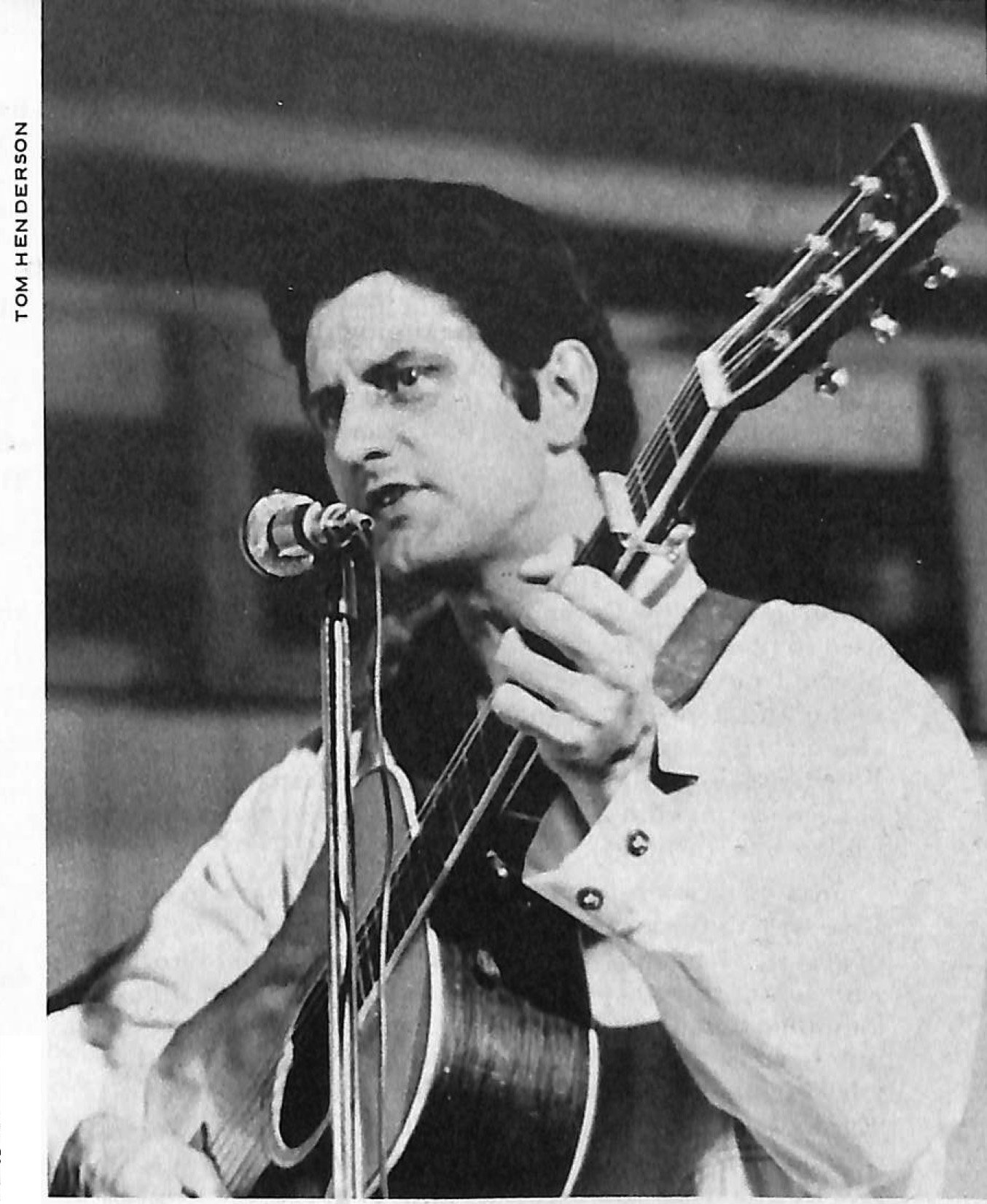
After his baptism by fire James started to play bass with the Blue Grass Boys and he “moonlighted” with another band in Nashville to gain more experience. “I played with a group at King Henry’s Lodge there in Nashville. Floyd Busbin played guitar and Willow Collins played banjo. Jerry Munday, who used to play with the Stoneman’s was in that group, too. We played from eight to twelve on Wednesday and Thursday nights and it gave me a good chance to get practice. They also played a variety of material rather than just what the Blue Grass Boys played. I guess I played in that group for almost a year. I did a lot of jamming around Nashville, too, while I was learning.”
James spent almost seven years as a bass player with the Blue Grass Boys and then another crisis caused him to switch to guitar. “Back when Roland (White) left to go to work with Lester (Flatt) I wasn’t ready for the guitar job. I never had done much with the guitar. Oh, I had done one number as a part of the show but that was all. I knew that job was going to be hard. Especially with tunes like ‘Rawhide’ and ‘John Henry’ and ‘Mule Skinner (Blues)’ with a guitar part in it and ‘Uncle Pen’ with the guitar kickoff. That was another job I kind of got forced into. I was ready singing-wise, but just had not done that much guitar playing. Right when Roland quit, the festivals and summer season were about three weeks away and I had to really get onto it. I wanted the opportunity to get that job.”
Many of the shows that James has been working are with his father. Under these circumstances, the comparison between the two generations is even more awkward to James. “Well, it depends on the crowd that is around. Daddy’s got his fans that won’t accept anything else but him. Then they hear there’s another Monroe coming up and they feel that I’m getting a free ride and won’t give me a break. I feel that sometimes. I want to earn their respect on my own and definitely not as a free ride. Of course, some people have become my fans, too. They are pulling for me one hundred percent.”
James is very conscious of how bluegrass music has changed over the years and is working hard to get a unique sound of his own. “I don’t think that I’m like other artists right now. My voice is different and some of the material I have written is different from standard bluegrass material. In years to come I know that I will change some. I don’t know how much of a change it will be, but I know I must keep up with the music. I know that many people say that I sound like daddy, but I don’t try to. It just comes out that way. I’ve heard him talk and sing all my life, and to do it any other way would not be natural. I know I talk too fast, but he talks too fast and he was the only person that I ever heard for very long doing MC work. So, I naturally copied him somewhat when I started. But I still want to have my own sound.”
James also feels the need for new groups in bluegrass and that the time is ripe to have many younger bands make their presence known. “I think that a good young group could come in now. But they’ve got to be good. At a festival, people are used to hearing the best in bluegrass music - people who have been at it for years. When a new group comes in, they have to be good. They can do new stuff but they have to have listened and learned from the guys who have been at it for years. All of the groups who have come into the music have learned from people like daddy, Lester Flatt, Earl Scruggs, Ralph Stanley, Don Reno, people like that. They have to learn from them. I think that a lot of young groups are coming up with fine material, now. I think that there is a bigger margin for groups to work in. Bluegrass is really at a peak. This ‘Dueling Banjos’ thing that the boys from New York have got out - that’s a great boost for bluegrass music.”
James is in a somewhat unique position for a young artist in bluegrass. His home base is Nashville, Tennessee where the majority of what bluegrass there is, is done by the established performers. The younger ideas and approaches are quickly grabbed up by the commercial record industry who don’t understand bluegrass very well. “They put bluegrass in a little bag and think just one type of song will go in bluegrass. You know what kind of song I’m speaking of. I don’t say that. I think you can take a lot of good country songs and sing them bluegrass style. They sound okay. Sometimes country writers will classify these old-timey sounds - mountain music - as the only bluegrass sound there is. They’ll say, “That’s a bluegrass song.” It may be something that Uncle Dave (Macon) did fifty years ago.
Well, with me that’s not right. I don’t think they even begin to understand it. They don’t know how wide a field it can be or what is involved in it. There are some who can. Damon Black, he’s from Missouri, he writes for Nashville publishing companies there. He understands the type of songs that would go into bluegrass. He wrote ‘Sweet Mary and the Miles In Between’, ‘Tall Pines’ and ‘I Haven’t Seen Mary In Years’. He’s a wonderful writer. He can write bar songs that country singers have cut, but he understands bluegrass and can write for it, too. He can write either way. I’ve never heard that many bar type songs that I have liked. You don’t find many of that kind of songs in bluegrass. I like a story song. I am partial to that type of song. I like a ballad with a pretty melody. But I also like to try something a little different.”
The management of the Grand Ole Opry has been a big help in trying to promote and advance bluegrass music when much of the country music industry has chosen to ignore it. “They did help it years ago when they let Bill Monroe join it. The Opry and the people behind it, WSM, are trying to help it now. Irvin Waugh, he’s president of WSM, I know that he understands bluegrass music. He knows what it stands for. Bud Wendell, who is the manager of the Grand Ole Opry, is doing a lot for bluegrass music. Many of the musicians and the stars in country music really respect bluegrass.
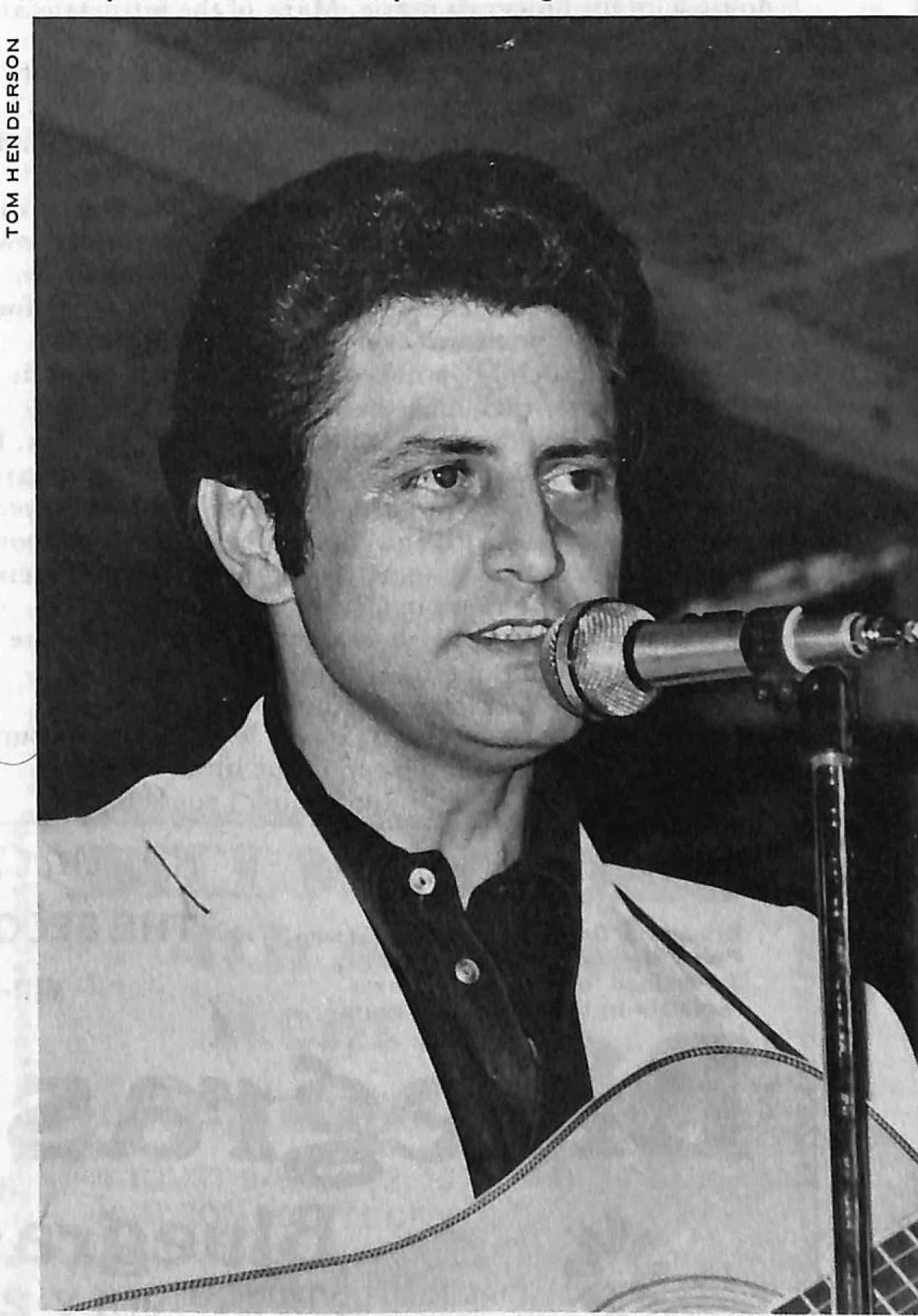
James’ decision to start a group of his own was a carefully planned move. “I wanted to do it. I felt that I was ready. I had some new material and wanted to get a different sound from a lot of the bands. It also gave me a chance to sing more. Even before I started my own group, I had people call and want to hire just me to work their shows. The first show I ever played all on my own was Bean Blossom, Indiana in 1971. That was the hardest show in the world to start on for a debut. The first time I was ever on a stage by myself! I never had done much MC work, and there were thousands of people out there, including the greatest bluegrass musicians in the world - all watching. It was hard to buck. I was scared to death. It seems like I always do things the hard way. Just like learning how to play the bass. Well, we played Carnegie Hall in New York and I had been on the bass about two years and I had been singing for about a week and there I was, singing trios up there in Carnegie Hall. You could hear a pin drop. The audience was watching you that close to see what you could put out. We worked the Newport festival about two weeks later and there were 30,000 or 40,000 people there. It was hard. I have been under pressure it seems like ever since I have been in the business. It has been a great teacher for me. I don’t think I could have learned anywhere near as much as I have any other way but it was the hard way to learn. I spent seven years on the bass and two years on the guitar with the Blue Grass Boys before I started my own group. The very same summer that I started my band I also started my festival in Cosby, Tennessee, so I was a busy guy. I have managed to be a bit more relaxed on stage now and things are starting to get a little easier for me.”
With determination which is “a typical Monroe”, James has started to make his own individual mark as a bluegrass musician. “I am working quite a few festivals and shows that I’ve got lined up: Next fall I’ll be working some NCO clubs and colleges. I am hoping to be able to record within the next month or two and get another album out. I’ve got enough material to do it. Things are looking better all the way around.”