
By Elijah Wald
Reprinted from Bluegrass Unlimited Magazine
July 1997, Volume 32, Number 1
Boston Bluegrass Union
It’s a long way from the mountains of Kentucky to the coast of Massachusetts, but bluegrass music has been making the journey for decades. Since the beginning of the 1960s folk boom, the Boston area has been one of the most welcoming areas for the classic bluegrass sound, nurturing both touring bands and a vibrant local scene. If one organization can be applauded for keeping the local scene strong, it is the Boston Bluegrass Union.
In 1996-97, the B.B.U. is celebrating its 20th anniversary, making it one of the longest-running bluegrass societies in the United States. Through the years, it has managed not only to hold on, but to glow and prosper, bringing the music to the Boston area through two decades of changing styles and audiences, and despite the burnout that bedevils all volunteer organizations. Last December, two of the Union’s foremost movers and shakers got together to talk about how they have kept things rolling through die years.
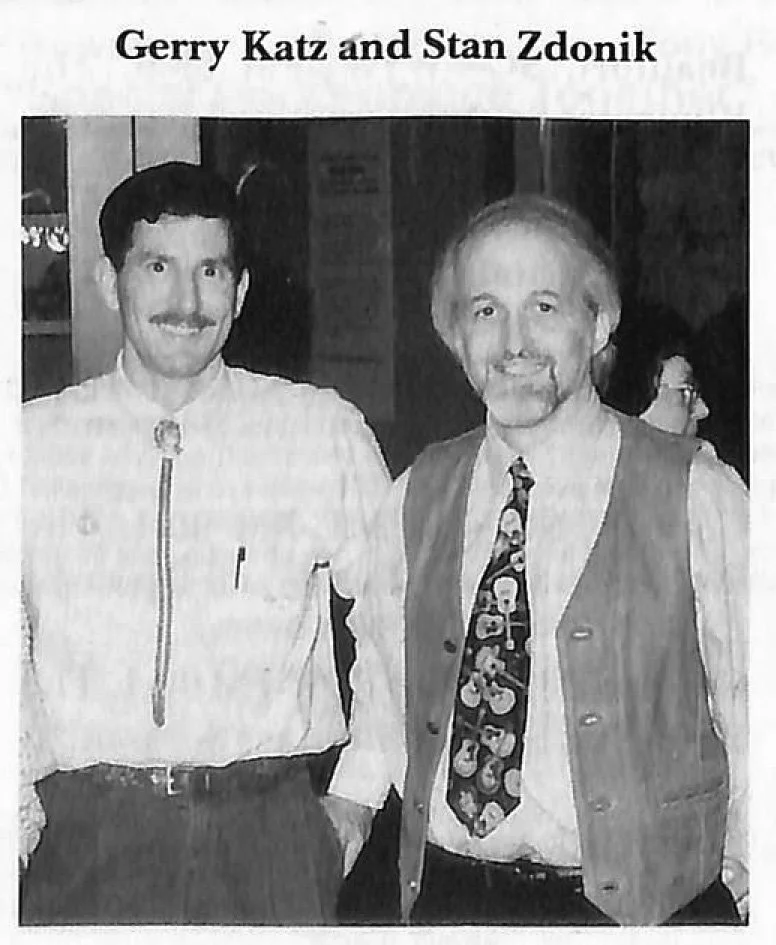
Stan Zdonik is a mandolinist, and one of the B.B.U.’s founding members. Gerry Katz is not a player himself, but became entranced by bluegrass some ten years ago, and has become the Union’s most energetic activist. Both are native New Englanders who heard bluegrass for the first time when they were already adults, Zdonik when he stumbled on a group jamming in Harvard Square and Katz through a local folk radio show.
As Zdonik explains, the B.B.U. was an offshoot of a previous group, the Boston Area Friends of Bluegrass. The split had partly come from personal frictions, but Zdonik feels that there was a real need for a complimentary organization. By the mid 1970s, the Friends were promoting concerts by the top names in bluegrass, Grand Ole Opry stars like the Osborne Brothers and Jim & Jesse. “Some of us felt that, while that was all well and good, there was another class of bluegrass band just a level down from that that wasn’t getting the exposure it needed,” Zdonik remembers. “We wanted to focus on people like Del McCoury and Buck White—great, dedicated musicians just scrimping to get by and not being heard in the Northeast.”
The Union started off with 21 members, including Zdonik, Joe Val, Alex Tottle, Rounder Records’ Marion Leighton (later Levy), and Ray Magliozzi, of Car Talk fame. As with many young organizations, Zdonik says that in the early days as much effort went into the meetings as the music. “At first, the Union was democratic to a fault. We held our meetings with Robert’s Rules Of Order and we didn’t move an inch without a vote, because we wanted to be incredibly egalitarian and equal. We met on a weekly basis, and we tried to thrash out who we were and how we would work.”
There was a lot of talk, but the members also put their money where their mouths were. “In order to put on a show you have to buy stamps and a few other things,” Zdonik says. “We started with zero money, so we each kicked in ten bucks. That gave us around $200, which at the time was enough to put on our first concert.”
In keeping with its commitment to build a solid scene rather than just bringing in national names, that first concert featured Joe Val’s New England Bluegrass Boys. It was quickly followed by a show featuring Tony Rice and fiddle champion Marie Rines, and the first season included McCoury’s Dixie Pals and local favorites like the Lilly Brothers and Northern Lights. “We wanted to be promoters not only of national names, but also Boston-based acts,” Zdonik says. “For the first few years, we tried to alternate national acts and local bands. That was good in principle, but what we found was that attendance would go way up for the national band, and then way down for the locals. So, rather than have this sawtooth revenue, we eventually decided to go to all national acts and use locals as openers, which made a lot more financial sense.”
Trying to follow their tastes, but also remain financially viable, the Union members worked hard to put together solid programs and build up the local audience. They had picking parties, to nurture the amateur scene, before or after every show and tried to give the performers a welcome that would keep them making the long trek north. “Trying to do fundamentally rural music in the city is no mean feat,” Zdonik points out. “But one thing that I’m proud about is that, even through the hard times, we have never paid a band one dime less than we’ve agreed to. Back in those days, especially, there were lots of stories going around about promoters that didn’t get a good turnout so they’d pay the band half or nothing, but we never did that.”
The B.B.U.’s schedules for the first decade read like a “Who’s Who” of bluegrass. Typically, the line-up was slightly weighted in the direction of traditional styles, but with a fair sampling of contemporary and newgrass bands thrown in for good measure. Katz points out that Tony Trischka and Skyline were one of the Union’s regular, “bread and butter” acts, though he readily acknowledges that the usual fare ran more to high, lonesome stylists like McCoury and the Johnson Mountain Boys. For him, the decisive issue was whether there was good singing. “That’s the only thing that is a real problem for me,” he says. “I think that a band has to have the vocal component, that’s a trademark of the music. I go to classical concerts on a regular basis, but I’m not sure I’m ready to sit through an all-instrumental bluegrass presentation, and I’m not sure our audience is either. So I think there are some bands that we excluded for that reason.”
Zdonik adds that the early years of the B.B.U. involved a lot of trial and error, and were a learning period for all concerned. For example, at the first concerts the ticket prices were only two or three dollars, and there was no attempt to do better than break even. That seemed logical lor a non-profit organization, but the problem was that money was sometimes being lost and never getting replaced. “After a while we got more mature,” Zdonik says. “We realized that even if you want to break even you’ve got to make money sometimes, because you’re not always gonna be so lucky.”
Another problem was that the Union was putting demands on its membership that not all of the members were prepared to meet. “We had elaborate rules for how new people would come into the organization. They had to attend a certain number of meetings before they could vote, and if you missed so many meetings then you wouldn’t be allowed to vote because you weren’t somehow as dedicated as the people who showed up,” Zdonik says, with a wry smile. That worked as long as the Union was propelled by its initial burst of energy, but became crippling as it became a long-term, sustained operation. By the ten-year mark, the hard-core of “very regular, committed members” had dwindled to three or four people, and Zdonik was feeling strained and overextended.
“The only way we could make shows happen financially was that, if we would decide we wanted to do Larry Sparks, say, I would spend a week on the phone,” he remembers. “First I’d call him and I’d say, ‘Look if I can get you x dollars for the weekend—not from our show, but for the weekend—would you come?’ Then, if he said ‘OK, we can do it,’ I would spend literally every night on the phone calling every folk club and our kind of associations in New England, and try and find people who were interested in co-booking with us. Because, if I could find the other gigs, then we could pay what we could afford, which was $600-$700, and we could gel the band. So I ended up being a mini-agent, and it was a tremendous amount of work.”
Another reason for the burnout was that the audiences were not growing. Zdonik kept seeing the same faces, month after month, and, while they were enough to keep things going, he couldn’t see any new energy coming in. That is, until Katz came on the scene in the late 1980s.
Katz had discovered bluegrass by chance when he tuned in to Emerson College’s Coffee House show, and had fallen in love. “I just soaked it up like a sponge,” he says. “All this great music, great ensemble playing, great vocal harmonies. I probably jumped in around ’83 or so, and maybe ’88 was when I put up my hand as a volunteer and started getting stuff dumped in my lap, and by ’91 I was doing a good share of the work. Stan was busy, and I had the free time and the energy to take it on.”
Zdonik describes Katz as “a savior.” By that time, he says, the only thing keeping him from packing it in was that Joe Val had died, and he felt obligated to keep the bluegrass torch alight in New England. “Whenever I would think I couldn’t do it anymore, a little voice in the back of my head would say, ‘No, you have to keep doing it, ‘cause Joe would want it,”’ Zdonik says, smiling at the memory. “He always used to call me ‘the Shepherd.’”
Katz brought more than just an injection of new enthusiasm. He had some experience in marketing, developed through a job with his family’s tire business, and felt there was a large, potential audience that was not being brought into the B.B.U.’s fold. He directed his energies towards reaching out to the local media, going on radio shows to promote concerts and sending out press releases to the newspapers.
He also worked to find a new concert venue to replace the Harvard Square church where the Union had held most of its shows. “That was a great room,” he says. “It had a nice liveliness to it, but you’d hear people grousing about having difficulty getting there, and how hard it was to find parking. At the same time, the cost of doing the shows increased dramatically because the talent that had been in the $600- $700 range was now getting up to a $1000-$ 1400. The church didn’t provide enough seats, and we needed to bring new people in. At this point, roots music was taking off, so I thought maybe with a new marketing emphasis and a new venue we could continue the thing.”
The times were right. Bluegrass had originally hit the Northeast.as part of the folk music boom, and its fortunes had declined along with those of the folk scene in the 1970s. In the late 1980s, folk was coming back strong, and there was also a growing interest in American roots styles like Cajun and traditional country, all of which could be related to bluegrass. Unlike the college audiences of the 1960s, though, a lot of the listeners for these styles were somewhat older and based in the suburbs, and Katz felt that concerts would have to be made accessible to them. After experimenting with various venues, the Union began holding its shows in the Museum of Our National Heritage, a Lexington hall with plenty of parking, fine acoustics, and enough seating capacity to pay the performers.
Now, his and Zdonik’s concern is to bring in the people to fill those seats, and so far they are enthusiastic. “We’ve realized that what you have to do is raise the ante,” Katz says. “The big problem I saw with the B.B.U. back in the ’80s was that, to a degree, it was just like another coffeehouse. We were doing national acts on a regular basis, but, with the profusion of shows and coffeehouses going on around town, we were getting lost in the clutter. So we had to somehow make each event more special, tell a story with each show, have it be a benefit or a reunion or a record release concert. All of this is an art form, not a science, but we realized that we had to consciously think in those terms and to try and make each show a big splash, and it seems to be working.”
Zdonik and Katz are happy with the B.B.U.’s success, but they are anything but complacent. “Certainly, what we have built over this period is something to hang onto,” Zdonik says. “But I do think that, now that we have more in the way of resources—both people and perhaps a little more money—it would be great to try a little have more in the way of resources— both people and perhaps a little more money—it would be great to try a little more outreach again to educate and to bring more people into the fold.” With that in mind, the B.B.U. has taken to sponsoring an annual outdoor festival in memory of Joe Val (now in its 12th year), Suzuki classes for children, two regional band showcases, and an expanded schedule of picking parties. Katz has also worked hard to upgrade the Union’s member mailings from a one-page flier to a regular, bimonthly newsletter, Bluegrass Breakdown, which lists not only B.B.U. events, but all the bluegrass-oriented club and concert presentations in eastern Massachusetts, and to develop a complementary web page and news group for on-line fans.
In the end, though, what really brings in the new members is not the new technology but the energy and power of the music. Zdonik points to a recent outdoor picking party which became the Boston Globe’s “pick of the week” and drew some 300 pickers and listeners. “People were just walking around who had never heard this stuff before,” he says. “And things like that can be transformative for people. If I hadn’t run across those guys playing outside in Harvard Square, I probably wouldn’t know bluegrass today, but I did and the rest is history. So, for me, if one person per month heard something like that and got turned on by it, that would be a wonderful success.”