
Bill Monroe: An Appreciation
By Dick Spottswood
Reprinted from Bluegrass Unlimited Magazine
November 1996, Volume 31, Number 5
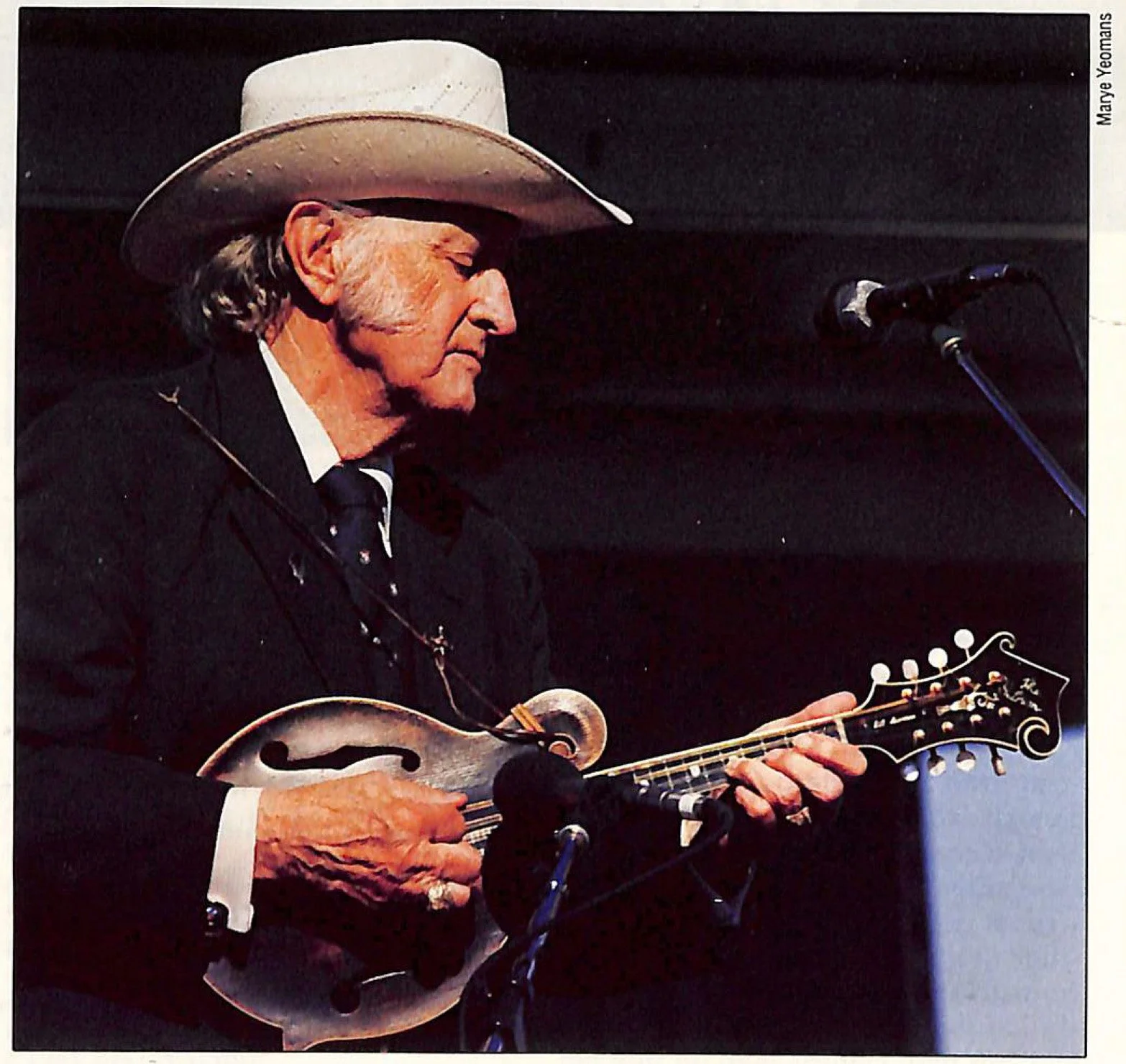
With Bill Monroe’s death, the world seems different. Sure, his health had been slowly declining, and his voice had been a less than perfect instrument for years, but the overdue acknowledgements and accolades of the 1980s and 1990s and, most of all, his continued presence among us kept him with us both as friend and as an artistic witness to everything he stood for in American music. His frailties may have revealed his humanity but through his artistry he was like God to us, his (lock, representing a creative genius we’ve come to understand was truly great. The stature and accomplishments of Bill Monroe invite comparison with those of any other artist you care to name.
Other attempts to establish Monroe’s proper place have inspired comparisons with performers and composers from Charlie Parker to Charles Ives and Mozart to Ellington. These seem just, if subjective, and acknowledge that appreciation of the impact and true worth of Monroe’s art has steadily grown since the 1960s, when his friend, manager and fan Ralph Rinzler first coined the phrase “Father of Bluegrass,” which implicitly crystalized his role as founder of a new music which owed its flowering to root elements of the blues, minstrelsy, gospel songs, fiddle tunes and country music.
It’s not that Monroe’s musical revolution was part of any conscious scheme. Throughout his long career, he went out of his way to celebrate his and our musical past, both as it really was and as his fertile imagination remembered and recreated it. With his older brother Charlie, the Monroe Brothers revived and recast traditional songs, songs from the 19th and early 20th centuries, old and new gospel tunes, songs from the Carter Family and Jimmie Rodgers repertoires, and anything else which lingered from earlier days that could fire their imagination. The Blue Grass Boys of 1940 and beyond worked in new circumstances created by the recent formation of BMI (Broadcast Music, Incorporated) which sought new country music, rewarding composers with copyright protection and royalty payments. Though the system and its new economics didn’t cast traditional music aside, it soon became clear that an important part of a country musician’s livelihood would be the creation and publication of original material.
Monroe records of the time (1940- 45) extended the Brothers’ mixture to include new music which fit the Blue Grass Boys’ sound. Bill’s earliest “compositions” consisted of two blues-based mandolin features, the western-flavored “Honky Tonk Swing” and the supercharged “Tennessee Blues,” whose accelerated tempo and high energy foretold much that would be characteristic of bluegrass. By 1945, he had composed enough original songs to feature them on most of a record session. He kept creating memorable original songs through the early 1950s and astonishing instrumental tunes practically to the end.
Monroe’s songs came to define bluegrass as much as the sound of the mandolin or banjo. Except for his songs of faith, most were somber, some were tragic and, as Robert Cantwell has observed, there were few which didn’t carry a sense of deep nostalgia and distance in time or in place from home, family, a loved one, a community, cherished memories or cherished values. These qualities, as much as Bill’s arresting tenor voice, gave us the notion of the “high, lonesome sound.”
Despite his proclaimed “ancient tones,” Monroe was no antiquarian. He came of age with personalities like Alan Lomax and Burl Ives whose specialty was preserving and recreating the past; Bill Monroe celebrated the past instead by using it as a key reference point within the context of a music as contemporary—and revolutionary— as that of Igor Stravinsky or Miles Davis. Unike them, he rarely used dissonance for its own sake; Bill’s melodic and harmonic language rarely strayed beyond those in Baptist hymnals. Instead, his musical revolution was created by a new ensemble style which deliberately turned its back on the prevailing honky-tonk sound of electric guitars, keeping for rhythm only the guitar and jazz-derived plucked string bass.
Bill kept the fiddle for those ancient tones. Its association with 18th century Scots-Irish pioneers let us know that even his new music bore deep roots. His mandolin music echoed the fiddle, which, in Bill’s childhood, had been his first inspiration as he created new possibilities for an instrument historically thought of as little more than a toy. Finally, though Earl Scruggs brought his novel banjo techniques to the Blue Grass Boys in a state of high development, it’s hard to think of any other kind of ensemble Earl could have blended with so perfectly. And, as Stephen Wade notes, the banjo, with its head of stretched hide, not only replaced the jazz drum but added those exciting, displaced syncopations which reproduced African American rhythms in a white mountain band.
Had Bill Monroe not been such an accomplished, aggressive musician in his own right, an Earl Scruggs would have upstaged him and everyone else around, leaving only a backup role possible for others. But it proved a major final touch for Monroe, adding another level of excitement as Scruggs and his successors placed rhythmic accents where they’d never been before and provided a lead voice which could blend with and compete with the fiddle and mandolin. The banjo brought its own historical symbolism along too. Fiddle and banjo had been the African-American instruments of choice from slavery days through the early 20th century. They’d also been the vehicles for minstrel and mountain music in the 19th century; their inclusion in bluegrass kept still one more ancient tone alive and well in our own time.
Bill’s vision and imagination allowed him to mold his music from his ingredients and create something instantly recognizable and distinct from anything preceding it. Even after his music was emulated to the point where it received the name “bluegrass,” he continued to develop and extend it in accord with his inner voices. One fiddle became multiple fiddles in the 1950s and, when Kenny Baker became more or less a permanent adjunct, Monroe’s compositions became primarily instrumental and increasingly fiddle-dominated. His 1954 “Get Up John,” based on one of Uncle Pen’s fiddle tunes, became something of a model for Monroe pieces in the 1970s and 80s, which explored various modalities and minor keys, exploring those ancient tones at the expense of the hotter, more flamboyant sensibilities of “Rawhide” or “Bluegrass Breakdown.” Suitably sprinkled amongst the new/old tunes were some archaic polkas and waltzes, further recalling a real and imagined past. With the exception of “Jerusalem Ridge” and “My Last Days On Earth,” much of this large body of instrumental music has gone unappreciated in our time; I don’t think it will forever.
This all too brief appreciation hardly begins to tell the tale of this incomparable man and his music. For me, it’s only an inadequate testimonial to someone who, though I never knew him well, has touched me again and again from my own youth on to advancing years. I always felt a touch of shyness in his presence since even in the flesh he seemed so much larger than life.
For the moment I mourn his death while I celebrate his long, exciting life. Even if he hadn’t survived to create a musical landscape beyond that which he assembled in the 1940s, his would still be a household name. How fortunate we are that he did survive, that his vision, his sense of possibilities and his artistic resolve compelled him to renew and redefine for so many years the music we call bluegrass.